
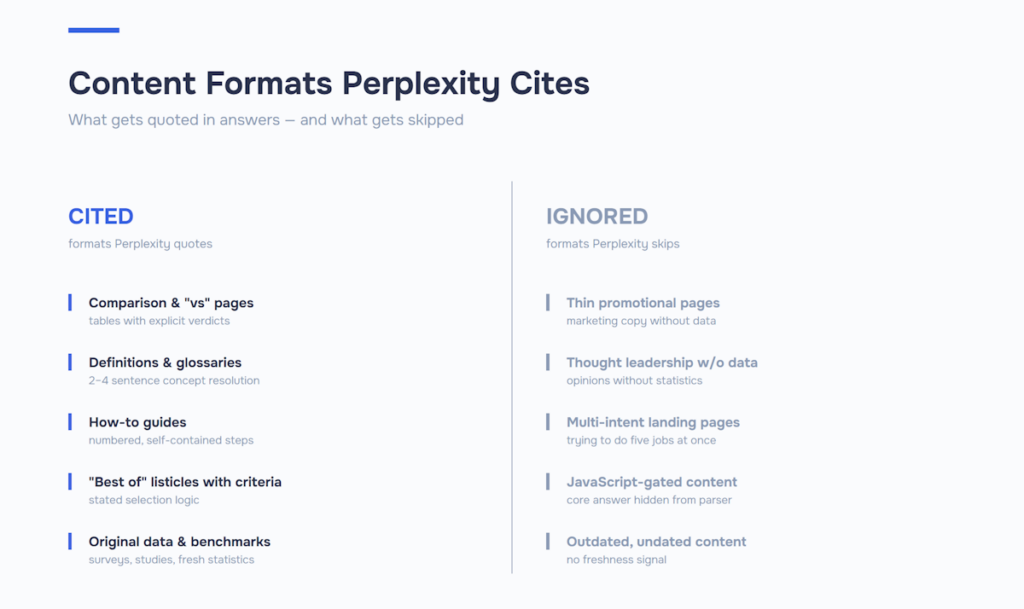
The digital landscape is experiencing an undeniable shift as traditional search engines face intense competition from AI-driven answer engines. For years, securing a spot on the first page of Google was the ultimate goal for digital publishers. However, in the modern era of generative search, learning how to get cited in perplexity has become the single most critical factor for maintaining organic web traffic. When a user submits a prompt, the platform does not merely display a passive list of URLs. Instead, it scrapes relevant web pages in real time, synthesizes a direct response, and attributes its data to specific platforms via numbered citation chips.
Consequently, if you want your content to survive this transition, you must understand exactly how to get cited by perplexity. The websites that consistently dominate AI engines are not necessarily those with legacy backlink profiles or massive domain budgets. Rather, they are the pages explicitly engineered for rapid machine extraction and seamless algorithmic ingestion. By analyzing thousands of conversational queries, we have identified eight specific page archetypes that consistently maximize performance. Below, we break down these dominant pages and outline the exact architectural blueprint they share.
8 Pages Perplexity Keeps Citing
To understand the core mechanics of AI visibility, one must analyze the physical characteristics of the web documents that the PerplexityBot crawler selects during its real-time [retrieval-augmented generation (RAG)] cycles. These eight specific page styles consistently win the AI search race, offering a repeatable framework for any publisher looking to boost their overall search presence.

1. The Real-Time Statistical Dashboard
Perplexity functions primarily as a factual answer engine that relies heavily on cold, hard data to validate its language model syntheses. Therefore, pages that host live tracking data, updated industry index scores, or frequently refreshed statistical dashboards maintain an incredibly high level of market trust. The platform’s retrieval algorithm heavily prioritizes these pages because they offer raw, uninflated numbers. These clean figures are exceptionally easy for a Large Language Model to extract and convert into an immediate, authoritative answer for the user.
2. Technical API Documentation and Help Centers
Dedicated help subdomains, customer service knowledge bases, and developer API documentation pages are absolute goldmines for earning citations. By design, these specific platforms are built to solve highly precise user problems with zero marketing fluff. Because they utilize clean layouts, direct code snippets, parameter explanations, and explicit troubleshooting steps, the retrieval engine routinely grabs them to answer complex “how-to” queries. If you are wondering how to get cited in perplexity, translating your content into this direct, educational format is a proven shortcut.
3. The Unbiased Cost Calculators
When consumers input transactional queries regarding pricing, budgeting, or manufacturing expenses, the platform rarely relies on standard promotional material. Instead, it frequently cites interactive cost calculators or tabular price breakdowns. Pages that offer localized pricing data, transparent fee charts, or detailed material cost estimations bypass typical corporate sales pitches. This structured financial data allows the AI to provide immediate, balance-sheet answers, which directly elevates the page’s overall perplexity ranking.
4. Single-Topic Pillar Hubs
The underlying AI models favor deep, hyper-focused topical authority over massive, generalized websites that cover thousands of disjointed categories. High-performing pages act as the definitive, singular hub for a very narrow entity or niche market. Instead of trying to claim ranking positions across broad industries, these pages exhaustively answer every conceivable sub-question of a specific technical topic. This absolute thoroughness makes them the canonical choice for the algorithm during deep-dive research sessions.

5. Official Government and Academic Repositories
For legal, medical, historical, or scientific inquiries, the retrieval algorithm biases heavily toward official verification and institutional trust. Pages originating from educational extensions or government portals are treated by the AI as baseline truths. The system routinely uses these highly trusted pages to anchor the core of its synthesized response before it looks for any supplementary commercial insights from standard blogs. Aligning your content with these primary documents is a core requirement for advanced optimization.
6. Structured Product Comparison Indexes
Generic, narrative product reviews containing heavy promotional language rarely achieve strong conversational tracking. On the other hand, pages that feature direct, multi-attribute comparison tables comparing technical specifications, pricing tiers, and specific warranty sets are cited constantly. The clean HTML framework of an index table allows the language model to map out pros and cons efficiently. Consequently, this clear formatting dramatically improves your odds to get cited by perplexity during commercial intent queries.
7. Crowd-Sourced Forum Aggregators
For subjective queries, lifestyle recommendations, or real-world experiential reviews, the platform pulls heavily from community forums and active user networks. Threads that contain raw human opinions, unedited troubleshooting steps, and authentic user feedback provide a unique qualitative “information gain” metric. This is something static corporate blogs simply cannot replicate. The engine relies on these forums to give users a realistic look at public sentiment.
8. The Living FAQ Matrix
Web documents explicitly built around a high-density, frequently updated Q&A framework achieve exceptional citation rates. Rather than hiding critical answers deep within long-form narrative paragraphs, these pages use direct questions as their primary headings. They provide immediate, standalone answers that the retrieval model can lift verbatim without needing to parse or filter the surrounding text. This structural layout remains a foundational pillar for modern perplexity visibility strategies. Consistently maintaining a Living FAQ Matrix and statistical dashboards requires a disciplined editorial workflow, integrating AI tools for content planning helps teams schedule updates, track topical gaps, and keep high-priority pages fresh.
Technical Metric and Architecture Comparison
To successfully implement a strategy that boosts your perplexity ranking, you must understand the specific data formats that the engine’s extraction tools prefer. This technical matrix outlines how different page setups influence your brand’s indexation.
| Document Style Type | Core HTML Framework | Ingestion Priority Level | Primary Visibility Metric |
| Statistical Dashboards | Dynamic Markdown Tables | Critical | Immediate data-point extraction |
| Technical Help Centers | Clean Semantic H3 Blocks | High | Direct step-by-step code usage |
| Financial Calculators | Parameterized Lists | High | Immediate numeric balance outputs |
| Living FAQ Matrices | Explicit Conversational H2s | Critical | Verbatim sentence-level citations |
What These Top-Cited Pages Share: The Optimization Blueprint
While these eight distinct page types serve entirely different business models, their underlying technical layouts and editorial frameworks are remarkably uniform. To secure a sustainable competitive advantage, your writing teams must adapt to the three core habits shared by these dominant web documents.
Factual Density Over Winding Narrative
The pages that consistently maintain maximum AI indexing completely abandon traditional introductory fluff, rhetorical filler, and vague transitions. Instead, they rely heavily on quantified statistics, exact percentages, named entities, and explicit dates. The retrieval algorithm looks for text strings that offer high information value per sentence. As a result, it routinely ignores pages that take too many paragraphs to deliver a straightforward answer.
Absolute Context Isolation
The most critical trait these top-tier pages share is that their key text blocks are entirely self-contained. An AI crawler rarely reads an entire 2,000-word article from start to finish during a real-time search loop. Instead, it extracts isolated blocks of text that match the user’s prompt. The winning pages write every single section so it makes perfect sense on its own. This means avoiding vague pronouns like “this” or “they” that rely on previous paragraphs for context.
Perfect Token Cleanness
Language models process information by breaking text down into semantic units called tokens. If your writing uses overly complex metaphors, convoluted sentence structures, or rare industry jargon, the AI may struggle to categorize your page accurately. The most cited websites keep their sentences short, clear, and direct. Keeping your writing clear and direct simplifies the tokenization process, allowing the engine to safely pull your text into its context window.
Conclusion
To summarize, optimizing your digital infrastructure requires moving past outdated SEO tactics and embracing the technical realities of natural language processing. By focusing on exceptional factual density, structuring data into clean tables, and ensuring every section of your text can stand completely on its own, you transform your website from a standard marketing asset into a highly citable database. Ultimately, building your platform around these AI-friendly principles is the best way to ensure your brand remains highly visible, trusted, and frequently quoted across the future of search.
For digital marketers, enterprise founders, and tech-focused publishers looking to master advanced search engine strategies, executing with algorithmic discipline is the ultimate pathway to long-term traffic sustainability. If you are ready to update your digital infrastructure, optimize your text layouts for large language models, or discover next-generation optimization tactics, visit Openaihit to explore practical guides built to scale your visibility across the modern AI landscape.
Frequently Asked Questions
How does Perplexity choose which specific web pages to cite?
The platform utilizes an advanced, multi-step retrieval-augmented generation pipeline. When a user enters a conversational prompt, the system deploys its web crawler to fetch high-performing documents from traditional search indexes. Then, specialized algorithms scan those pages, extract the most factually dense, structured text snippets, and feed them into the language model to construct the final response accompanied by explicit perplexity citations.
Do traditional backlinks still impact my overall perplexity ranking?
Yes, traditional backlink profiles still carry significant weight because the platform uses established search indexes to run its initial real-time web search. Therefore, having strong domain authority and a clean technical link profile remains an essential prerequisite for getting your URLs into the initial pool of candidate documents.
What is the ideal paragraph length to improve perplexity visibility?
To optimize for real-time AI extraction, keep your paragraphs highly focused and concise, ideally between two and four sentences. This tight format makes it incredibly easy for the retrieval algorithm to isolate a clean, complete fact without pulling in unnecessary text filler or unrelated ideas.
Can using AI writing tools prevent my site from getting cited by perplexity?
Using AI tools will not automatically disqualify your site, but publishing generic, robotic summaries that offer no unique value will hurt your chances. To consistently get cited by perplexity, your content must feature original research, proprietary data, unique insights, or primary expert interviews that the underlying language model cannot find anywhere else on the web.