AI (now SpaceXAI) has officially launched Grok 4.5, shaking up the frontier AI landscape. Positioned by Elon Musk as an “Opus-class model, but faster and significantly cheaper,” Grok 4.5 introduces native integrations and massive performance optimizations that directly challenge Anthropic’s Claude and OpenAI’s flagship models. While it doesn’t sweep every intelligence benchmark, its unprecedented token efficiency, aggressive pricing, and deep engineering focus make it a powerful alternative for developers and enterprise teams looking for high-volume execution.
Keypoints
- Grok 4.5 was launched on July 8, 2026, as an “Opus-class” disruptor offering elite reasoning speed at a fraction of competitors’ costs.
- It features native Cursor integration, having been trained directly on real developer IDE sessions for hyper-accurate contextual coding.
- The model delivers unmatched token efficiency, completing complex engineering tasks using up to 4x fewer tokens than Claude Opus.
- It provides exclusive, real-time live search access across the entire X platform to pull immediate, breaking technical solutions.
- Built-in agentic tool chaining allows it to handle long-running, multi-step software engineering tasks with high autonomy.
- It introduces a disruptive pricing structure of just $2 per million input tokens and $6 per million output tokens for high scalability.
- According to the technical analysis on openaihit, this model shifts the industry focus from leaderboard scores to actual economic ROI.
On July 8, 2026, Elon Musk sent shockwaves through the tech community by announcing the public release of Grok 4.5 under the newly unified SpaceXAI banner. Musk boldly described it as an “Opus-class model, but faster, more token-efficient, and lower cost.”
For months, developers, startups, and tech enthusiasts have felt a shared pain point: a growing confusion over which LLM actually deserves their hard-earned API spend. While Anthropic’s Claude dominates specialized coding tasks and OpenAI’s models maintain broad analytical dominance, the sheer volume of tokens required to run agentic workflows has become an expensive bottleneck.
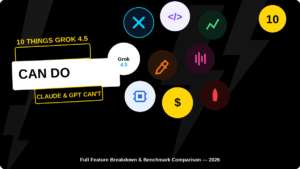
Is Grok 4.5 just another hype cycle, or does it bring tangible utility to your workflow? In this comprehensive breakdown by openaihit, we promise to uncover 10 exclusive features, hidden engineering perks, and benchmark realities that set Grok 4.5 entirely apart from the competition.
Quick Comparison Table
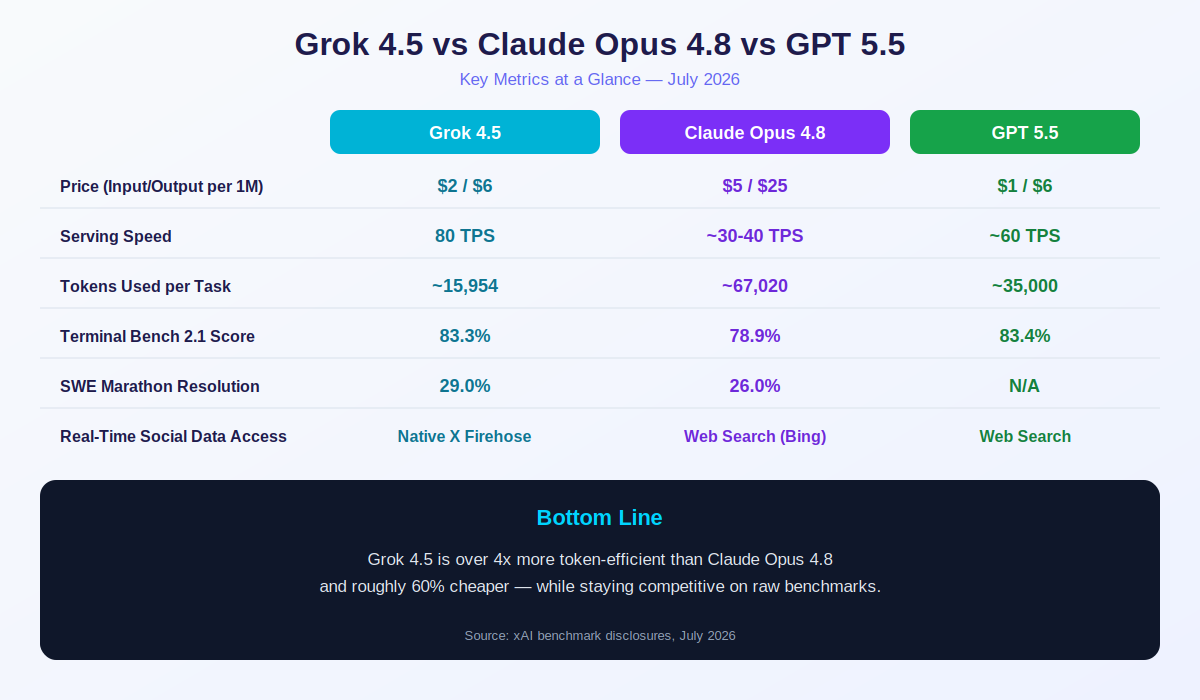
To understand how Grok 4.5 positions itself as a practical tool rather than just a benchmark trophy, let’s look at the hard technical data against Claude Opus 4.8 and GPT 5.5.
| Feature / Metric | Grok 4.5 (SpaceXAI) | Claude Opus 4.8 (Anthropic) | GPT 5.5 (OpenAI) |
| Price (Input / Output per 1M Tokens) | $2.00 / $6.00 | $5.00 / $25.00 | $1.00 / $6.00 |
| Serving Speed (Tokens per Second) | 80 TPS | Slower (~30-40 TPS) | Medium (~60 TPS) |
| Token Efficiency (Tokens per Task) | Highest (~15k tokens/task) | Lower (~67k tokens/task) | Medium (~35k tokens/task) |
| Training Data Differentiator | Real Cursor Dev Sessions | Curated Web & Academic | Synthetic & Multimodal Web |
| Terminal Bench 2.1 Score | 83.3% | 78.9% | 83.4% |
| SWE Marathon Resolution Rate | 29.0% (Highest) | 26.0% | N/A |
| Real-Time Social Data Access | Native X (Twitter) Firehose | Web Search via Bing | Web Search via Bing/Google |
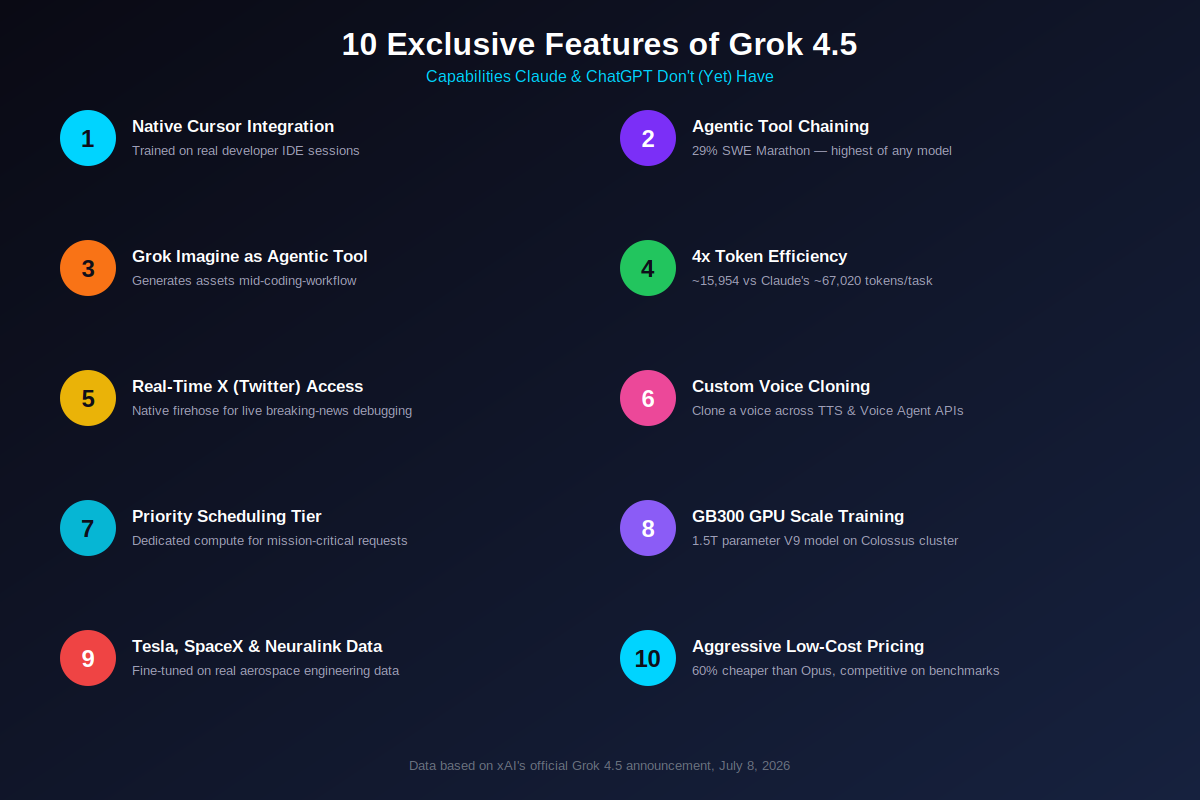
The 10 Exclusive Features of Grok 4.5
1. Native Cursor Integration: Trained Directly with Real Developer Sessions
Unlike standard models that read code repositories like static textbooks, Grok 4.5 was co-developed and trained jointly with the Cursor team. By analyzing thousands of hours of real, active developer IDE sessions, Grok understands how developers debug, refactor, and pivot mid-task. This gives it an intuitive grasp of developer intent that Claude and ChatGPT simply cannot replicate with traditional pre-training data.
2. Built-In Agentic Tool Chaining for Multi-Step Engineering Tasks
Grok 4.5 isn’t just a chatbot; it is built to execute long-running, autonomous workflows without constant human prompting, similar to how agent mode workflows operate in modern coding tools. On the grueling SWE Marathon benchmark, which tests an AI’s ability to resolve complex, multi-file codebase issues over extended periods, Grok 4.5 scored a 29% resolution rate outperforming all other tested frontier models. It manages its own state, writes tests, and iterates until the bug is squashed.
3. Grok Imagine as an Agentic Tool
In a brilliant workflow update, the model can now autonomously invoke Grok Imagine natively mid-task. If you are a game developer asking Grok to write code for a UI layout, it doesn’t just write the CSS—it can trigger its own image and video generation engine to create placeholders, textures, or asset concepts right inside the code generation environment, drastically minimizing context switching.
4. Massive Token Efficiency: Same Task, Far Fewer Tokens
Raw benchmark numbers don’t tell the full story; token consumption does. In practical engineering tasks, Grok 4.5 resolved complex SWE problems using an average of 15,954 output tokens. Compare that to Claude Opus 4.8, which burned through 67,020 tokens for the exact same outcomes. This makes Grok over 4 times more token-efficient, saving developers massive amounts of context window space and API processing time.
5. Real-Time Access to X (Twitter) Data via Live Search
Social trends, breaking news, and developer discussions change every second. Grok 4.5 retains its crown jewel feature: native, real-time firehose access to X. When debugging an open-source library that broke ten minutes ago due to a faulty package update, Grok 4.5 will pull live developer tweets about the error, whereas other models remain blind until traditional search engines index the forums.
6. Custom Voice Cloning Across Text-to-Speech and Voice Agent APIs
Expanding far beyond text, Grok 4.5 introduces enterprise-grade voice features. Users can upload a short audio clip to securely clone a voice, deploying it instantly across automated systems, Customer Support Voice Agents, or internal multi-lingual video dubbing tools, creating a highly personalized brand presence.
7. Priority Scheduling Tier for Time-Sensitive API Requests
For enterprise applications where every millisecond translates to revenue, SpaceXAI introduced a new API control flag: service_tier: "priority". This grants mission-critical applications dedicated compute pipelines, bypassing standard queues during peak traffic hours to guarantee predictable, ultra-low latency execution.
8. Trained Using GB300 GPU Infrastructure at Unprecedented Scale
The physical infrastructure backing Grok 4.5 is staggering. It was trained on the massive Colossus cluster utilizing tens of thousands of next-generation NVIDIA GB300 GPUs. This unmatched compute scale allowed xAI to run a 1.5-trillion-parameter foundation model (known as V9) through hyper-complex reasoning simulations that smaller labs cannot afford to run.
9. Direct Feedback Loop from Tesla, SpaceX, Neuralink, & Boring Company
Grok 4.5 has a secret weapon: real-world physics and engineering data. Before its public launch, the model spent weeks in private beta at Tesla and SpaceX. It was fine-tuned on highly complex technical documentation, mechanical telemetry, and actual aerospace engineering problems, giving it unparalleled logic depth in hard science domains.
10. Aggressive Low-Cost Pricing With Highest Benchmark-to-Cost Ratio
At $2/M input and $6/M output tokens, Grok 4.5 is roughly 60% cheaper than running Claude Opus. Yet, despite the budget-friendly pricing, it goes head-to-head on the elite Terminal Bench 2.1, scoring an impressive 83.3% (a statistical tie with GPT 5.5’s 83.4%). It brings premium reasoning down to a commodity price point.
What Claude and ChatGPT Still Do Better
To keep this guide completely unbiased and objective, we must acknowledge that Grok 4.5 isn’t a flawless silver bullet. Both Anthropic and OpenAI hold strong ground in key areas:
-
Documented Safety & Governance Layers: Anthropic’s Claude retains the gold standard for institutional safety, alignment, and detailed governance documentation. For enterprises requiring strict compliance audits, Claude is much easier to clear through legal departments.
-
Overall Intelligence Index Score: On the comprehensive Artificial Analysis Intelligence Index, Grok 4.5 sits at 4th place overall. For hyper-abstract creative writing or pure multi-disciplinary academic reasoning, GPT 5.5 and Claude Opus still hold a slight edge.
-
Geographic Availability: Due to regulatory complexities and compliance standoffs, Grok 4.5 remains highly restricted or unavailable across the European Union (EU), giving ChatGPT a massive global accessibility advantage.
Who Should Actually Use Grok 4.5?
Grok 4.5 is custom-built for a specific breed of power user. You will get immense value out of this model if you are:
-
Startups & Coding Teams: If your developers live inside Cursor and build high-volume agentic applications, the cost savings and native code comprehension will immediately impact your bottom line.
-
Data Engineers & DevOps Specialists: With an 83.3% score on Terminal Bench 2.1, it excels at managing command lines, automation scripts, and cloud infrastructure deployment.
-
Professional Fields: As verified by expert benchmarks like Snorkel’s GDPVal+, it dramatically outperforms legacy models in legal analysis, financial reviews, and healthcare analytics.
Who should skip it? If your organization operates within a highly regulated market requiring extensive AI safety documentation, or if you are located deep within the EU, sticking with ChatGPT or Claude remains the safer bet for now.
Conclusion
Grok 4.5 represents a massive paradigm shift for SpaceXAI. By ignoring the vanity metrics of general leaderboards and tuning the engine specifically for token efficiency, speed, and real-world software engineering, they have built a developer’s dream tool. It proves that the future of LLMs isn’t just about being smarter it’s about being faster, more practical, and ruthlessly cost-effective. If you want to stay updated on the latest AI benchmarks, prompts, and tool tutorials, make sure to keep reading openaihit.
Frequently Asked Questions
Is Grok 4.5 better than Claude Opus 4.8?
It depends on the metric. For long-running software engineering tasks (SWE Marathon) and cost efficiency, Grok 4.5 wins decisively. However, Claude Opus 4.8 still maintains an advantage in raw academic reasoning benchmarks and broader creative assignments.
How much does Grok 4.5 cost per API call?
Grok 4.5 is priced extremely aggressively at $2.00 per 1 million input tokens and $6.00 per 1 million output tokens, making it one of the most affordable frontier-class models available.
Is Grok 4.5 available in the EU?
No, due to strict regulatory frameworks and data privacy disputes, Grok 4.5 is currently restricted across most countries in the European Union.
Can Grok 4.5 generate images and videos?
Yes, Grok 4.5 features native tool call access to the Grok Imagine engine, allowing it to autonomously generate high-fidelity images and conceptual assets mid-workflow.
What makes Grok 4.5 different from ChatGPT?
Grok 4.5 stands out due to its training integration with real Cursor developer IDE sessions, native access to the real-time X social media firehose, and vastly superior token efficiency during multi-step tasks.