

Creating posts that feel like your brand is needed to build trust, find the right audience, and keep an easy-to-remember sense of who you are online. Whether you post blog posts, social media captions, email newsletters, or website copy, your brand voice helps people understand who you are and what makes your business different.
However, keeping the same writing style across many places can be hard. Normal AI-generated content may sound the same again and again, too formal, or different from your brand’s style.
That’s where ChatGPT brand voice prompts become useful. With the right prompts, you can show ChatGPT the path to follow your favorite tone, words you use, sentence structure, and way to talk. You can also create a use again and again brand voice guide that helps you make same style always content more quickly and easily.
AI Overview:
ChatGPT brand voice prompts are orders that help AI make content consistent with a business’s personality, tone, vocabulary, and way of talking. By giving brand rules, audience details, and examples of old content, users can create more consistent blog posts, social media captions, marketing emails, product descriptions, and website copy.
The most best prompts set the wanted writing style, find words not to use , and tell clearly the reason of each piece of content. Using these prompts together with checking by a person and checking true facts helps businesses keep your true brand style while saving time on making content.
Key Takeaways
- Decide your brand style: find your brand’s words, way of talking, and talking rules.
- Use clear ChatGPT brand voice prompts: Give simple orders not depending on vague requests such as make it engaging.
- Give old writing examples: Share old content so ChatGPT can identify your preferred writing patterns.
- Maintain consistency: Use the same core guidelines across blogs, emails, websites, and social media.
- Customize content for each platform: Adapt formatting and messaging without losing your brand’s identity.
- Improve AI-generated writing: Remove generic expressions, repetitive phrases, and unnecessary jargon.
- Optimize for SEO naturally: Include relevant keywords where they fit the topic and reader’s needs.
- Review every draft: Check factual accuracy, originality, readability, and brand alignment before publishing.
12 Best ChatGPT Prompts for Creating Content That Matches Your Brand Voice
1. Create a Complete Brand Voice Guide

Best for: Defining your brand’s writing style before creating content.
A brand voice guide gives ChatGPT a clear reference for how your business should communicate. It establishes consistent writing rules that you can reuse across different content formats.
Prompt:
Act as an experienced brand strategist and content editor. Create a comprehensive brand voice guide for [brand name], a [business type] serving [target audience].
Our brand values are [values], and our desired personality is [three to five traits].
Define our tone, vocabulary, sentence structure, preferred expressions, formatting style, and communication principles. Include words and phrases to use, language to avoid, and examples of on-brand and off-brand writing.
Make the guide practical and easy to follow for blog posts, website pages, social media, and email campaigns.
2. Analyze Existing Content to Identify Your Brand Voice

Best for: Businesses that already publish content.
Your existing content can reveal how your brand communicates in practice. This prompt helps identify patterns that make your writing recognizable.
Prompt:
Analyze these examples of our existing content: [paste three to five writing samples].
Identify recurring characteristics of our brand voice, including tone, personality, vocabulary, sentence length, paragraph structure, formality, and storytelling style.
Create a brand voice profile based on the evidence in the samples. Identify five specific writing rules and provide examples of how to apply them.
Separate consistent patterns from occasional choices and do not invent characteristics that the examples do not support.
3. Write SEO Blog Posts in Your Brand Voice

Best for: Blog articles, educational content, and organic search traffic.
SEO content should answer readers’ questions while maintaining a consistent brand identity. This prompt combines search requirements with writing preferences.
Prompt:
“Write an SEO-focused blog post about [topic] for [target audience].
Brand voice: [paste brand guidelines].
Primary keyword: [primary keyword].
Secondary keywords: [secondary keywords].
Search intent: [intent].
Create a compelling introduction, logical headings, useful examples, actionable advice, and a strong conclusion. Integrate keywords naturally without keyword stuffing.
Use clear, engaging language that reflects our brand personality. Avoid generic introductions, repetitive explanations, unsupported claims, and unnecessary filler. Prioritize accuracy, reader value, and search intent.
4. Make AI-Generated Content Sound More Natural
Best for: Improving generic or robotic drafts.
Sometimes AI-generated content follows the right topic but misses the personality you want. This prompt focuses on editing rather than unnecessarily rewriting everything.
Prompt:
“Edit the following draft to match our brand voice: [paste draft and brand guidelines].
Preserve the original meaning, important facts, and intended message. Replace generic expressions with natural, specific language that reflects our brand personality.
Improve sentence flow, remove repetition, vary sentence structure where appropriate, and simplify unnecessary jargon.
Avoid exaggerated enthusiasm, forced humor, empty transitions, and unsupported claims. Provide the revised draft and briefly explain the most important changes.
5. Create Social Media Content That Matches Your Brand

Best for: LinkedIn posts, Instagram captions, Facebook updates, and other social platforms.
Social media content often needs a different structure from blog posts, but it should still reflect the same brand identity.
Prompt:
“Create [number] social media posts about [topic] for [platform].
Our audience is [audience], and our brand voice is [tone and personality]. Our key message is [message], and our desired action is [call to action].
Write platform-appropriate posts with strong openings, useful insights, and natural language. Give each post a distinct angle while maintaining our brand identity.
Avoid engagement bait, irrelevant slang, exaggerated claims, and phrases that conflict with our guidelines. Include hashtags only when relevant.
6. Write Marketing Emails in Your Brand Voice
Best for: Newsletters, welcome emails, promotional campaigns, and product announcements.
Email marketing requires a balance of personality, clarity, and persuasion. A detailed prompt can help you maintain that balance.
Prompt:
“Write a marketing email for [brand name] promoting [product, service, or offer] to [target audience].
Brand voice: [paste guidelines].
Email goal: [goal].
Main customer benefit: [benefit].
Provide three subject line options, an engaging opening, a concise explanation of the value, supporting details, and one clear call to action.
Use our preferred tone and vocabulary. Avoid aggressive sales language, false urgency, generic greetings, and exaggerated promises. Ensure all claims are supported by the information provided.
7. Adapt Your Brand Voice to Different Audiences
Best for: Businesses serving multiple customer segments.
You may need to explain the same product to beginners, experienced professionals, and business decision-makers. Adapt your language to each audience while keeping your core identity consistent.
Prompt:
“Rewrite this message for the following audience segments: [audience A] and [audience B].
Original message: [paste message].
Our core brand voice is [brand voice], and our communication principles are [principles].
Adapt the terminology, level of detail, examples, and emphasis to each audience’s knowledge and needs. Preserve the core message, factual accuracy, and brand personality.
Provide two versions and explain which elements remained consistent and which were adapted.
8. Create Product Descriptions That Reflect Your Brand
Best for: E-commerce stores, software businesses, and service providers.
Product descriptions should communicate value in a way that reflects your brand while remaining accurate.
Prompt:
“Write a product description for [product or service] using our brand voice: [paste guidelines].
Target customer: [customer profile].
Product features: [features].
Verified benefits: [benefits].
Customer problem: [problem].
Create a compelling headline, concise introduction, benefits-focused description, and clear call to action.
Use specific, customer-centered language. Avoid generic superlatives, repetitive phrases, unsupported performance claims, and invented product specifications.”
9. Maintain Brand Consistency Across Multiple Channels

Best for: Multi-channel campaigns and content marketing teams.
A single campaign may require a blog introduction, email, website banner, and social media post. This prompt keeps the main message aligned across all of them.
Prompt:
“Create a set of brand-aligned content assets using this campaign brief: [paste brief].
Brand voice: [guidelines].
Core message: [message].
Target audience: [audience].
Produce a social media post, marketing email, website banner, short blog introduction, and promotional message.
Adapt the length, format, and call to action for each channel while preserving our brand personality, preferred terminology, and core message. Identify phrases that should remain consistent across all assets.
10. Build a Brand Vocabulary and Style Checklist
Best for: Content teams, editors, and businesses publishing regularly.
A vocabulary checklist turns abstract brand preferences into practical writing rules.
Prompt:
“Create a brand vocabulary and style checklist for [brand name].
Industry: [industry].
Target audience: [audience].
Brand personality: [traits].
Include preferred words and expressions, phrases to avoid, terminology that needs explanation, sentence structure preferences, capitalization rules, formatting conventions, and tone guidelines.
For important rules, provide one off-brand sentence and a revised on-brand version. Make the checklist concise, specific, and easy for writers to use before publishing.”
11. Rewrite Existing Content Without Losing Its Meaning
Best for: Refreshing old articles, website copy, and content written by multiple authors.
You do not always need to start from scratch. Sometimes you only need to adjust wording that conflicts with your current brand identity.
Prompt:
“Review this content against our brand voice guide: [paste content and guidelines].
Identify sections that conflict with our tone, vocabulary, sentence structure, or communication principles. Rewrite only the sections that need improvement.
Preserve the original meaning, useful information, important keywords, and factual details. Avoid unnecessary changes to effective passages.
Provide the revised version and a short list of important edits. Flag claims that need verification instead of silently changing their meaning.
12. Create a Reusable Master Prompt for Brand Content

Best for: Businesses that regularly use ChatGPT for content creation.
A master prompt provides a consistent starting point for recurring writing tasks.
Prompt:
“Act as the brand-aligned content writing assistant for [brand name].
Follow these guidelines:
- Brand personality: [traits].
- Target audience: [audience].
- Preferred tone: [tone].
- Vocabulary preferences: [preferences].
- Sentence and paragraph style: [style].
- Language and expressions to avoid: [restrictions].
- Core brand values: [values].
For each task, identify the content format, audience, goal, and main message. Ask concise questions if essential information is missing.
Create useful, accurate, engaging content that reflects our brand personality. Adapt the structure to the requested format, integrate relevant keywords naturally, and never invent facts, testimonials, product features, or results.
Before delivering the draft, check it against these guidelines and flag important factual uncertainties.
Comparison Table: Best ChatGPT Brand Voice Prompts
| No. | ChatGPT prompt | Best use | Main benefit |
| 1 | Brand voice guide | Brand strategy | Defines writing rules |
| 2 | Existing content analysis | Voice discovery | Identifies authentic patterns |
| 3 | SEO blog writing | Blog content | Balances SEO and brand tone |
| 4 | Natural writing editor | Draft improvement | Reduces generic wording |
| 5 | Social media content | Social campaigns | Maintains platform-ready voice |
| 6 | Marketing email writer | Email marketing | Creates focused messaging |
| 7 | Audience adaptation | Segmented content | Tailors language to readers |
| 8 | Product description writer | E-commerce | Communicates product value |
| 9 | Multi-channel content | Campaigns | Aligns messaging across platforms |
| 10 | Vocabulary checklist | Editorial standards | Establishes practical writing rules |
| 11 | Content rewriting | Content refreshes | Improves existing material |
| 12 | Master brand prompt | Recurring tasks | Creates a reusable workflow |
1. Brand Voice AI Prompts
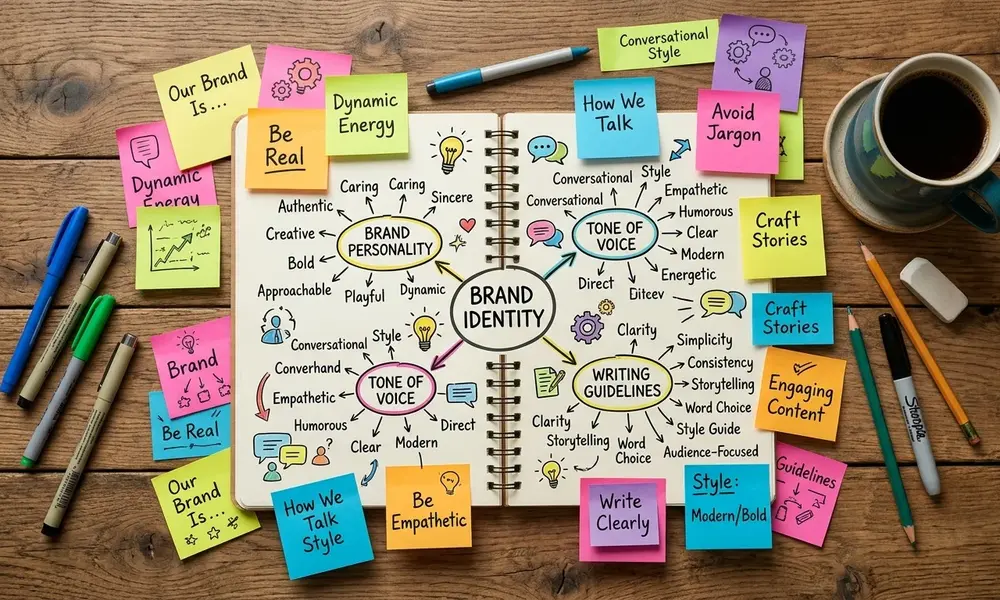
Brand style AI prompts are instructions that guide AI tools like ChatGPT to create content that matches a business’s style, personality, values, and tone of voice. These prompts help businesses maintain a consistent identity across blog posts, social media captions, emails, and website copy. Businesses can also use Claude YouTube-to-blog prompts to repurpose video content into written articles while maintaining their brand voice.
For example, if your brand is friendly, professional, and helpful, you can instruct ChatGPT to use simple language, explain ideas clearly, and avoid overly formal or promotional expressions.
prompt:
Act as a brand voice specialist. Create content for my brand using a friendly, professional, and conversational tone. Use simple English, short paragraphs, and practical examples. Avoid generic phrases, unnecessary jargon, and exaggerated claims. Keep the content consistent with my brand personality.
Why it matters: Brand voice AI prompts help reduce repetitive editing, maintain consistency, and create content that feels more recognizable to your audience.
2. ChatGPT Writing Style Prompts

ChatGPT writing style prompts are instructions that control how ChatGPT writes. They specify the tone, vocabulary, sentence length, paragraph structure, level of detail, and overall presentation of the content.
For example, you can ask ChatGPT to write in a conversational style for blog readers, a formal style for business reports, or a persuasive style for marketing emails. These prompts are especially useful when you want AI-generated content to sound natural and fit a particular audience.
prompt:
“Rewrite this article using a clear, engaging, and conversational writing style. Use short sentences, natural transitions, and specific examples. Remove repetitive phrases and unnecessary jargon while preserving the original meaning. Make the content easy for beginners to understand.”
Why it matters: ChatGPT writing style prompts help improve readability, adapt content to different audiences, and make AI-generated drafts more consistent with your preferred writing style.
3. Brand Voice Content
Brand voice content refers to any written material that reflects a business’s distinctive personality and communication style. It includes blog articles, website pages, product descriptions, social media posts, newsletters, and promotional emails.
For example, a technology brand might publish informative, confident, and straightforward content, while a lifestyle brand might use a warm, friendly, and inspirational tone. Although the formats differ, the underlying personality remains consistent.
Example prompt:
“Create brand voice content for my business, [brand name]. Our audience is [target audience], and our brand personality is friendly, trustworthy, and knowledgeable. Write a blog introduction, a social media caption, and a short email using consistent terminology and tone. Adapt the format to each platform without changing our core message.
Why it matters: Consistent brand voice content helps audiences recognize your business, understand your values, and develop trust in your messaging over time.
Quick comparison table
Keyword |
Main focus |
Example use |
| Brand voice AI prompts | Guiding AI to follow your brand identity | Creating a brand voice guide |
| ChatGPT writing style prompts | Controlling how content is written | Improving tone and readability |
| Brand voice content | Producing content that reflects your brand | Writing blogs, emails, and social posts |
Conclusion
Creating content that matches your brand voice becomes easier when you give ChatGPT clear instructions about your personality, tone, audience, vocabulary, and writing preferences. These 12 ChatGPT brand voice prompts provide a practical framework for producing consistent blog posts, marketing emails, social media captions, product descriptions, and website copy.
You can also use Claude prompts to humanize AI content to make AI-generated writing sound more natural, authentic, and aligned with your brand’s unique personality.
Start by creating a brand voice guide and analyzing your existing content. Then use the appropriate prompts for each format, refine the output with specific feedback, and review every draft before publishing.
For better results, keep your guidelines updated, use secondary keywords naturally, and prioritize your readers’ needs over repetitive SEO phrases. Using effective Claude prompts for writing can help streamline your content creation process, but your brand’s experience, expertise, and editorial judgment are what make the final content valuable and distinctive.
Frequently Asked Questions (FAQs)
1. What are ChatGPT brand voice prompts?
ChatGPT brand voice prompts are instructions that guide ChatGPT to create content according to a brand’s tone, personality, vocabulary, and communication style. They help maintain consistency across blogs, websites, social media, and emails.
2. How do I make ChatGPT match my brand voice?
Provide a brand voice guide, examples of existing content, details about your audience, preferred vocabulary, and phrases to avoid. Ask ChatGPT to follow those guidelines and review its output before publishing.
3. What are the best brand voice AI prompts?
Useful prompts include creating a brand voice guide, analyzing existing writing samples, editing generic drafts, adapting content for different audiences, and creating a reusable master prompt.
4. Can ChatGPT maintain a consistent writing style across platforms?
Yes. With consistent guidelines, ChatGPT can adapt your brand voice across blogs, social media, emails, and product pages. You should still adjust formatting, length, and messaging to suit each platform.
5. How can I make AI-generated content sound less generic?
Share representative writing samples, provide specific tone instructions, identify phrases to avoid, and request concrete examples. Ask ChatGPT to improve sentence flow and remove repetition without changing the original meaning.
6. Should I use one prompt for all my content?
A reusable master prompt is a good starting point, but customize it for each task. Blog articles, emails, product descriptions, and social posts have different formatting and communication requirements.
7. How often should I update my brand voice guide?
Review your guidelines whenever your audience, products, positioning, or messaging changes. Periodic reviews also help you identify inconsistent language and refine your writing standards.