Imagine you’re working on a software project with a tight deadline. You ask an AI assistant to generate code, debug an issue, search documentation, and organize everything into one workflow.
Most models can complete one or two of those tasks well. Very few handle the entire process efficiently without slowing down or becoming expensive. That challenge is exactly why Gemini 3.5 Flash has attracted so much attention since its launch at Google I/O 2026.
Instead of acting like another chatbot, Google designed it as an execution engine that plans, performs actions, verifies results, and supports developers through complex workflows.
If you’re wondering whether it lives up to that promise, this article explains its architecture, standout capabilities, pricing, benchmarks, limitations, and the situations where it performs best.
AI Overview
Gemini 3.5 Flash is Google’s latest high-efficiency AI model built specifically for the agentic AI era. Unlike earlier lightweight models focused mainly on speed, it combines fast responses with advanced reasoning, tool use, and large-context processing.
Released during Google I/O 2026, it targets developers building AI agents, automation systems, and complex software workflows. This guide explains how it works, its major features, pricing, coding performance, and whether it’s the right model for your projects.
Key Takeaways
- Gemini 3.5 Flash combines high-speed inference with advanced reasoning in a single model.
- Google designed it specifically for autonomous AI agents and multi-step workflows.
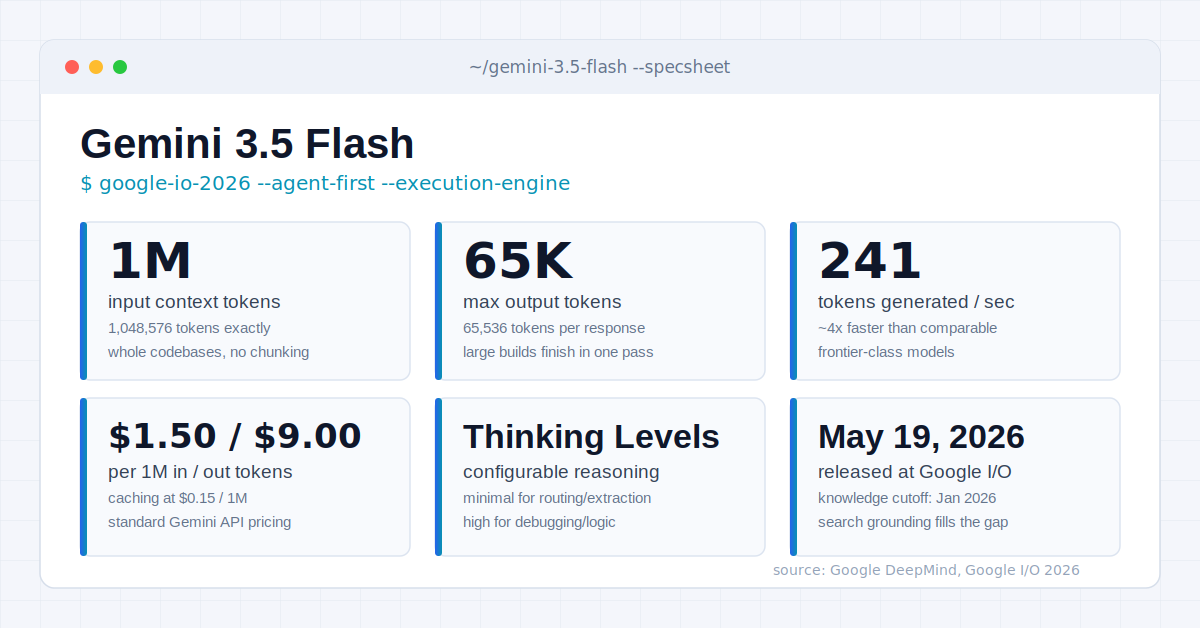
- It supports a 1 million token context window and a 65K output limit.
- Developers can control reasoning depth through configurable Thinking Levels.
- Built-in tool calling, Python execution, and search grounding simplify automation.
- It costs significantly less than many frontier AI models while maintaining strong coding performance.
What Is Gemini 3.5 Flash?
Gemini 3.5 Flash is Google’s high-efficiency, natively multimodal AI model built for the emerging era of agentic AI. Unlike earlier lightweight models that focused mainly on speed, this version combines fast performance with advanced reasoning and autonomous task execution.
Released on May 19, 2026, during Google I/O 2026, the model is designed to help developers build AI agents, coding assistants, automation pipelines, and enterprise applications without relying on slower, premium-tier models.
Its defining characteristic is an agent-first architecture. Instead of simply generating text, Gemini 3.5 Flash can plan multi-step tasks, use external tools, execute code in a secure environment, and verify its own output before responding. This release is part of a broader wave of changes covered in our Google Gemini update roundup, tracking how Google’s AI lineup is evolving in 2026.
Why Google Built Gemini 3.5 Flash
Google developed Gemini 3.5 Flash to eliminate a long-standing trade-off in AI development. Previously, developers often chose between lightweight models for speed and premium models for stronger reasoning.
It brings those strengths together.
According to Google DeepMind, the goal was to deliver near-Pro reasoning capabilities while maintaining the speed and affordability expected from the Flash family.
How It Fits Into the Gemini Family
The model represents the next major step in Google’s AI evolution.
- Gemini 1.5 Flash (2024): Prioritized high-speed inference and large context windows.
- Gemini 3.1 Flash-Lite (Early 2026): Reduced latency for simple, repetitive tasks.
- Gemini 3.5 Flash (May 2026): Combined rapid performance with deeper reasoning, tool use, and agentic workflows.
This progression reflects Google’s broader strategy of turning AI from a conversational assistant into an active problem-solving partner.
Who Should Use Gemini 3.5 Flash?
Gemini 3.5 Flash is best suited for users who need both speed and intelligent task execution.
It is particularly valuable for:
- Software developers building AI-powered applications.
- Teams creating autonomous AI agents and workflow automation.
- Businesses processing large documents or codebases.
- Researchers working with multimodal data.
- Enterprises deploying scalable AI solutions through Google AI Studio or Vertex AI.
If your work involves long-context reasoning, coding, or multi-step automation, Gemini 3.5 Flash offers capabilities that go well beyond a traditional chatbot while remaining cost-efficient.
Gemini 3.5 Flash Features
Gemini 3.5 Flash introduces several improvements that make it more than a faster language model. Google designed it as an execution-focused AI that can reason, interact with tools, and complete complex workflows while keeping latency and costs under control.
These capabilities allow developers to build applications that can plan, execute, and refine tasks with minimal manual intervention.
Agent-First Architecture
The biggest change in Gemini 3.5 Flash is its agent-first design. Rather than waiting for one prompt after another, the model is built to handle long, multi-step tasks that require planning, execution, and verification.
For example, it can generate code, call external tools, check the results, and revise its output before delivering a final response. This workflow makes it suitable for autonomous software agents instead of simple chat interfaces.
Flexible Thinking Levels
Google introduced configurable Thinking Levels, allowing developers to balance reasoning quality against speed and cost.
For straightforward tasks like classification or data extraction, a minimal thinking level reduces latency. More complex jobs, such as debugging software or solving multi-step logic problems, can use higher reasoning levels for better accuracy.
This flexibility gives developers greater control over API performance without switching to another model.
Native Multimodal Understanding
Gemini 3.5 Flash accepts multiple input types within a single workflow, including text, images, PDFs, audio, and video.
According to Google DeepMind, developers can also adjust image processing quality through configurable media resolution settings. Lower resolutions reduce token usage, while higher settings preserve fine details for diagrams, technical documents, and complex visuals.
Large Context Window
One of the model’s biggest strengths is its massive context capacity.
Google reports that Gemini 3.5 Flash supports 1,048,576 input tokens and 65,536 output tokens, making it possible to process extensive documentation, large codebases, or lengthy conversations without splitting data into smaller requests.
This expanded output limit also reduces the chances of code generation stopping before a project is complete.
Built-In Tool Calling and Code Execution
Gemini 3.5 Flash goes beyond text generation by supporting native tool execution.
Developers can connect external APIs, enforce structured JSON outputs, and execute Python code inside a secure sandbox. These capabilities enable the model to calculate results, validate logic, automate repetitive tasks, and integrate directly into production workflows.
Search Grounding and Stateful Interactions
The model also supports Google Search grounding for retrieving up-to-date information beyond its January 2026 knowledge cutoff.
In addition, Google’s Interactions API stores conversation history and execution state on Google’s infrastructure. This reduces repeated token usage, lowers network overhead, and improves efficiency during long-running AI workflows.
Together, these features position Gemini 3.5 Flash as a practical platform for developers building intelligent applications rather than a standalone conversational assistant.
Gemini 3.5 Flash Coding Performance
For many developers, coding performance is the biggest reason to consider Gemini 3.5 Flash. Google designed the model to handle software development, debugging, and multi-step programming tasks while maintaining the speed expected from the Flash family.
Unlike earlier lightweight models, it doesn’t simply generate code. It can reason through problems, execute Python in a sandboxed environment, verify results, and refine its output before returning a final response. If you’re deciding between AI coding tools altogether, this head-to-head on Cursor vs GitHub Copilot vs Claude Code is a useful companion comparison for 2026.
Coding Benchmarks
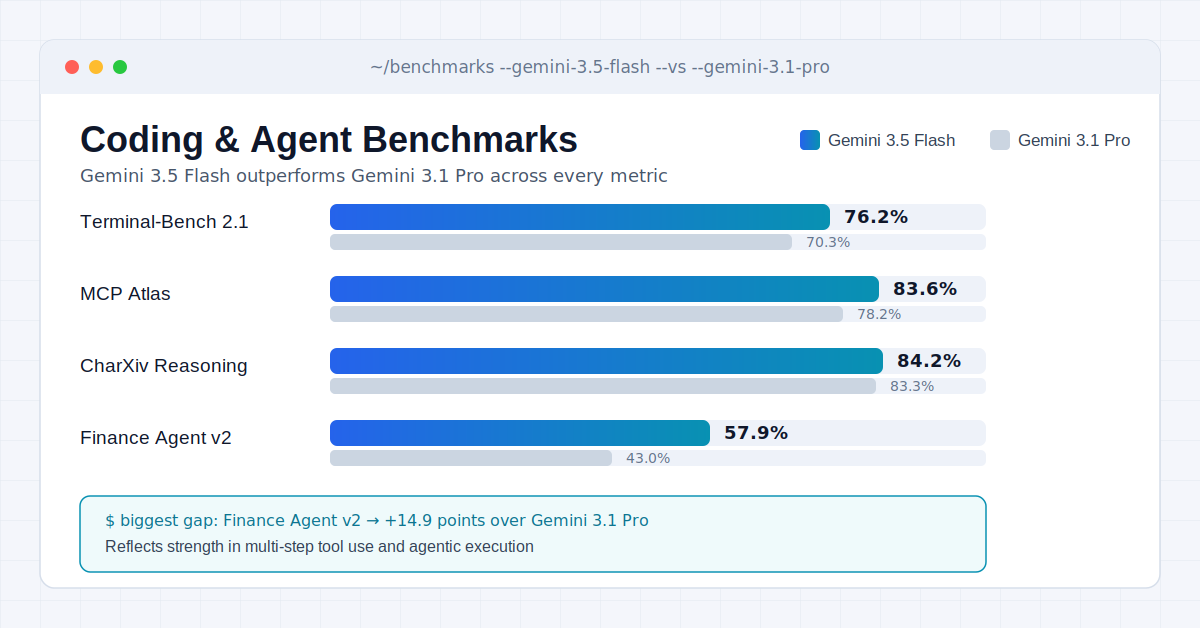
According to Google DeepMind, Gemini 3.5 Flash surpasses the previous Gemini 3.1 Pro on several developer-focused benchmarks.
| Benchmark | Gemini 3.5 Flash | Gemini 3.1 Pro |
| Terminal-Bench 2.1 | 76.2% | 70.3% |
| MCP Atlas | 83.6% | 78.2% |
| CharXiv Reasoning | 84.2% | 83.3% |
| Finance Agent v2 | 57.9% | 43.0% |
These results highlight the model’s strengths in coding, tool usage, multimodal reasoning, and agent-based workflows rather than pure academic reasoning.
Faster Development Cycles
Speed is another major advantage.
According to Google DeepMind, Gemini 3.5 Flash generates an average of 241 tokens per second, making it roughly four times faster than many comparable frontier models.
That responsiveness allows developers to iterate on UI designs, debug code, and test new ideas with minimal waiting between prompts.
Built for Large Software Projects
Large applications often exceed the output limits of traditional AI models, forcing developers to split projects into multiple requests.
Gemini 3.5 Flash reduces that problem with support for 1,048,576 input tokens and 65,536 output tokens. This expanded capacity makes it easier to analyze extensive codebases and generate substantial amounts of code in a single response.
Where It Excels
Gemini 3.5 Flash performs particularly well for:
- Writing and refactoring code.
- Debugging complex runtime errors.
- Building AI agents and automation workflows.
- Processing large software repositories.
- Generating structured JSON and API responses.
Its combination of speed, reasoning, and execution tools makes it especially valuable for developers who need more than a code completion assistant without paying premium-model costs.
Real-World Use Cases for Gemini 3.5 Flash
Strong benchmarks are valuable, but what matters most is how a model performs in everyday development. Gemini 3.5 Flash was designed to support real production workflows where speed, reasoning, and automation work together.
The following examples are based on the research data and demonstrate where the model delivers the greatest value.
Building Autonomous AI Agents
One of the model’s primary strengths is powering AI agents that can complete tasks with minimal supervision.
Instead of responding to a single prompt, It can plan a sequence of actions, call external tools, execute code, verify the results, and continue until the task is complete. This makes it well suited for modern agent-based applications. To see how this compares against other agent-focused models, our roundup of best AI agents in 2026 breaks down the top contenders.
Rebuilding Applications from Screenshots
Initial testing shows developers using Gemini 3.5 Flash to recreate legacy software interfaces from screenshots.
Its large 64K output token limit enables the model to generate front-end code, business logic, and styling in a single response, reducing the need to split projects into multiple prompts.
Automating Research Workflows
Businesses can also use Gemini 3.5 Flash to automate research-intensive projects.
For example, a marketing team can configure an AI agent to analyze competitor websites, execute Python scripts for data analysis, and compile the findings into structured reports with minimal human involvement.
Enterprise Customer Support
Another practical use case is intelligent customer support automation.
Multiple AI agents can work together, with one processing user input, another retrieving information through APIs, and a coordinating agent assembling the final response. This parallel workflow helps reduce response times while maintaining accuracy.
Large-Scale Code Refactoring
Organizations maintaining legacy software often struggle with large codebases. Thanks to its 1 million token context window, It can analyze extensive projects, identify outdated patterns, execute test code in a secure environment, and help modernize applications more efficiently than smaller-context models.
Who Should Use Gemini 3.5 Flash?
It is an excellent choice for:
- Software developers building AI-powered applications.
- Teams creating autonomous AI agents.
- Businesses automating repetitive workflows.
- Enterprises managing large codebases.
- Researchers working with multimodal documents and data.
Who Should Consider Another Model?
Gemini 3.5 Flash may not be the best fit if your primary work depends on:
- Advanced abstract reasoning benchmarks.
- Native AI image generation.
- Creative visual content production.
In those situations, a specialized reasoning or multimodal generation model may be a better choice, depending on your project requirements.
Gemini 3.5 Flash Pricing
One of the biggest advantages of Gemini 3.5 Flash is its balance between capability and cost. Google positioned the model as a high-performance option that delivers advanced reasoning and agentic workflows without the premium pricing of larger frontier models.
For startups and enterprises running millions of API requests, those savings can have a significant impact over time.
API Pricing
According to the research data, Gemini 3.5 Flash uses the following standard API pricing:
| Usage | Price |
| Input Tokens | $1.50 per 1 million tokens |
| Output Tokens | $9.00 per 1 million tokens |
| Context Caching | $0.15 per 1 million tokens |
Google also reported that enterprises processing 1 trillion tokens per day could save more than $1 billion annually by shifting approximately 80% of deep-reasoning workloads from more expensive frontier models to Gemini 3.5 Flash.
Availability
Developers can access Gemini 3.5 Flash through:
- Google AI Studio
- Vertex AI
- Gemini API
- Google Antigravity for supported agent-based workflows
These platforms make it easy to move from experimentation to production without changing the underlying model.
Gemini 3.5 Flash vs GPT-5.6
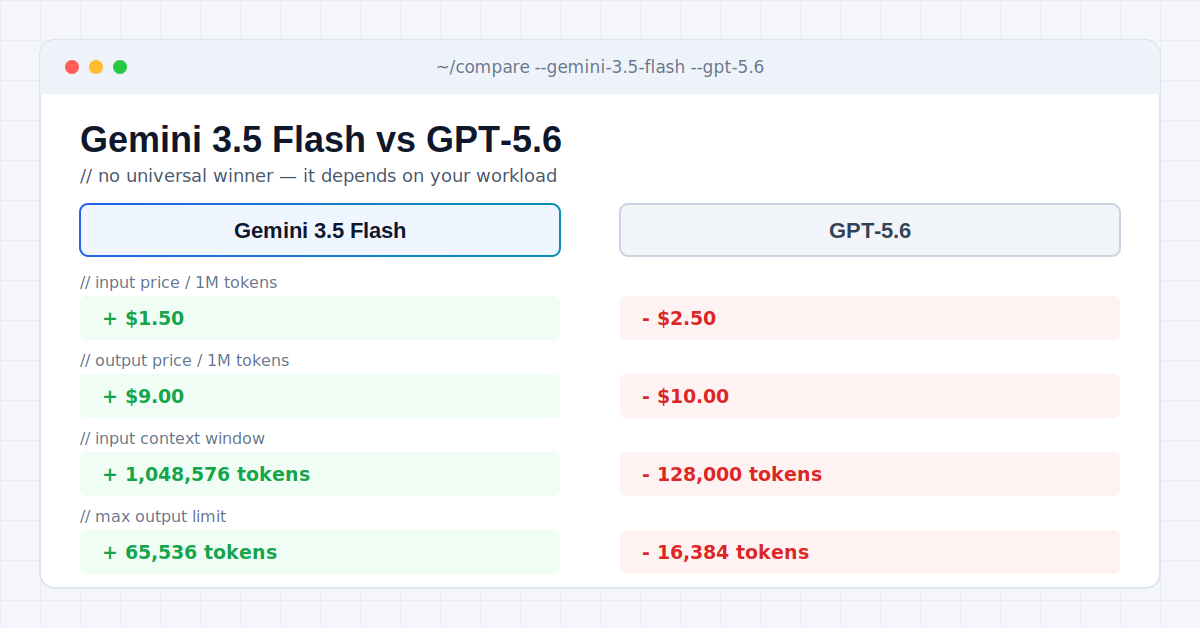
Choosing between Gemini 3.5 Flash and GPT-5.6 depends on your workload rather than finding a universal winner. Each model focuses on different strengths.
The research data shows that Google emphasizes execution speed, large context windows, and lower API costs, while GPT-5.6 remains a strong option for complex enterprise deployments.
| Feature | Gemini 3.5 Flash | GPT-5.6 |
| Input Price | $1.50 / 1M tokens | $2.50 / 1M tokens |
| Output Price | $9.00 / 1M tokens | $10.00 / 1M tokens |
| Input Context | 1,048,576 tokens | 128,000 tokens |
| Output Limit | 65,536 tokens | 16,384 tokens |
| Primary Strength | Agent execution, speed, large context | Enterprise reasoning and system architecture |
Choose Gemini 3.5 Flash If You Need
- Cost-efficient API usage.
- Long-context document or code processing.
- AI agents with tool execution.
- High-speed coding workflows.
- Large-scale automation projects.
Consider GPT-5.6 If You Need
- Advanced enterprise reasoning.
- Existing GPT-based production systems.
- Workflows optimized around the OpenAI ecosystem.
For developers building autonomous agents, processing large codebases, or optimizing API costs, Gemini 3.5 Flash offers a compelling combination of speed, context capacity, and developer-focused features without significantly increasing operational expenses.
Advantages and Limitations
No AI model is perfect, and Gemini 3.5 Flash is no exception. Its strengths make it an excellent choice for many development tasks, but understanding its limitations is just as important before integrating it into production workflows.
Strengths
| Advantage | Why It Matters |
| High-speed performance | Generates an average of 241 tokens per second, helping developers iterate faster. (Google DeepMind) |
| Large context window | Supports 1,048,576 input tokens and 65,536 output tokens for large documents and codebases. |
| Cost efficiency | Lower input pricing than many competing frontier models, making large-scale deployments more affordable. |
| Agent-first design | Plans, executes, and verifies multi-step tasks instead of acting as a simple chatbot. |
| Native tool integration | Supports Python execution, function calling, structured outputs, and Google Search grounding. |
Limitations
| Limitation | Impact |
| Weaker abstract reasoning | Trails Gemini 3.1 Pro on benchmarks focused purely on abstract problem-solving. |
| January 2026 knowledge cutoff | Requires Search Grounding for information released after the cutoff date. |
| Higher output token cost | Output tokens cost $9.00 per million, so lengthy responses can increase API expenses. |
| No native image generation | Can generate code for image creation but cannot directly create images itself. |
Practical Implementation Guide
Understanding the model’s capabilities is one thing. Using them effectively is what delivers real value.
Start With the Right Thinking Level
Choose a lower Thinking Level for simple classification, summarization, or routing tasks. Reserve higher reasoning levels for debugging, complex coding, and multi-step decision-making where accuracy matters more than speed.
Use Long Context Strategically
The 1 million token context window is powerful, but that doesn’t mean every prompt should be enormous. Include only the files, documentation, or conversations relevant to the task. Cleaner context often produces clearer results while controlling token costs.
Take Advantage of Native Tools
Instead of asking the model to explain code conceptually, let it execute Python, call APIs, or produce structured JSON when appropriate. Using built-in tools reduces manual work and improves reliability for production applications.
Common Mistakes to Avoid
Avoid these mistakes when working with Gemini 3.5 Flash:
- Using high reasoning levels for simple tasks.
- Ignoring output token costs on large responses.
- Forgetting to enable Search Grounding for recent information.
- Treating the model like a basic chatbot instead of an execution engine.
- Sending unnecessary context that increases latency and API costs.
Following these practices helps developers get better performance, lower costs, and more reliable results without changing the underlying model. for deep dive information visit Openaihit.
Final Verdict
If your goal is to build AI agents, automate workflows, or develop software that can reason through complex tasks, It is one of Google’s most capable models to date. It successfully combines speed, large-context processing, and advanced execution tools without the premium pricing associated with many frontier AI models. Its biggest strengths are the agent-first architecture, native tool integration, configurable Thinking Levels, and support for a 1,048,576-token context window.
According to Google DeepMind, it also outperforms the previous Gemini 3.1 Pro on several coding and agent-focused benchmarks, making it a practical option for modern development teams.
That said, it isn’t the perfect choice for every workload. Developers who prioritize abstract reasoning above coding performance or need native image generation may find another model better suited to those specific tasks. The opening scenario reflects a common challenge many developers face today: finding an AI model that can do more than generate text. Gemini 3.5 Flash moves closer to that goal by acting as an intelligent execution engine rather than just a conversational assistant. As AI continues to shift toward autonomous software, this model represents an important step in that evolution.
Frequently Asked Questions
What is Gemini 3.5 Flash?
Gemini 3.5 Flash is Google’s high-speed, multimodal AI model designed for developers building AI agents, coding tools, and automated workflows. It combines advanced reasoning, native tool execution, and a 1 million-token context window while keeping API costs relatively low.
What are Gemini 3.5 Flash features?
Key Gemini 3.5 Flash features include configurable Thinking Levels, multimodal input support, Python code execution, function calling, structured outputs, Google Search grounding, and a stateful Interactions API for efficient long-running workflows.
How much does Gemini 3.5 Flash cost?
According to Google’s published pricing, Gemini 3.5 Flash costs $1.50 per million input tokens and $9.00 per million output tokens. Context caching is priced at $0.15 per million tokens.
Is Gemini 3.5 Flash good for coding?
Yes. Google DeepMind reports that Gemini 3.5 Flash outperforms Gemini 3.1 Pro on several coding and agent-focused benchmarks. It also supports secure Python execution and large-context code analysis.
Gemini 3.5 Flash vs GPT-5.6: Which is better?
Gemini 3.5 Flash is a better choice for long-context processing, AI agents, and cost-efficient automation. GPT-5.6 remains a strong option for organizations already using the OpenAI ecosystem or requiring enterprise-focused reasoning.