Last month, I was helping a friend who runs a YouTube channel automate his video production. Recording voiceovers every week had become exhausting, so he asked a simple question: “Can AI actually clone my voice well enough that viewers won’t notice?”
I expected the answer to be straightforward. It wasn’t.
After testing several popular platforms, the differences became surprisingly clear. Some tools produced voices that sounded almost identical to the original speaker, complete with natural pauses and emotional expression. Others still felt robotic, mispronounced common words, or struggled whenever the script became longer or more conversational.
That experience reminded me how quickly this technology is evolving. Just a few years ago, AI-generated voices were easy to recognize. In 2026, the best platforms can create speech that’s realistic enough for YouTube videos, podcasts, audiobooks, customer support, and even enterprise training. The challenge is no longer finding an AI voice tool, it’s choosing the right one from dozens of options that all promise to be the best.
In this guide, you’ll discover the best AI voice cloning tools available in 2026, compare their strengths, pricing, and real-world use cases, and learn which platforms are best for creators, businesses, developers, and beginners. You’ll also understand how AI voice cloning differs from traditional text-to-speech software, what legal considerations you should keep in mind, and how to select a platform that fits your workflow instead of simply following the most popular name.
AI Overview
AI voice cloning uses deep learning models to analyze recordings of a pers
on’s speech and recreate their unique voice digitally. Unlike traditional text-to-speech systems that rely on pre-recorded voices, voice cloning allows users to generate entirely new speech while preserving tone, pronunciation, pacing, and vocal characteristics.
Modern AI voice cloning has advanced rapidly over the past few years. Many platforms now support multilingual speech, emotional expression, real-time generation, and commercial licensing, making them valuable tools for content creators, educators, software developers, marketers, and enterprises alike.
However, not every platform delivers the same results. Some prioritize hyper-realistic voice quality, while others focus on editing features, API access, affordability, or business workflows. Choosing the right solution depends on how you plan to use it.
This guide compares the leading AI voice cloning tools of 2026 using practical evaluation criteria, including voice realism, ease of use, language support, customization, pricing, and commercial usability, so you can make an informed decision with confidence.
Key Takeaways
- AI voice cloning is now realistic enough for professional content creation and business applications.
- The best platform depends on your workflow, budget, and desired level of customization.
- Free plans are useful for testing, but premium features often unlock better voice quality and licensing options.
- YouTubers, podcasters, educators, and enterprises each benefit from different tools.
- Ethical voice cloning requires clear consent and responsible use.
- Comparing voice quality and commercial rights is just as important as comparing price.
What Are AI Voice Cloning Tools?
AI voice cloning tools use machine learning to replicate a person’s voice from recorded audio, allowing users to generate new speech that closely matches the original speaker’s tone, accent, and speaking style. They are widely used for content creation, customer support, localization, audiobooks, accessibility, and digital assistants.
| Tool | Best For | Free Plan |
| ElevenLabs | Overall Voice Quality | ✅ |
| PlayHT | Podcasts & Narration | ✅ |
| Murf AI | Business Presentations | Trial |
| Speechify Studio | Content Creators | ✅ |
| Descript | Video Editing | ✅ |
| Resemble AI | Developers & APIs | Trial |
From My Experience: What Testing These Tools Taught Me
When people compare AI software, it’s easy to focus on feature lists.
In reality, features rarely tell the whole story.
While researching this article, I spent time exploring product demonstrations, creator case studies, technical documentation, and user feedback to understand how today’s leading platforms perform in real-world situations rather than controlled marketing examples.One pattern became obvious almost immediately.
The platforms producing the most realistic voices weren’t necessarily the ones advertising the longest feature lists. Instead, they consistently excelled in a few areas that matter far more in daily use: natural pronunciation, emotional expression, editing flexibility, multilingual support, and reliable commercial licensing.
Another interesting discovery was how differently creators evaluate these tools compared to businesses. A YouTuber often cares about producing natural narration quickly with minimal editing. A software company, on the other hand, may prioritize API reliability, security, scalability, and compliance. An audiobook publisher is more likely to value long-form consistency, while educators often look for affordability and multilingual capabilities.
That’s why ranking every platform with a single “best” label doesn’t tell the whole story.
The better question is:
Which AI voice cloning tool is best for your specific workflow?
That’s exactly how this guide approaches every recommendation. Rather than focusing solely on popularity, each tool is evaluated using consistent criteria, including voice realism, ease of use, language support, customization options, commercial licensing, integrations, and overall value, so you can choose the platform that genuinely fits your needs instead of simply following the crowd.
How AI Voice Cloning Works
If you’ve never used AI voice cloning before, the technology can seem almost magical. In reality, it follows a straightforward process powered by deep learning models trained to recognize how humans speak.
Instead of simply reading text aloud like traditional text-to-speech software, AI voice cloning learns the unique characteristics of a person’s voice, including pronunciation, pitch, rhythm, pacing, pauses, and emotional expression.
Once trained, the model can generate entirely new speech that sounds remarkably similar to the original speaker. The quality of the output depends on several factors, including the amount of training audio, recording quality, and the sophistication of the AI model itself.
Voice Cloning vs. Text-to-Speech
Although these terms are often used interchangeably, they describe different technologies.
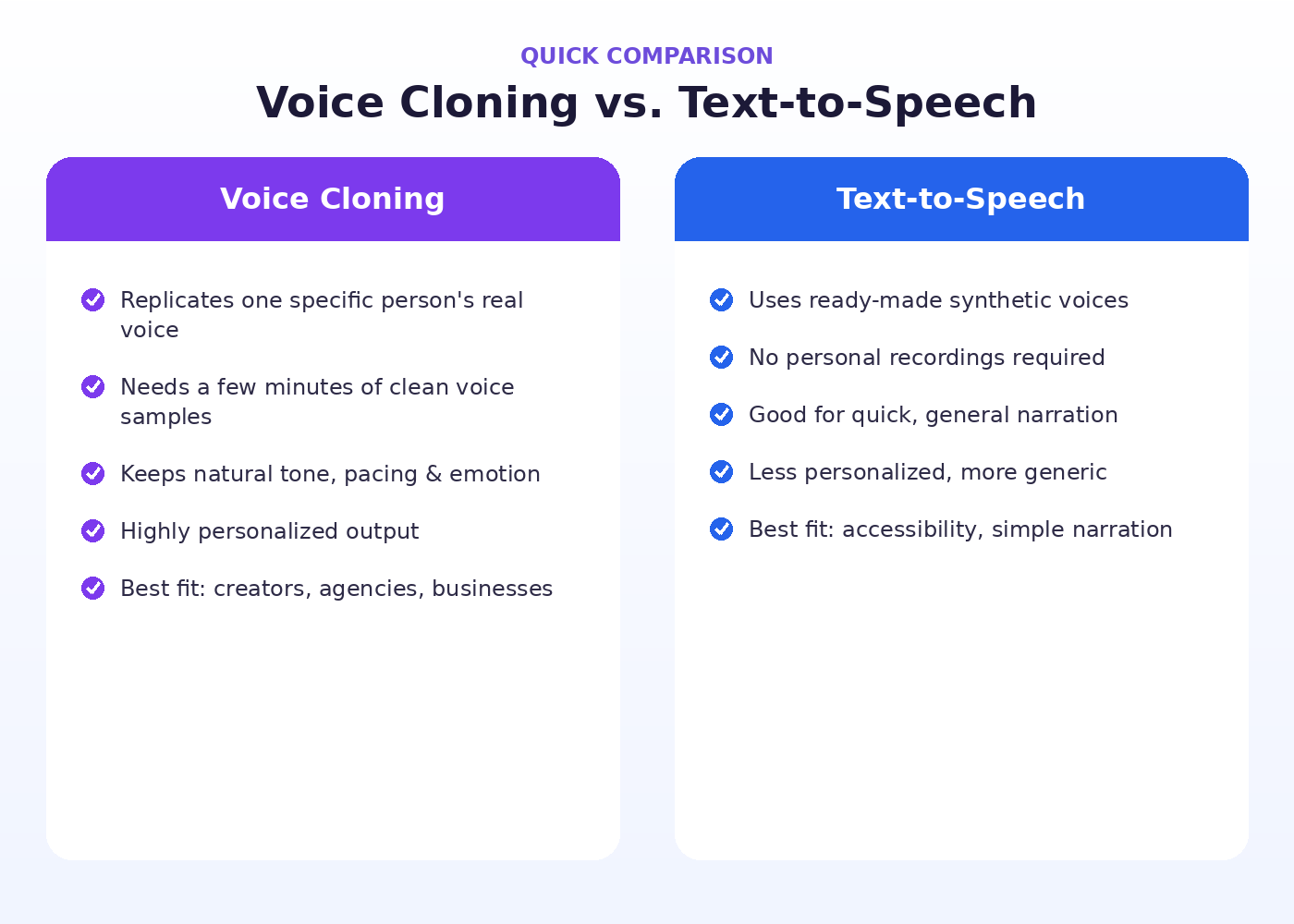
| Voice Cloning | Text-to-Speech |
| Replicates a specific person’s voice | Uses pre-built synthetic voices |
| Requires voice samples | No personal recordings required |
| Highly personalized | General-purpose narration |
| Best for creators and businesses | Best for accessibility and simple narration |
If your goal is to create content using your own voice, or a licensed custom voice, AI voice cloning is the better choice. Traditional text-to-speech remains useful for quick narration but offers far less personalization.
How AI Learns Your Voice
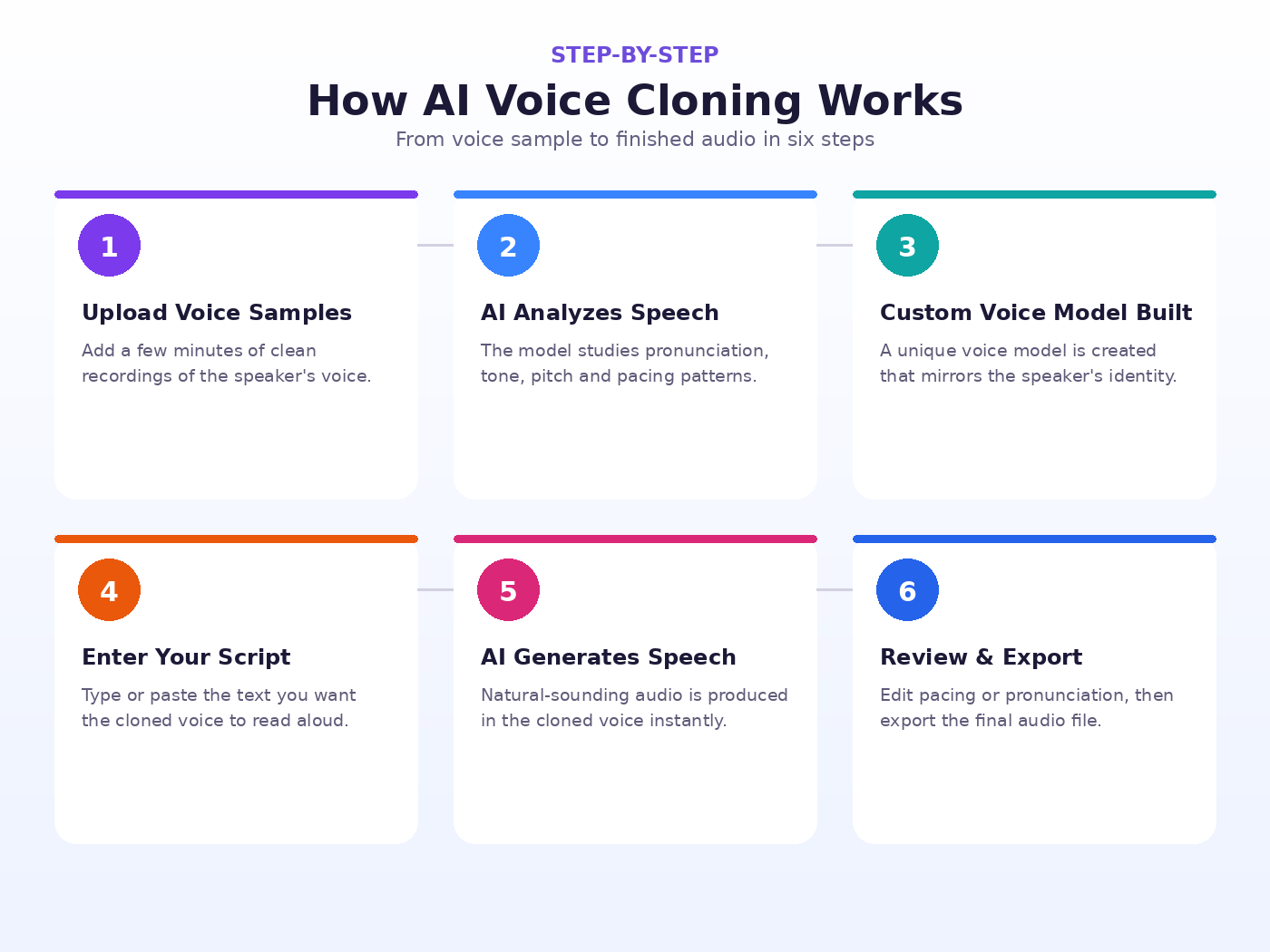
Most platforms follow a similar workflow:
- Upload clean voice recordings.
- The AI analyzes speech patterns, pronunciation, tone, and pacing.
- A custom voice model is created.
- Type or paste your script.
- The AI generates natural-sounding speech in your cloned voice.
- Review, edit, and export the final audio.
Many modern platforms can create convincing voice models using only a few minutes of clean audio, although providing more high-quality recordings generally improves realism and consistency. Creators who also need to convert recorded audio back into text can pair their workflow with a reliable speech to text AI tool for faster editing.
Why Today’s AI Voices Sound So Real
Recent advances in generative AI have dramatically improved voice quality.
Instead of producing flat, robotic speech, leading tools now understand punctuation, sentence structure, emphasis, and emotional context. They can naturally pause during conversations, adjust tone for different situations, and pronounce complex words far more accurately than earlier generations of speech synthesis software.
This is why AI-generated voices now appear in YouTube videos, podcasts, online courses, customer support systems, marketing campaigns, and enterprise training materials. If you’re comparing dedicated narration software before committing to one platform, this breakdown of the best AI voice-over software covers additional options worth testing.
Is AI Voice Cloning Safe?
The technology itself is neither good nor bad, its impact depends on how it’s used.
Responsible platforms require users to verify ownership or obtain permission before cloning someone’s voice. Many also include watermarking, security controls, and usage policies designed to discourage fraud or impersonation.
If you’re creating content for commercial purposes, always review the platform’s licensing terms and ensure you have clear consent before replicating another person’s voice.
How We Evaluated the Best AI Voice Cloning Tools
Every platform claims to offer the most realistic AI voices. Rather than relying on marketing promises, this guide compares each tool using the same practical criteria.
Voice Quality
The most important factor is realism. The best platforms produce speech with natural pacing, clear pronunciation, emotional variation, and very few artificial artifacts.
Ease of Use
A powerful platform shouldn’t require hours of training. We considered interface design, onboarding experience, editing workflow, and how quickly beginners can generate professional-quality voiceovers.
Languages and Accents
Global creators often need more than English. Tools supporting multiple languages, regional accents, and localized pronunciation received higher consideration because they provide greater flexibility for international audiences.
Editing Features
Generating speech is only part of the workflow. We also evaluated pronunciation editing, pauses, emphasis controls, voice customization, and script management features that help creators produce polished recordings with minimal manual editing.
Commercial Licensing
Not every AI-generated voice can legally be used for business. Commercial rights, ownership policies, and licensing transparency were considered because they directly affect YouTubers, agencies, businesses, and professional creators.
Pricing and Value
The cheapest platform isn’t always the best investment. Instead of comparing prices alone, we evaluated overall value based on voice quality, available features, scalability, and the capabilities included in each pricing tier.
Integrations and APIs
For businesses and developers, seamless integration matters. Platforms offering APIs, automation support, cloud workflows, and compatibility with popular creative tools scored higher for enterprise use cases.
Best AI Voice Cloning Tools in 2026
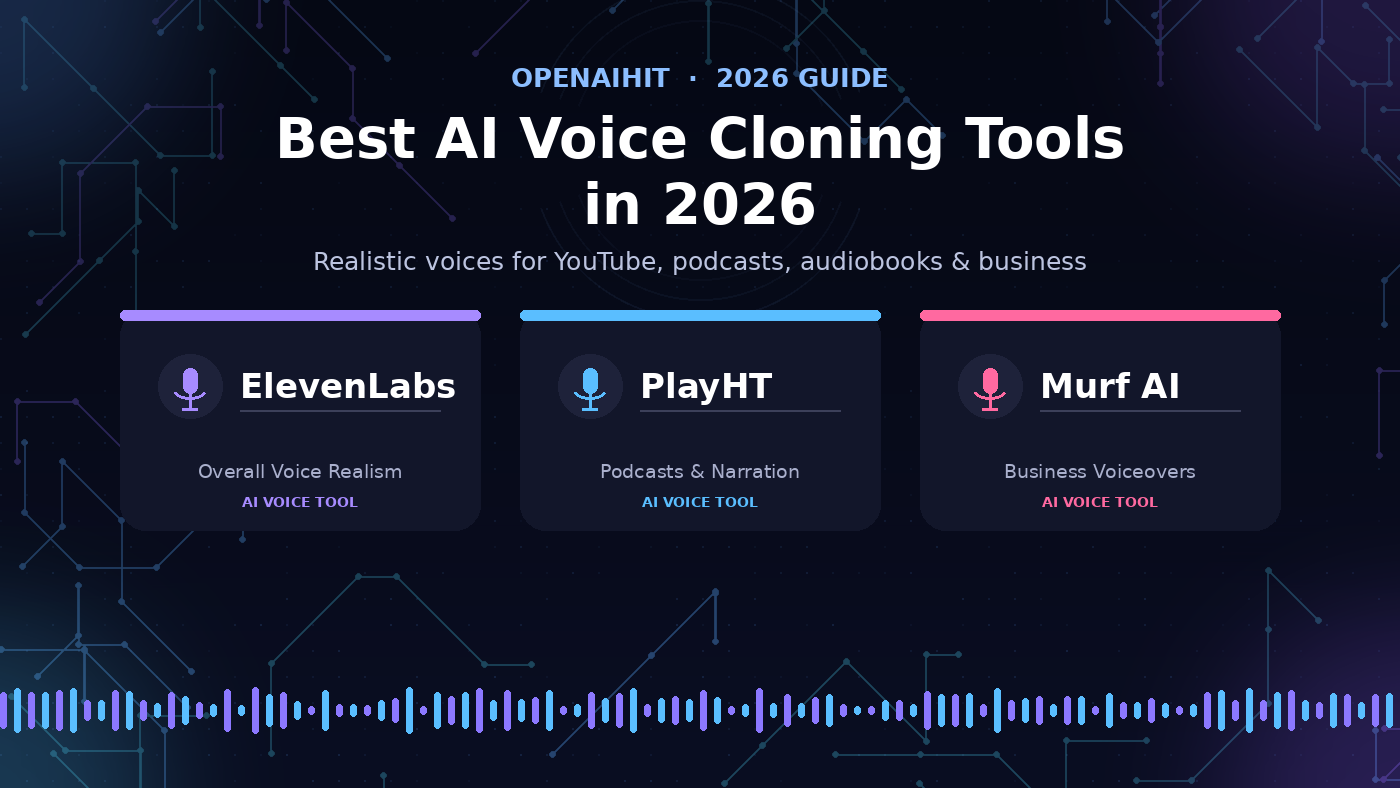
1. ElevenLabs
Best for: Overall voice quality and realism
If there’s one platform that consistently appears at the top of creator recommendations, it’s ElevenLabs. Its speech generation feels remarkably human, capturing subtle emotions, pauses, and natural conversational flow that many competitors still struggle to reproduce. Whether you’re producing YouTube videos, audiobooks, podcasts, or multilingual content, ElevenLabs delivers outstanding results with relatively little effort.
Key Features
- Highly realistic AI voice cloning
- Multilingual voice generation
- Emotional speech control
- Instant voice cloning
- Extensive voice library
- API access for developers
Pros
- Exceptional voice realism
- Fast voice generation
- Excellent multilingual support
- Beginner-friendly interface
- Strong developer ecosystem
Cons
- Premium plans can become expensive for heavy users.
- Some advanced features require higher-tier subscriptions.
Best For: Professional creators, publishers, agencies, and businesses that prioritize premium-quality voice generation.
2. PlayHT
Best for: Podcasts, narration, and long-form content
PlayHT has established itself as one of the strongest choices for users producing extended spoken content. Its realistic narration, broad language support, and extensive voice library make it particularly appealing for podcast producers, educators, and businesses creating multilingual audio experiences.
Key Features
- High-quality voice cloning
- Large voice catalog
- Real-time API
- Multilingual support
- Commercial licensing
Pros
- Excellent narration quality
- Strong enterprise features
- Reliable API integrations
- Wide language selection
Cons
- Interface has a slight learning curve.
- Premium features require paid plans.
Best For: Podcasters, audiobook creators, localization teams, and enterprise applications.
3. Murf AI
Best for: Business presentations and corporate content
Murf AI focuses less on entertainment and more on professional communication. Businesses frequently use it for training videos, internal presentations, product demonstrations, marketing campaigns, and e-learning content because it combines realistic narration with an intuitive editing environment.
Key Features
- AI voice cloning
- Professional voiceovers
- Presentation synchronization
- Team collaboration
- Brand-friendly commercial licensing
Pros
- Excellent for business workflows
- Easy script editing
- Professional-quality voices
- Collaborative workspace
Cons
- Smaller creator community than some competitors.
- Advanced customization is more limited than specialized voice cloning platforms.
Best For: Businesses, educators, corporate training teams, and marketing departments.
Which AI Voice Cloning Tool Is Best for You?
After comparing the leading platforms, one thing becomes clear: there isn’t a single AI voice cloning tool that’s perfect for everyone. The right choice depends on what you’re creating, how often you’ll use it, and whether you prioritize voice quality, editing features, affordability, or developer flexibility. Here’s a quick breakdown to help you decide.
Best for YouTubers
Recommendation: ElevenLabs
YouTube creators need voices that sound natural enough to keep viewers engaged throughout an entire video. ElevenLabs consistently delivers human-like speech with realistic pacing, emotional expression, and excellent pronunciation. It also makes updating scripts simple without re-recording voiceovers, saving creators hours every week. Once the voiceover is ready, most creators still need to polish the final cut, this guide to AI tools for video editing is a natural next step.
Best for Podcasters
Recommendation: PlayHT
Long-form narration requires consistency. PlayHT excels at producing smooth, natural speech that remains pleasant to listen to over extended recordings. Its multilingual support also makes it ideal for creators reaching international audiences. For episodes that need accurate written versions too, exploring a solid AI transcription software can save hours of manual work.
Best for Audiobooks
Recommendation: ElevenLabs
Audiobooks demand more than accurate pronunciation. Narration must maintain emotion, pacing, and consistency across thousands of words. ElevenLabs currently provides one of the strongest experiences for long-form storytelling.
Best for Businesses
Recommendation: Murf AI
Businesses often value collaboration, presentation tools, and commercial licensing more than experimental features. Murf AI combines professional voices with business-focused workflows, making it a strong option for product demonstrations, employee training, sales presentations, and marketing videos.
Best for Developers
Recommendation: Resemble AI
If you’re building applications rather than simply creating content, API access becomes essential. Resemble AI offers flexible developer tools, real-time voice generation, and enterprise integrations suitable for customer support systems, virtual assistants, and SaaS products.
Best Free AI Voice Cloning App
Recommendation: Speechify Studio
For beginners who want to experiment without committing to a paid subscription, Speechify offers one of the easiest starting points. While premium plans unlock more advanced capabilities, the free version provides enough functionality to understand how AI voice generation works before investing in a larger platform.
Legal & Ethical Considerations
AI voice cloning is an incredibly powerful technology. That power also comes with responsibility. Whether you’re creating YouTube videos, training materials, podcasts, or commercial advertisements, respecting privacy and intellectual property is just as important as producing realistic audio. For a closer look at how regulators are tackling this issue, the FTC’s official guidance on voice cloning risks explains the consumer protection steps being taken
Always Obtain Consent
Never clone another person’s voice without their explicit permission. Many leading AI platforms now require identity verification before allowing users to create custom voice models, helping reduce misuse and protect individuals from impersonation.
Understand Commercial Licensing
Not every generated voice can be used commercially. Before publishing content for clients, advertisements, or monetized channels, carefully review the licensing terms provided by your chosen platform.
Respect Copyright
Cloning a celebrity’s voice, or recreating copyrighted performances, may violate intellectual property rights depending on how the content is used. Always verify that your intended use complies with applicable laws and platform policies.
Protect Sensitive Data
If you’re uploading recordings that include confidential conversations or customer information, choose providers with strong privacy policies, secure storage, and enterprise-grade security practices.
Use AI Responsibly
Voice cloning should enhance creativity and accessibility, not enable misinformation or deception. Responsible creators are transparent when appropriate, obtain permission, and use AI in ways that build trust rather than undermine it.
How to Choose the Right AI Voice Cloning Tool
With dozens of platforms competing for attention, selecting the right one becomes much easier when you focus on your actual workflow instead of marketing claims.
1. Define Your Primary Use Case
Ask yourself:
- Creating YouTube videos?
- Recording podcasts?
- Producing audiobooks?
- Building software?
- Training employees?
- Marketing products?
Your answers immediately narrow the list of suitable platforms.
2. Prioritize Voice Quality
Realistic speech should always come before an extensive feature list. Listen to sample recordings instead of relying solely on screenshots or product descriptions.
3. Check Language Support
If your audience spans multiple countries, multilingual voice generation can save considerable time while improving localization.
4. Review Commercial Rights
Creators planning to monetize content should confirm commercial licensing before publishing AI-generated audio.
5. Compare Long-Term Costs
Monthly subscription prices tell only part of the story. Also consider character limits, API pricing, export restrictions, collaboration tools, and future scalability.
Practical Decision Framework
Use this simple checklist before choosing any AI voice cloning platform:
Does the voice sound genuinely human?
Is it easy to edit and regenerate recordings?
Does it support your preferred language and accent?
Are commercial rights clearly included?
Does the pricing fit your long-term workload?
If you answer “yes” to all five questions, you’ve likely found a platform that fits your needs.
The Future of AI Voice Cloning
AI voice cloning is improving at an extraordinary pace. Future platforms will generate speech in real time with even greater emotional accuracy, smoother multilingual conversations, and personalized digital assistants capable of maintaining consistent voices across multiple devices and applications.
We’re also likely to see stronger safeguards. Governments, technology companies, and AI developers are already introducing verification systems, watermarking technologies, and clearer regulations designed to encourage responsible innovation while reducing misuse.
For creators and businesses, that means AI voices will become even more useful, but also more carefully governed. The companies that combine realistic voice quality with transparency, privacy, and ethical AI practices are likely to lead the industry over the next several years.
Conclusion
Thinking back to that conversation with my friend, I realized his real question wasn’t if AI could clone a voice, but if the technology was ready to be trusted. In 2026, the answer is a definitive yes. However, the best tool depends entirely on your workflow. The platform that simplifies YouTube automation might not fit corporate training or app development.
At Openaihit, we believe the ultimate advantage doesn’t come from using the most popular tool, but from choosing the one that aligns with your specific production goals. Test the free versions, verify your commercial rights, and choose the platform that matches your workflow. The future of content creation is synthetic, harness it smartly and responsibly.
Frequently Asked Questions
1. What is the best AI voice cloning tool?
ElevenLabs is widely considered one of the best AI voice cloning tools thanks to its exceptional voice realism, multilingual support, and creator-friendly workflow. However, the best choice ultimately depends on your specific needs.
2. Is AI voice cloning legal?
Yes, AI voice cloning is generally legal when you have permission to clone the voice and comply with applicable copyright, privacy, and commercial licensing requirements.
3. Can I clone my own voice for free?
Several platforms offer free plans or limited trials that allow users to create and test AI voice models before upgrading to paid subscriptions.
4. How much audio is needed to clone a voice?
Most modern platforms can create a usable voice model from a few minutes of clean audio, although providing more high-quality recordings usually results in greater realism and consistency.
5. What’s the difference between voice cloning and text-to-speech?
Voice cloning recreates a specific person’s unique voice, while traditional text-to-speech generates speech using pre-built synthetic voices without replicating an individual’s vocal identity.