Gemini 3.5 Flash was one of the most important releases in that progression. Launched in May 2026, it was designed to combine advanced reasoning and coding with the speed associated with Google’s Flash models.
Gemini 3.5 is no longer Google’s newest Flash generation. Google has since introduced Gemini 3.6 and Gemini 3.7 Flash while Gemini 3.5 remains relevant for users and developers who want a capable multimodal model with a large context window and strong agentic performance.
So, is Gemini 3.5 Flash still worth using? For many coding, research, automation, multimodal, and everyday AI tasks, the answer is yes. However its value depends heavily on what you need from an AI model.
Gemini 3.5 Review: Quick Verdict
Gemini 3.5 review is a powerful, fast and highly capable AI model, particularly for coding, agentic workflows, multimodal analysis and tasks involving large amounts of context.
Its biggest strengths are speed, a 1million token context window, multimodal input, tool use and strong performance on complex multi-step workflows. Google says it was built specifically to deliver frontier level performance while maintaining Flash class speed.
The main drawback is that 3.5 Flash is no longer the newest option in Google’s lineup. Gemini 3.7 Flash is now positioned as Google’s more capable workhorse model for complex coding and agentic tasks.
Overall verdict: 8.5/10
It remains a strong choice, but new users should compare it with newer Gemini models before making it their primary AI model.
What Is Gemini 3.5 Flash?
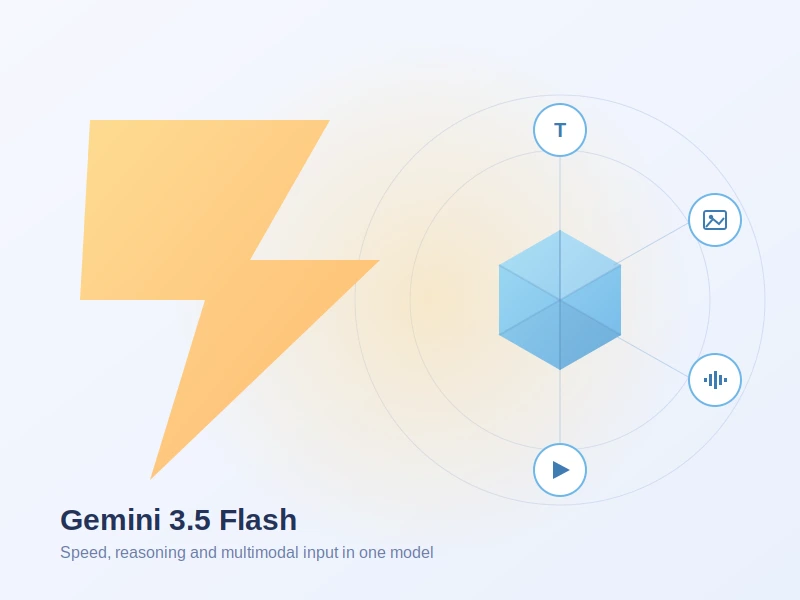
Gemini 3.5 Flash is a reasoning focused multimodal model from Google DeepMind. It is based on the Gemini 3 Flash reasoning foundation and supports configurable thinking levels that let developers balance response quality, latency and cost.
Google introduced the model on May 19, 2026, positioning it as a model capable of handling difficult agentic and coding tasks without sacrificing response speed. It became available through the Gemini app, Google Search’s AI Mode, Google AI Studio, the Gemini API, Android Studio and enterprise platforms.
Unlike a traditional text-only chatbot, Gemini 3.5 Flash is natively multimodal. It can work with text, images, audio, video, and documents, making it useful for tasks that require understanding information across different formats.
Key Takeaways
- Gemini 3.5 Flash launched in May 2026.
- It focuses heavily on speed, coding, reasoning, and agentic workflows.
- It supports a 1million token context window.
- It accepts text, images, audio, video and files.
- Google reports strong performance on coding and agentic benchmarks.
- API pricing is currently $1.50 per million input tokens and $9 per million output tokens.
- Its speed makes it particularly attractive for high volume workflows.
- It remains a strong model but newer Gemini generations are now available.
- Users should compare models using their own real world tasks rather than benchmark scores alone.
Gemini 3.5 Flash Features at a Glance
| Feature | Gemini 3.5 Flash |
| Release | May 19, 2026 |
| Context window | Up to 1 million tokens |
| Maximum output | Up to 65,536 tokens |
| Input | Text, image, audio, video, files |
| Reasoning | Configurable thinking |
| Tool use | Function calling, search, computer use |
| Primary strengths | Coding, agents, multimodal tasks |
| Standard API input price | $1.50 per 1M tokens |
| Standard API output price | $9 per 1M tokens |
Google’s developer documentation confirms the 1million token context window, 65K maximum output, thinking capabilities and support for the same major tool ecosystem available to the model family.
How Good Is Gemini 3.5 Flash?
The most interesting thing about Gemini 3.5 Flash is that Google did not position it simply as a cheaper model.
Instead, Google focused on agentic execution, coding, long-horizon tasks, and multimodal reasoning.
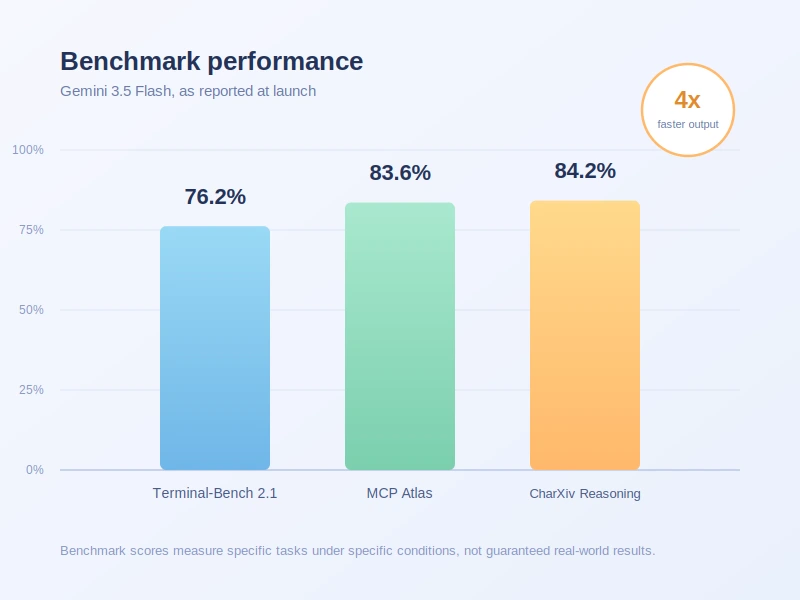
According to Google’s launch results, Gemini 3.5 Flash achieved a 76.2% score on Terminal-Bench 2.1, 83.6% on MCP Atlas and 84.2% on CharXiv Reasoning. Google also reported that the model could produce output at roughly four times the speed of other frontier models in its comparison.
These benchmarks are useful, but they should not be treated as a guarantee of real-world performance.
Benchmark results measure specific tasks under specific testing conditions. An AI model that performs exceptionally well on coding agents may not necessarily produce the best marketing copy, reasoning explanation, or factual answer every time.
That is why the better way to evaluate Gemini 3.5 is by looking at practical workloads.
Gemini 3.5 Flash for Coding
Coding is one of the areas where Gemini 3.5 Flash makes the strongest case for itself.
The model was specifically designed for iterative coding workflows. Instead of simply generating a short code snippet, it can help with a longer process involving planning, implementation, testing, debugging, and revision.
This is especially useful when working with AI agents.
A developer could ask Gemini 3.5 Flash to:
- Analyze an existing codebase
- Identify a bug
- Propose a solution
- Modify multiple files
- Run or reason through tests
- Review the resulting implementation
- Suggest further improvements
Google describes these kinds of multi-step workflows as a core use case for the model.
Multimodal Performance
Gemini’s multimodal capabilities are another area where the model stands out. Gemini 3.5 Flash can accept text, images, audio, video, and files. That opens up use cases beyond conventional chatbot conversations.
For instance, you could use it to analyze:
- Screenshots
- Charts
- PDFs
- Presentations
- Recorded conversations
- Images containing text
- Video content
- Technical documentation
This makes Gemini 3.5 particularly useful for people whose work is not limited to plain text.
A content marketer could analyze a PDF report and extract statistics. A developer could inspect screenshots of an interface. A student could summarize lecture material. A business user could work through spreadsheets and supporting documents.
Gemini 3.5 Flash Speed
Speed is arguably the defining characteristic of Gemini 3.5 Flash.
Google designed the model to deliver strong intelligence without the latency traditionally associated with larger reasoning systems. Google reported that Gemini 3.5 Flash could generate output around four times faster than the frontier models used in its comparison.
Independent hands-on reviews also frequently identified speed as one of the model’s most noticeable advantages. For example, Analytics Vidhya’s testing emphasized how quickly responses began across its experiments.
For everyday users, faster responses may not seem revolutionary when asking simple questions.
Gemini 3.5 Flash Pricing
For developers using Google’s API, Gemini 3.5 Flash is currently listed at $1.50 per million input tokens and $9 per million output tokens on the standard paid tier. Google also lists cached input at $0.15 per million tokens.
There is also a free tier for eligible API use, although availability and limits depend on Google’s current policies.
| Pricing component | Gemini 3.5 Flash |
| Input | $1.50 / 1M tokens |
| Output | $9.00 / 1M tokens |
| Cached input | $0.15 / 1M tokens |
| Batch input | $0.75 / 1M tokens |
| Batch output | $4.50 / 1M tokens |
So developers should not judge the model’s cost solely by its input price.
Gemini 3.5 Flash vs ChatGPT
The comparison with ChatGPT is unavoidable because users frequently consider both when choosing an AI assistant.
Gemini 3.5 Flash has a strong advantage when the workflow benefits from Google’s multimodal ecosystem, very large context, Google Search grounding, and agentic capabilities.
ChatGPT, meanwhile, may be preferable for users who prioritize a broader conversational ecosystem, specific OpenAI tools, or workflows built around OpenAI’s models.
The right choice therefore depends less on which model has the highest benchmark score and more on the environment surrounding it.
For someone already working heavily with Google services, Gemini can be particularly convenient.
This is also where an independent AI-focused brand such as openaihit can add value by comparing AI products according to actual use cases instead of treating benchmark rankings as the entire story.
Gemini 3.5 Flash vs Claude
Claude is another major competitor, particularly for writing, reasoning, coding, and professional knowledge work.
Gemini 3.5 Flash’s strongest differentiator is its combination of speed, multimodality, long context, and agentic functionality.
Claude may be more attractive for users who particularly value its writing style or reasoning workflow.
There is no universal winner.
A developer building an agent-heavy workflow may prefer Gemini. A writer may prefer Claude’s response style. A Google Workspace user may benefit from Gemini’s ecosystem integration.
The smartest approach is to test both using the same five or ten real tasks you perform regularly.
Pros and Cons of Gemini 3.5 Flash
Pros
- Very fast response generation
- 1million token context window
- Strong coding capabilities
- Excellent fit for agentic workflows
- Native multimodal input
- Supports tool use
- Useful for large documents
- Configurable thinking levels
- Available through Google’s developer ecosystem
Cons
- It is no longer Google’s newest Flash model
- Output token costs can add up for reasoning-heavy applications
- Benchmark performance does not guarantee consistent real-world results
- Complex AI outputs still require human verification
- Some advanced features depend on the specific Google product or API environment
Who Should Use Gemini 3.5 Flash?
Gemini 3.5 Flash makes the most sense for users who need speed plus capability.
It is particularly well suited to:
Developers
Developers can use it for coding assistance, debugging, prototyping, tool calling, and multi-step agent workflows.
Researchers
Its large context window and multimodal capabilities make it useful for analyzing large quantities of source material.
Businesses
Companies can use the model for document processing, automation, classification, data extraction, and internal AI agents.
Content Creators
Writers and marketers can use Gemini for research, outlining, content analysis, summarization, and multimedia understanding.
Everyday AI Users
People who simply want a fast general purpose assistant can also benefit from it, especially if they already use Google’s ecosystem.
Final Verdict
Gemini 3.5 Flash is fast, capable, multimodal, and unusually well suited to agentic workflows. Its 1million token context window and strong coding performance make it much more than a basic lightweight chatbot.
Its biggest weakness in 2026 is not necessarily poor performance. It is competition from newer Gemini models.
For developers, businesses, researchers, and advanced AI users who need speed and large context processing, Gemini 3.5 Flash remains a worthwhile tool. For someone choosing Google’s newest model today, however, the newer Gemini generations should be evaluated first.
The bigger lesson is simple: don’t choose an AI model because its version number sounds impressive. Choose the model that performs best on the work you actually need to accomplish.
FAQs About Gemini 3.5
Is Gemini 3.5 free?
Gemini 3.5 Flash has had free access options, including a free API tier subject to Google’s usage limits and availability. Paid API usage is billed according to Google’s token based pricing.
Is Gemini 3.5 better than ChatGPT?
There is no universal winner. Gemini 3.5 Flash is especially strong for multimodal workloads, large contexts, Google ecosystem integration, and agentic tasks. ChatGPT may be preferable depending on the model, tools and workflow you use.
Is Gemini 3.5 good for coding?
Yes. Coding and agentic software development are among Gemini 3.5 Flash’s primary strengths. Google specifically highlights coding, iterative development, and long horizon agentic tasks as important use cases.
Does Gemini 3.5 have a large context window?
Yes. Gemini 3.5 Flash supports a context window of up to 1 million tokens.
Is Gemini 3.5 still the latest Gemini model?
No. Google has since introduced newer Gemini models, including Gemini 3.7 Flash. Google’s current lineup describes 3.7 Flash as its most capable Flash workhorse for complex agentic tasks.
Should I use Gemini 3.5 Flash or a newer Gemini model?
If you are choosing a model today, compare Gemini 3.5 Flash with Google’s newer options based on your workload, pricing, latency, and required capabilities. For demanding coding and agentic tasks, the newer Gemini 3.7 Flash deserves particular attention.