A few years ago, creating a professional voiceover meant finding a voice actor, booking recording time, fixing pronunciation issues, and spending hours editing audio. Many creators had great ideas for videos, courses, and marketing campaigns, but the cost and complexity of professional narration slowed everything down.
Today, that process looks completely different. With AI voiceover tools 2026, you can turn written scripts into natural-sounding audio within minutes, without needing expensive equipment or a recording studio.
But choosing the right tool is not simple anymore because every platform focuses on different strengths: some prioritize emotional realism, some focus on speed, and others are built for enterprise applications.
In this guide, you will learn how modern AI voiceover software works, which platforms stand out in 2026, what features actually matter, where these tools still struggle, and how you can choose the right solution for YouTube, business content, education, or professional production.
AI Overview
AI voiceover tools in 2026 use advanced generative AI models to convert written text into realistic human-like speech. Modern platforms can reproduce emotions, natural pauses, different accents, and even cloned voices from short audio samples.
The market has divided into two major categories: studio-quality voice generation for content creation and ultra-fast real-time voice systems for interactive applications.
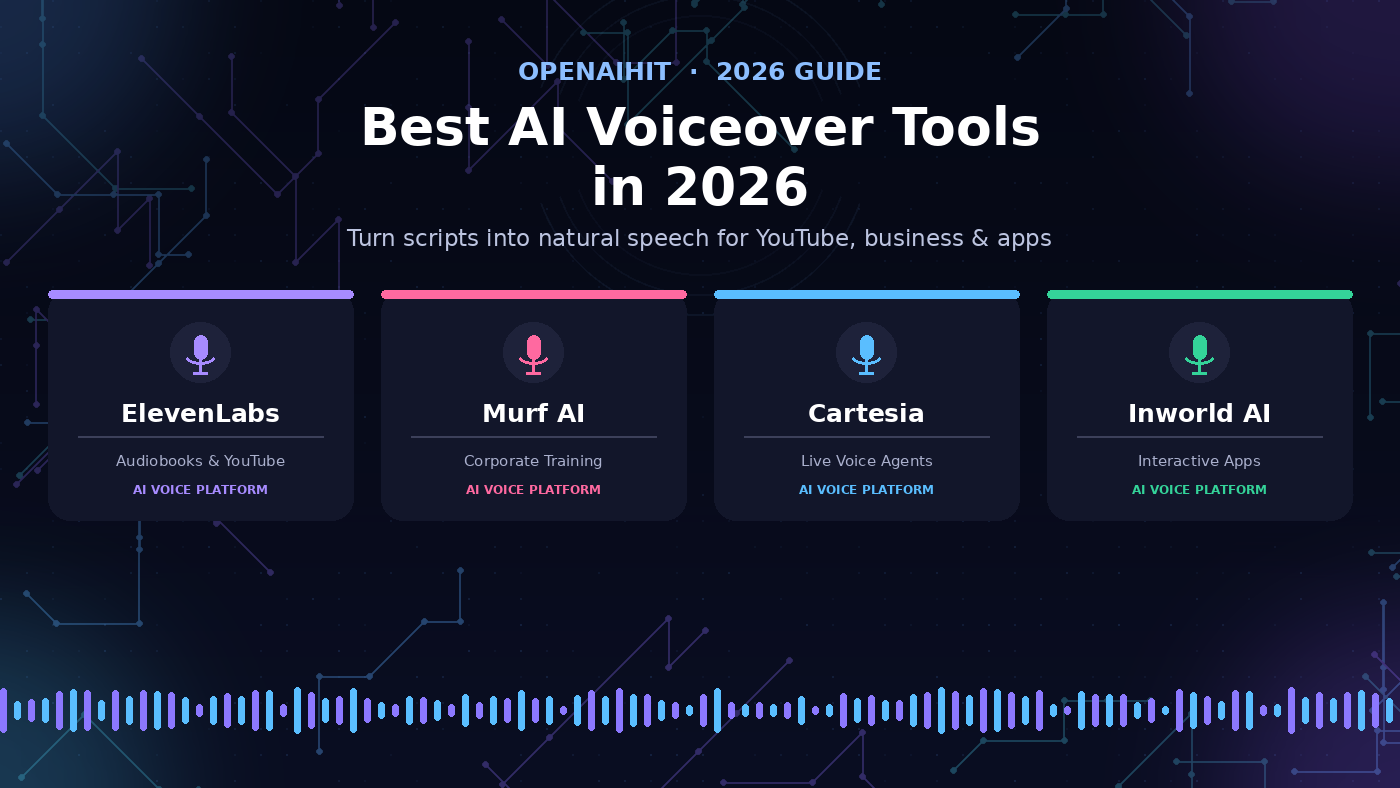
Tools such as ElevenLabs, Murf AI, Cartesia, and Inworld AI are leading different areas of the industry, from long-form narration to conversational voice agents.
Key Takeaways
- The global text-to-speech market reached approximately $5.7 billion in 2026 and is projected to grow to $35.3 billion by 2035, according to Global Market Insights.
- Modern AI voice generators can create realistic speech with emotional control, natural pauses, and multilingual capabilities.
- ElevenLabs remains one of the strongest options for realistic long-form voice production, while Cartesia focuses on ultra-low-latency real-time conversations.
- Zero-shot voice cloning allows some platforms to recreate a voice using audio samples as short as 5 to 15 seconds.
- AI voiceover software is increasingly used for YouTube videos, audiobooks, e-learning, advertisements, customer support, and global localization.
- Generative AI voice systems have improved pronunciation accuracy significantly, with ElevenLabs reporting a reduction in complex pronunciation errors from 15.3% to 4.9%.
- Choosing the right tool depends on your goal: content production, real-time interaction, enterprise automation, or multilingual publishing.
What are the best AI voiceover tools in 2026?
The best AI voiceover tools in 2026 depend on your specific needs. ElevenLabs is considered one of the strongest choices for realistic voices, emotional control, and multilingual content. Murf AI is popular for presentations and business videos, while Cartesia and Inworld AI focus on fast real-time voice applications with extremely low latency. For a deeper look at narration-focused platforms specifically, this dedicated voice-over software roundup breaks down more options worth testing.
What Are AI Voiceover Tools 2026 and How Do They Work?
AI voiceover tools are software platforms that use artificial intelligence to transform written text into realistic spoken audio. Unlike older text-to-speech systems that sounded robotic, modern systems analyze language context, emotion, pronunciation, and speaking patterns before generating the final voice output.
These platforms are built on generative speech models trained on large collections of human audio data. They can understand sentence meaning, adjust tone, create natural pauses, and produce voices that sound much closer to professional human recordings.
The technology has moved far beyond traditional text-to-speech software. Early speech systems used concatenative TTS, where companies recorded thousands of small speech fragments from human speakers and stitched them together. The result worked, but the output often sounded unnatural and mechanical.
Later, parametric synthesis improved flexibility by using mathematical models to generate speech patterns. However, voices still lacked the emotional quality and natural rhythm people expect from human communication. The major breakthrough came with neural TTS, powered by deep learning models such as Google’s WaveNet architecture. These systems learned how humans speak by analyzing massive audio datasets.
By 2026, generative AI voice models will have reached another level. Some platforms now support zero-shot voice cloning, allowing users to recreate a vocal identity from a short sample while maintaining characteristics such as pitch, accent, and speaking style.
How Does AI Voice Generation Technology Work?
Modern AI voice generation follows several technical stages before you hear the final audio.
Text Understanding and Context Analysis
The first step happens when the AI analyzes your script.
The system does not simply read individual words. It studies context to understand pronunciation, meaning, and sentence structure.
For example, the word “read” has different pronunciations depending on whether you say “I read books every day” or “I read a book yesterday.”
Advanced AI voice systems identify these differences before creating audio.
Linguistic and Emotional Modeling
After understanding the text, the system creates a speech plan.
It determines:
- Where natural pauses should happen
- Which words require emphasis
- How the sentence should rise or fall
- What emotional style matches the script
Newer systems use features such as audio tags, where creators can add instructions like [whispers], [sighs], or [excited] to control delivery. ElevenLabs introduced these emotional controls with its Eleven v3 model, helping creators produce more expressive narration.
Acoustic Processing and Voice Creation
The AI then converts language information into acoustic patterns. Instead of selecting pre-recorded sounds, generative models create speech using complex mathematical representations of human vocal characteristics.
These systems can adjust:
- Voice tone
- Pitch
- Speaking speed
- Accent
- Emotional intensity
The final stage uses neural vocoders that transform these acoustic patterns into actual sound waves. The result is a voice file that can be exported as professional-quality audio.
Why Are AI Voiceover Tools Becoming Popular in 2026?
The biggest reason behind their growth is simple: they remove many traditional barriers to creating audio content. A creator no longer needs a microphone, studio setup, voice actor, and editing team for every project. A marketing team can update a product video by changing the script and generating new narration within minutes. An education company can convert hundreds of written lessons into audio courses without recording every chapter manually.
The market growth reflects this shift. According to Global Market Insights, the global text-to-speech market is valued at $5.7 billion in 2026, increasing from $4.8 billion in 2025. The same report projects the industry could reach $35.3 billion by 2035, growing at a compound annual growth rate of 22.4%. These figures come from a detailed market analysis by Global Market Insights, which tracks the industry’s growth trajectory through 2035.
AI Voiceover Tools 2026 Market: Two Major Categories
The industry is now divided into two main areas.
Studio-Quality AI Voice Generation
These tools focus on creating polished audio for:
- YouTube videos
- Audiobooks
- Advertisements
- Training content
- Video localization
Platforms like ElevenLabs and Murf AI compete in this category. Their priority is not just speed. They focus on emotional expression, editing control, and professional sound quality.
Real-Time AI Voice Systems
The second category focuses on instant conversations.
These systems power:
- AI customer support agents
- Voice assistants
- Interactive applications
- Gaming characters
- Real-time translation
Cartesia Sonic and Inworld AI are examples of companies focusing on this area. Cartesia’s Sonic architecture achieved sub-90ms latency, making it suitable for applications where even small delays affect the user experience.
Best AI Voiceover Tools 2026 Compared
Choosing the best platform depends less on popularity and more on how you plan to use it. Some tools excel at long-form narration, while others are designed for live conversations, multilingual localization, or enterprise infrastructure.
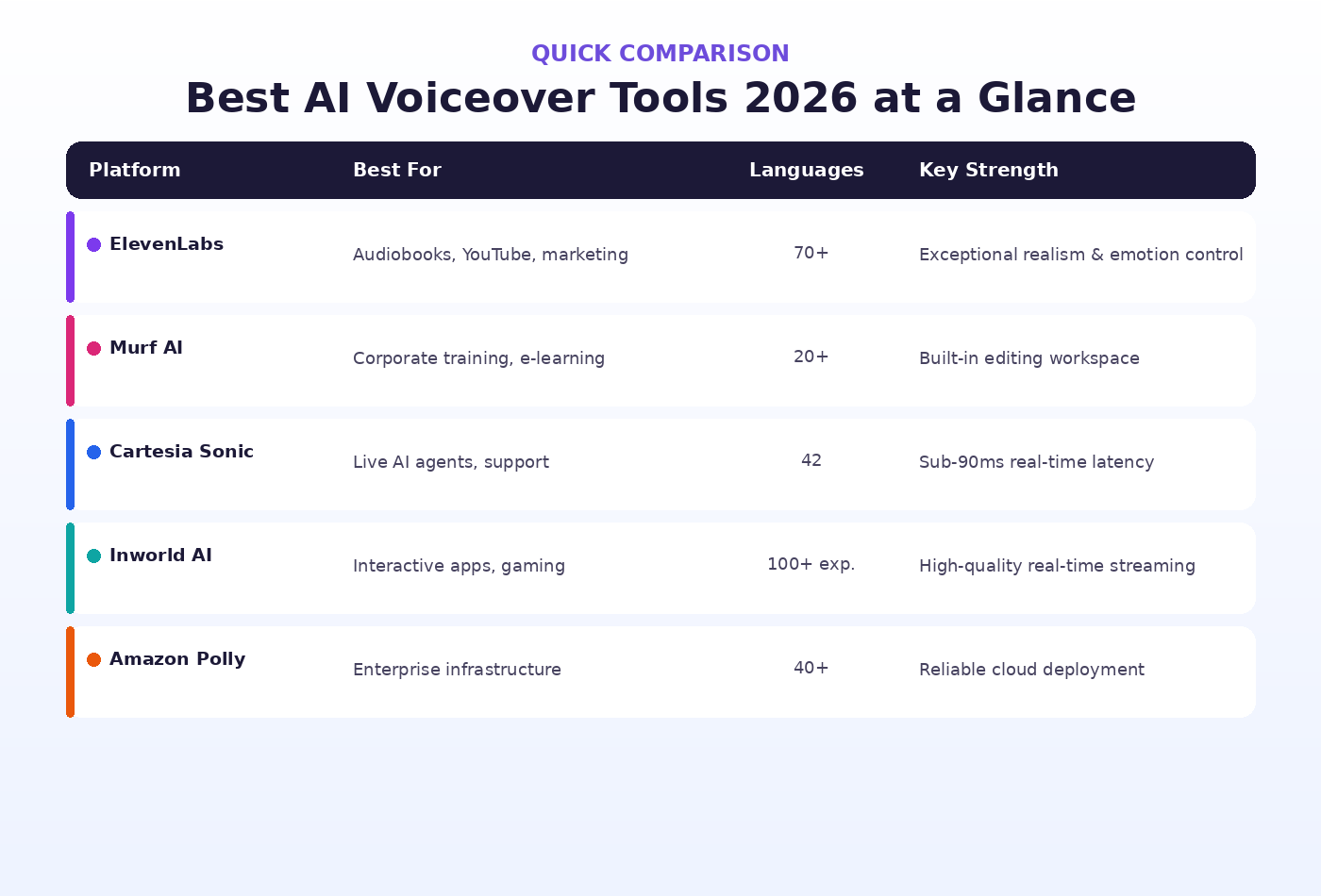
The comparison below highlights the strengths and trade-offs of the leading AI voiceover platforms in 2026.
| Platform | Best For | Languages | Key Strength | Main Limitation |
| ElevenLabs | Audiobooks, YouTube, podcasts, marketing | 70+ | Exceptional realism and emotional control | Premium pricing increases with heavy usage |
| Murf AI | Corporate training, presentations, e-learning | 20+ | Built-in editing workspace and templates | Less granular emotional control |
| Cartesia Sonic | Live AI agents and customer support | 42 | Sub-90ms latency for conversations | Not designed for advanced video editing |
| Inworld AI | Interactive applications and gaming | 100+ experimental languages | High-quality real-time streaming | Smaller commercial ecosystem |
| Amazon Polly | Enterprise infrastructure | 40+ | Reliable cloud deployment | Less expressive than generative AI platforms |
ElevenLabs: The Premium Choice for Realistic AI Voiceovers
ElevenLabs continues to set the benchmark for realistic AI narration in 2026.
Its Eleven v3 model introduced native Audio Tags, allowing creators to insert instructions such as [whispers], [laughs], or [excited] directly into a script. Instead of editing audio afterward, you guide the voice while writing.
The platform also reduced complex pronunciation errors by 68%, lowering error rates from 15.3% to 4.9%, according to ElevenLabs research.
Who Should Use ElevenLabs?
- YouTube creators
- Audiobook publishers
- Marketing agencies
- Podcast producers
- Professional narrators
- Businesses producing multilingual content
If you’re searching for ai voiceover software for YouTube, ElevenLabs is one of the strongest options because it combines natural speech with excellent language support.
Who Should Avoid ElevenLabs?
It may not be the best fit if your priority is handling thousands of real-time conversations where response speed matters more than cinematic voice quality.
Murf AI: Built for Business and E-Learning
Murf AI approaches voice generation differently. Rather than focusing only on voice realism, it provides a complete production workspace where teams can synchronize narration with presentations, training videos, and educational content.
This makes it attractive for organizations producing large volumes of internal learning material. Large retailers already use Murf AI to convert lengthy operating procedures into localized training videos, reducing production time from weeks to hours.
Who Should Use Murf AI?
- HR departments
- Learning and development teams
- Course creators
- Corporate trainers
- Marketing departments
Who Should Avoid Murf AI?
Creators seeking fine-grained emotional storytelling or advanced voice acting may find other platforms more flexible.
Cartesia Sonic: Speed Above Everything Else
Cartesia has become one of the most discussed names in AI voice technology. Instead of relying solely on transformer models, Cartesia uses State Space Models (SSMs), enabling extremely fast voice generation with latency below 90 milliseconds.
That speed is essential for conversational AI. When people interact with voice assistants, delays longer than a fraction of a second quickly become noticeable.
Who Should Use Cartesia?
- Customer service platforms
- AI phone assistants
- Live translation systems
- Interactive applications
- Developers building voice agents
Who Should Avoid Cartesia?
If your work centers on audiobook narration, documentary production, or long-form storytelling, you’ll likely benefit more from platforms designed for studio-quality rendering.
Inworld AI: Designed for Interactive Experiences
Inworld AI originally gained attention through AI-powered game characters.
Its focus has expanded into enterprise voice infrastructure, where responsive conversations matter more than polished studio narration.
According to the research report, Inworld’s Realtime TTS-2 achieved the highest ranking on the Artificial Analysis Realtime TTS Arena leaderboard with an Elo rating of approximately 1,208.
The platform also supports cross-lingual identity preservation, allowing a cloned voice to maintain its character across multiple languages.
Who Should Use Inworld AI?
- Game developers
- Virtual assistants
- Interactive education platforms
- AI application developers
Who Should Avoid Inworld AI?
Organizations primarily producing prerecorded marketing videos may not benefit from its real-time strengths.
Amazon Polly, Google Cloud TTS, and Microsoft Azure Speech
These platforms remain important despite newer competitors entering the market. Their biggest advantages include reliability, enterprise security, and mature cloud infrastructure. Many global organizations continue using these services because they integrate easily into existing software ecosystems and offer dependable uptime.
Although modern versions have become more natural, they generally sound more functional than emotionally expressive compared with the latest generative AI voice models.
AI Text-to-Speech Generator Free vs Paid Software
Many people begin by searching for an AI text-to-speech generator free before considering paid plans. Free versions are useful for learning the technology, testing different voices, or creating small personal projects.
However, they often include restrictions such as:
- Limited monthly characters
- Smaller voice libraries
- Lower audio quality
- Few customization options
- Limited commercial licensing
Paid plans remove many of these limits and typically offer better emotional control, higher-quality exports, API access, and commercial usage rights. If your work generates revenue, upgrading usually becomes worthwhile long before technical limitations become the main issue.
Can You Find a Realistic AI Voice Generator Free?
Yes, but expectations should remain realistic.
A realistic ai voice generator free can produce surprisingly natural speech for simple projects, especially when using trial versions from leading providers.
Professional productions, however, often require premium features such as:
- Voice cloning
- Commercial licensing
- Higher bitrate exports
- Longer projects
- Better pronunciation controls
- Advanced emotional direction
Free plans work well for experimentation. Professional content usually benefits from paid subscriptions.
AI Voiceover Software for YouTube: What Creators Should Look For
Not every voice generator fits YouTube production. Content creators typically need software that balances realism, speed, and editing flexibility.
When evaluating AI voiceover software for YouTube, prioritize these features:
- Natural human pacing
- Emotional expression
- Accurate pronunciation
- Background noise-free output
- Multiple accents
- Commercial usage rights
- Fast regeneration after script edits
- Integration with video editing workflows
The ability to revise one sentence instead of rerecording an entire project saves significant production time. Creators publishing long-form videos also benefit from pairing narration with a reliable AI transcription software for accurate captions.
Best AI Voice Generator Online: Features That Matter Most
If you’re comparing the best ai voice generator online, avoid focusing only on the number of available voices. Instead, evaluate the features that affect everyday use.
Voice Quality
Natural breathing, pacing, and emotional variation separate excellent tools from average ones.
Pronunciation Accuracy
Technical terms, currencies, formulas, abbreviations, and names should be spoken correctly without manual corrections.
Language Support
The strongest platforms now support dozens of languages while maintaining consistent voice identity across translations.
Voice Cloning
Modern zero-shot cloning can reproduce a speaker using only a short recording. Professional-grade cloning typically benefits from longer, high-quality recordings for maximum consistency.
Editing Controls
Advanced tools allow you to adjust pauses, emphasis, pronunciation, and emotional delivery directly within the script instead of editing audio afterward. These controls become increasingly valuable as projects grow longer and more complex.
Real-World Examples of AI Voiceover Tools in Action
The best way to judge AI voice technology is to see how organizations use it in real production environments. The following examples come directly from the research data and show how different platforms solve different business problems.
Talkpal AI Improved Localization
Language-learning platform Talkpal migrated its speech systems to modern real-time TTS APIs. The company reduced infrastructure costs by 40%, while increasing user engagement by 7% and improving retention by 4% within one month. These results demonstrate how high-quality voice generation can improve both efficiency and user experience.
Bible Chat Reduced Audio Costs
Bible Chat integrated low-latency streaming voices to narrate long passages and answer user questions. According to the research, this change reduced ongoing audio infrastructure costs by more than 90% compared to legacy voice providers.
Deliveroo Enhanced Customer Support
Deliveroo adopted custom AI voices powered by ElevenLabs for communication with delivery partners and restaurants. The system helped automate delivery updates while maintaining more natural conversations during busy periods.
Poe Added Real-Time Conversations
Quora’s Poe platform integrated Cartesia’s Sonic models to enable voice conversations with AI assistants. The platform benefited from low-latency responses that made interactions feel more natural for millions of users.
Corporate E-Learning at Scale
Large retail companies use Murf AI to convert lengthy operating procedures into multilingual training videos. Instead of spending weeks recording content, training teams can update scripts and regenerate professional narration within hours.
Benefits of AI Voiceover Tools 2026
Modern AI voice platforms provide much more than convenience. They solve practical production problems for creators, businesses, educators, and developers.
Lower Production Costs
Traditional voice production often requires hiring voice talent, renting recording studios, and paying editors. AI voice software reduces these expenses by generating professional narration through subscription-based services.
Faster Content Updates
Businesses frequently revise products, pricing, or company policies. Instead of scheduling another recording session, teams simply edit the script and generate updated narration within minutes.
Multilingual Publishing
One voice can now speak dozens of languages while maintaining the same vocal identity. This makes international marketing and educational localization far more practical than traditional recording methods.
Better Accessibility
Educational institutions and businesses increasingly use AI narration to make written content more accessible for people with visual impairments, dyslexia, and other learning preferences. Educators converting written lessons into audio can also explore these AI tools for teachers to streamline classroom content.
Limitations You Should Know Before Choosing an AI Voice Tool
Despite rapid progress, no platform is perfect. Understanding current limitations helps you choose realistic expectations.
Long-Form Emotional Consistency
Short advertisements usually sound excellent. Long audiobooks lasting several hours may still reveal occasional monotone delivery or emotional inconsistency during complex storytelling.
Voice Cloning Risks
Zero-shot cloning is powerful, but it also introduces security concerns. Fraudsters have used cloned executive voices in social engineering attacks, making responsible verification and platform safeguards increasingly important.
Language Quality Still Varies
English, Spanish, Mandarin, and French generally receive the best support because of extensive training data. Lower-resource languages and regional dialects may still sound less natural.
Legal and Copyright Considerations
Commercial use depends on licensing terms and ownership of the voice being cloned. Leading providers now emphasize compliance, identity verification, and stronger privacy protections as regulations continue to evolve.
Common Mistakes to Avoid
Many creators focus only on voice quality and overlook other important factors. Avoid these common mistakes when selecting an AI voice platform.
- Choosing a tool based only on price.
- Ignoring commercial licensing requirements.
- Using cloned voices without proper authorization.
- Selecting a real-time engine for audiobook production.
- Selecting a studio-focused platform for live customer support.
- Skipping pronunciation testing before publishing.
- Forgetting to review multilingual output manually.
Practical Framework for Choosing the Right Tool
Instead of asking, “Which tool is best?”
Ask, “Which tool matches my workflow?”
| If Your Goal Is… | Best Choice |
| YouTube videos | ElevenLabs |
| Audiobooks | ElevenLabs |
| Corporate training | Murf AI |
| Live customer support | Cartesia Sonic |
| AI assistants | Inworld AI |
| Enterprise infrastructure | Amazon Polly, Microsoft Azure Speech, Google Cloud TTS |
This simple approach prevents choosing software that excels in the wrong area.
Practical Application:
How to Start Using AI Voiceover Tools
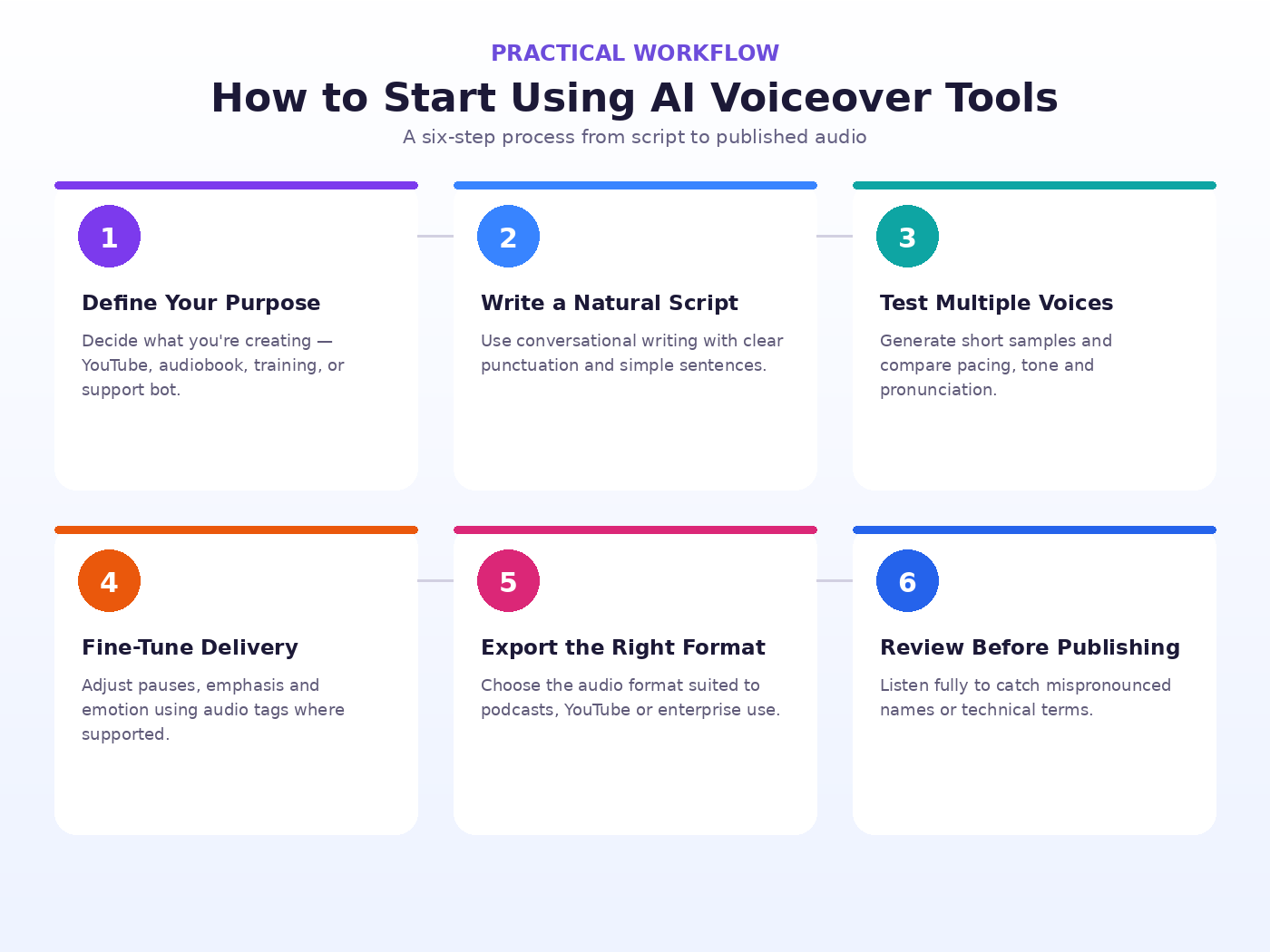
Many articles compare features but stop before explaining how to apply them. Here’s a practical workflow you can follow.
Step 1: Define Your Purpose
Decide what you’re creating before selecting a platform. A YouTube channel, audiobook, training course, and customer support bot all have different requirements. If you’re mapping voiceover needs across an entire content calendar, these AI tools for content planning help keep scripts organized.
Step 2: Write a Natural Script
AI voices perform better with conversational writing. Use punctuation naturally, keep sentences clear, and avoid overly complex structures.
Step 3: Test Multiple Voices
Generate short samples using different voices. Listen for pacing, pronunciation, and emotional delivery rather than choosing the first acceptable result.
Step 4: Fine-Tune Delivery
Adjust pauses, emphasis, and pronunciation where supported. Features like Audio Tags can dramatically improve the final output for storytelling and presentations.
Step 5: Export in the Right Format
Choose high-quality audio formats suitable for your project. Podcast production, YouTube videos, and enterprise systems may require different export settings.
Step 6: Review Before Publishing
Always listen to the complete recording. Even advanced AI occasionally mispronounces names, technical terms, or abbreviations. A final review saves time and protects your credibility.
Future Trends Shaping AI Voice Technology
The pace of innovation remains extremely fast. Several developments are already defining the next generation of voice AI.
Native Multimodal Models
Future systems will process audio directly instead of passing information between separate text and speech models. This enables more natural emotional understanding and conversational responses.
Faster Real-Time Performance
State Space Models continue improving processing efficiency. Research suggests future systems may reduce latency even further, making conversations feel almost indistinguishable from speaking with another person.
Better Creative Controls
Voice editing is becoming more precise. Instead of adjusting an entire paragraph, creators will increasingly control emotion, pacing, age, and vocal style at the word level.
Stronger Voice Protection
As voice cloning becomes more common, providers are investing in watermarking, identity verification, and licensing systems to reduce misuse.
Conclusion
The evolution of AI voiceover tools in 2026 clearly proves that creating high-quality narration no longer requires an expensive studio setup. Tasks that once took days can now be completed in minutes with a clean text script and the right processing architecture.
However, as the industry splits into studio-grade rendering and real-time interactive voice agents, no single software fits every workflow. ElevenLabs excels at expressive narration, Murf AI streamlines business presentations, and Cartesia delivers the ultra-low latency needed for conversational customer support.
At Openaihit, our core approach is simple: don’t choose a tool based entirely on popularity. Evaluate your media delivery channels, run a thorough test with your industry’s technical terms, and pick the platform that genuinely fits your daily operational workflow. Synthetic audio is changing content creation forever, harness it intelligently and responsibly.
Frequently Asked Questions
What is the best AI voice generator in 2026?
For realistic narration and multilingual support, ElevenLabs is widely regarded as one of the leading platforms in 2026. Its Eleven v3 model introduced Audio Tags for emotional control and significantly improved pronunciation accuracy. If your priority is real-time conversations rather than prerecorded content, platforms such as Cartesia Sonic or Inworld AI may be a better fit.
Are AI voiceover tools 2026 suitable for YouTube?
Yes. Many creators rely on AI voiceover tools 2026 to produce YouTube videos, tutorials, explainers, and educational content. Look for software that offers commercial usage rights, natural voice quality, accurate pronunciation, and quick script editing to simplify production.
Can I use an AI text-to-speech generator free for commercial work?
Some free plans allow limited commercial use, while others restrict it entirely. Always review the provider’s licensing terms before publishing monetized content. If you create content professionally, a paid subscription generally offers better voice quality, higher usage limits, and broader commercial rights.
How much audio is needed for AI voice cloning?
Modern zero-shot voice cloning can often create a convincing voice from just 5 to 15 seconds of clean audio. However, professional-grade cloning usually performs better when trained with 30 to 60 minutes of high-quality recordings, resulting in greater consistency across long-form projects.
Are AI-generated voiceovers legal?
Yes, provided you use platforms that grant commercial rights and you have permission to use any voice you clone. Responsible providers increasingly require identity verification and follow stricter licensing policies to reduce misuse. You should always ensure your projects comply with applicable copyright, privacy, and platform guidelines.
Can AI voice software speak multiple languages?
Yes. Modern platforms can generate speech in dozens of languages while preserving the original voice’s identity. This makes AI voice technology valuable for localization, international marketing, online education, and multilingual customer support.
Is a realistic AI voice generator free good enough for professional projects?
Free versions are excellent for learning and testing different voices, but they usually include limitations such as lower usage quotas, fewer voices, and restricted commercial rights. For professional production, premium plans generally provide higher-quality audio, better editing controls, and advanced voice cloning features.