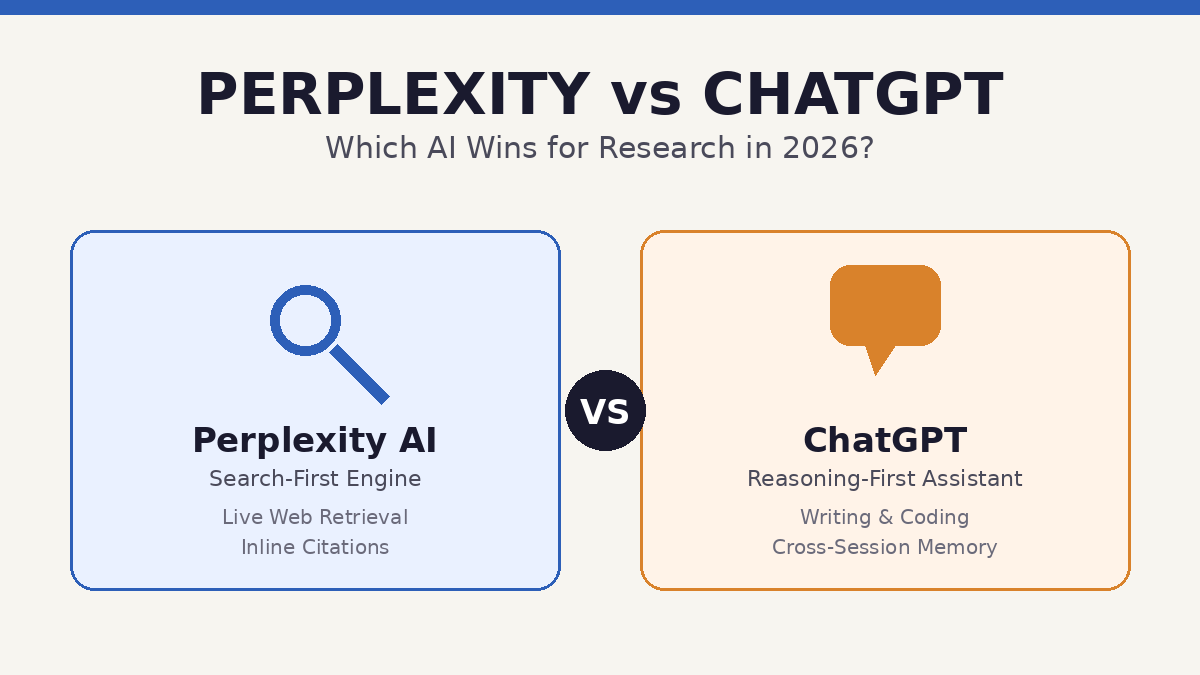
Perplexity AI and ChatGPT approach search very differently. Perplexity was built as an AI search engine that retrieves live information with clear citations, while ChatGPT is a broader AI assistant that combines reasoning, creativity, coding, and web search.
If your priority is verifying current information, Perplexity has an advantage. If you need analysis, writing, coding, or long-term conversations, ChatGPT remains the stronger all-around assistant.
Key Takeaways
- Perplexity performs live web searches for every query and provides structured citations.
- ChatGPT combines AI reasoning with optional web browsing for deeper explanations.
- Perplexity is stronger for research and fact verification.
- ChatGPT is better for coding, writing, data analysis, and creative work.
- Both platforms continue evolving as AI search replaces traditional search engines.
- Many professionals now use both tools together rather than choosing only one.
What is the difference between Perplexity AI and ChatGPT?
Perplexity AI is an AI-powered search engine that retrieves live web information and cites its sources for nearly every answer. ChatGPT is a conversational AI assistant that combines reasoning, creativity, coding, and optional web browsing to provide detailed explanations and complete tasks beyond search.
Although both platforms answer questions using artificial intelligence, they were designed with different goals. If you want to explore similar assistants, this detailed comparison of apps like ChatGPT is also a useful read. Perplexity AI was created as a search-first platform. Every search begins by retrieving current information from the web before generating an answer.
ChatGPT started as a conversational language model. Search was added later through OpenAI’s browsing infrastructure, allowing it to combine existing knowledge with live information when necessary. That difference shapes almost everything else.
Perplexity’s Search-First Approach
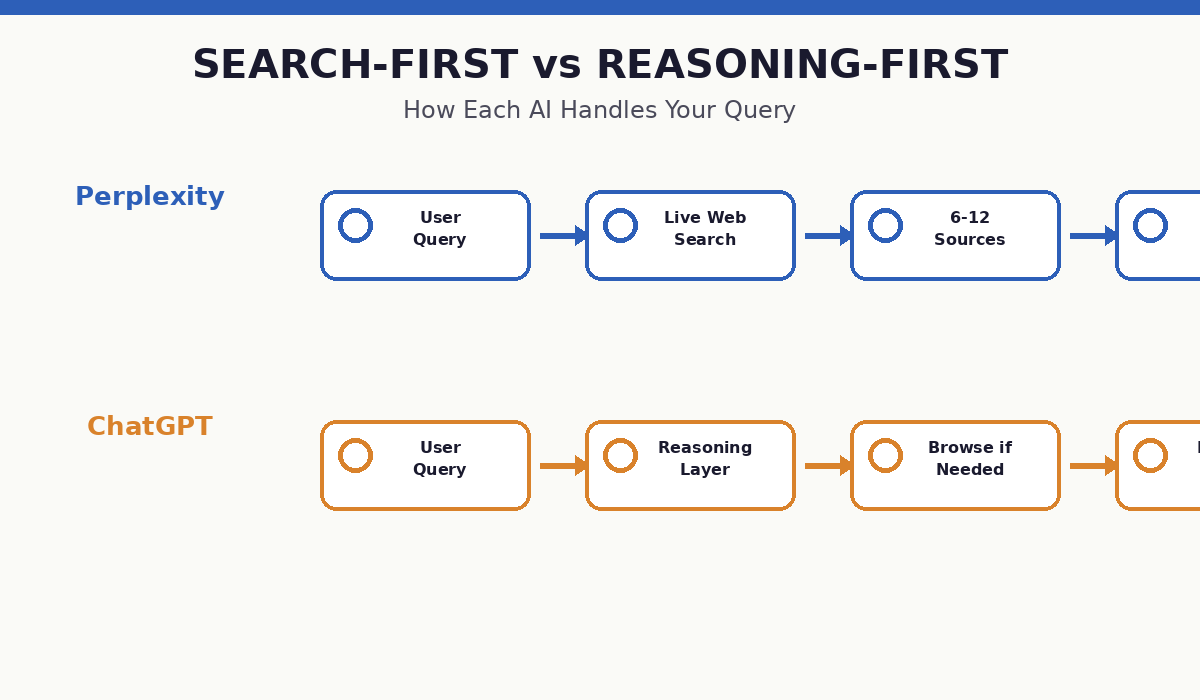
Perplexity searches the internet before answering.
According to the research, it typically analyzes 6–12 different sources before generating a response, displaying numbered citations throughout its answers. This makes fact-checking much easier, especially for journalists, researchers, and students.
ChatGPT’s Reasoning-First Approach
ChatGPT focuses on understanding your request first.
Only when real-time information is needed does it activate its browsing layer, usually consulting 2–4 authoritative websites before producing a detailed explanation. Rather than simply summarizing pages, ChatGPT often explains relationships, patterns, and practical implications.
Why AI Search Changed in 2026
Search is no longer just about finding links.
People increasingly expect complete answers instead of browsing dozens of webpages. Industry analysts cited in the research predict traditional search volume could decline by 25% during 2026 as users move toward AI-powered answer engines.
This shift is also changing how websites approach SEO. Instead of optimizing only for Google rankings, businesses are investing in Generative Engine Optimization (GEO) so AI platforms can easily discover and cite their content. To make your content AI-search ready, this list of the best AI tools for SEO is a solid starting point.
The Evolution of Both Platforms
OpenAI introduced ChatGPT in late 2022 and changed public expectations for AI assistants almost overnight.
Early versions, though, lacked live internet access and relied entirely on static training data, which meant it could sound confident about information that was already out of date.
Perplexity solved that problem from the opposite direction. Instead of treating web search as an optional add-on, it made live retrieval the foundation of every single response, using retrieval-augmented generation (RAG) to ground its answers in real-time sources.
Over the years that followed, the two platforms evolved toward each other.
ChatGPT added increasingly capable search tools, while Perplexity introduced deeper reasoning models and workspace features of its own. Despite that convergence, their core philosophies haven’t really changed; One still starts with search, the other still starts with reasoning.
Perplexity vs ChatGPT Search: Feature Comparison
| Feature | Perplexity AI | ChatGPT |
| Primary purpose | AI Search Engine | AI Assistant |
| Live search | Every query | When needed |
| Typical sources | 6–12 websites | 2–4 authoritative sources |
| Citations | Inline numbered references | Embedded contextual links |
| Coding | Limited | Excellent |
| Creative writing | Basic | Advanced |
| Memory | Limited | Cross-session memory |
| File analysis | Basic | Advanced with Code Interpreter |
| Best for | Research | Productivity |
Which Platform Is Better for Research?
For research alone, Perplexity generally wins. Its strongest advantage is transparent sourcing. Instead of asking users to trust the answer, it encourages verification through direct citations.
According to the research report, Perplexity also indexes discussions from Reddit, LinkedIn, and other community platforms faster than many competitors, making it valuable for emerging topics.
Real-World Example
A financial analyst tracking US tax updates used Perplexity’s Focus Mode to retrieve recent government documents published within two days.
The platform linked directly to official sources, making verification much easier. For academic research, policy monitoring, and breaking news, this workflow is highly effective.
Why ChatGPT Still Leads Beyond Search
If your work goes beyond finding information, ChatGPT becomes much harder to replace.
It isn’t just a search tool. It’s an AI assistant that can reason through problems, write content, analyze data, generate code, create visuals, and remember context across conversations. That broader capability makes it a better everyday productivity tool.
Superior Reasoning and Analysis
ChatGPT doesn’t simply summarize webpages. It connects ideas, compares options, explains complex topics, and adapts its responses based on your follow-up questions.
When you upload spreadsheets or datasets, its built-in Code Interpreter can clean data, run Python scripts, and generate charts inside the conversation.
A Larger AI Ecosystem
Search is only one part of ChatGPT’s ecosystem.
You can upload PDFs, images, and documents, hold voice conversations, generate images, build Custom GPTs, and automate workflows without leaving the same interface. For professionals managing multiple tasks, that integration saves considerable time.
Real-World Example
The research report highlights an operations manager who uploaded an 8,000-row logistics spreadsheet into ChatGPT.
Using Code Interpreter, ChatGPT cleaned missing values, grouped records by geographic regions, and produced an interactive chart, all within one conversation. Perplexity could locate relevant logistics information, but it couldn’t execute the same analytical workflow.
Perplexity AI Free vs Pro
One of the most searched questions in 2026 is perplexity ai free vs pro. The free version is surprisingly capable for everyday searches.
It performs live web searches, provides citations, and answers most informational questions without requiring a subscription. Perplexity Pro expands those capabilities considerably.
According to the research, Pro users can switch between multiple frontier AI models—including OpenAI GPT models, Anthropic Claude, and Google’s Gemini, while keeping Perplexity’s search engine at the center of the experience.
Free Version Is Best For
- Casual web searches
- Students
- Quick fact-checking
- Daily information lookups
- Basic research
Pro Version Is Best For
- Researchers
- Analysts
- Consultants
- Journalists
- Heavy daily AI users
If your work depends on verifying large amounts of current information, the Pro subscription offers noticeably more flexibility.
Is Perplexity Better Than Google?
The answer depends on what you’re trying to accomplish.
Google remains unmatched when you want to browse websites, compare products, shop online, or explore multiple perspectives yourself. Perplexity shines when you simply want the answer.
Instead of opening ten browser tabs, it gathers information from multiple sources and produces a concise summary with citations. That dramatically reduces research time.
However, Google still offers a broader web ecosystem, including Maps, Shopping, News, Images, and countless specialized search tools. For most users, these tools complement each other rather than compete directly.
Comparison
| Feature / Dimension | Perplexity AI (2026 Standard) | ChatGPT Search (GPT-5/Live Ecosystem) |
| Primary DNA | Search Engine with a conversational skin | Creative & analytical Reasoning Assistant |
| Default Search Trigger | 100% of queries pass through live web indexes | Conditional; runs when real-time intent is identified |
| Source Volume | High (6 to 12 distinct URLs synthesized) | Targeted (2 to 4 authoritative core references) |
| Citation Model | Structured, rigid inline numbers on every sentence | Contextual links, often embedded within broader blocks |
| Primary Platforms Cited | Reddit (46.7%), forums, local updates, blogs | Wikipedia (47.9%), Tier-1 news media, official sites |
| Execution Mechanics | Summarizes, extracts, maps sources | Executes code, runs sandboxed Python data loops |
| Creative Capabilities | Weak; yields dry, reporting-style content | Elite; adjusts tone, structures scripts and copy |
| Memory Retention | Limited cross-thread index parsing | Highly personalized cross-session memory |
Statistics That Define AI Search in 2026
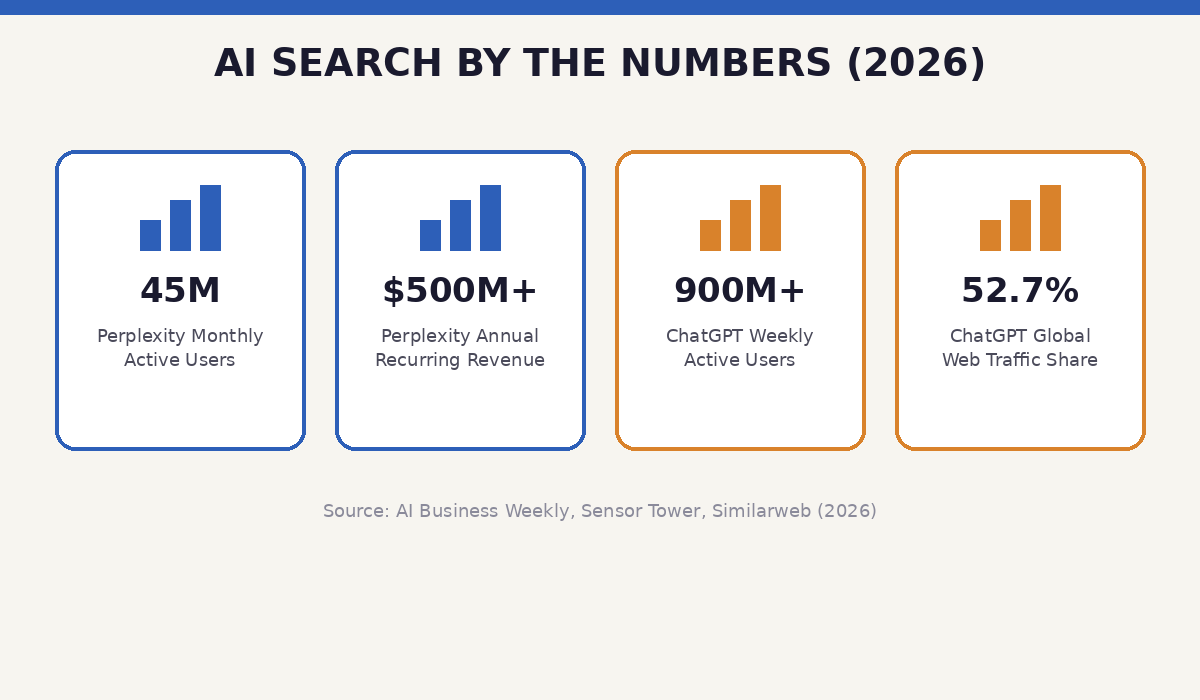
The numbers show how quickly this market is evolving. According to AI Business Weekly, Perplexity’s Annual Recurring Revenue surpassed $500 million in April 2026, representing roughly 400% growth compared with the previous year.
The same research reports that Perplexity now processes between 1.2 and 1.5 billion searches every month, while serving approximately 45 million monthly active users.
OpenAI continues to operate at an entirely different scale. Research cited from Sensor Tower reports that ChatGPT has more than 900 million weekly active users, while its mobile application surpassed 1 billion users during June 2026.
According to Similarweb, ChatGPT’s global web traffic share declined to 52.7% in May 2026, reflecting stronger competition from Perplexity, Google Gemini, and other AI assistants.
Meanwhile, OpenAI generated roughly $5.7 billion in Q1 2026 revenue, placing it on pace for approximately $30 billion annually, although the research also notes projected annual losses driven by high inference costs.
These figures highlight an important trend. ChatGPT dominates overall AI usage, while Perplexity continues growing rapidly within the AI search category.
Advantages and Limitations
Perplexity AI Pros
- Live web search on every query
- Clear inline citations
- Fast research workflow
- Excellent for breaking news
- Supports multiple AI models in Pro
Who Should Use Perplexity?
Perplexity is an excellent choice for researchers, students, journalists, financial analysts, consultants, and anyone who needs reliable, up-to-date information with transparent sources.
Who Should Avoid It?
If your daily work involves writing long articles, programming, image creation, or extensive brainstorming, Perplexity alone may feel limiting.
ChatGPT Pros
- Strong reasoning and problem-solving
- Excellent writing quality
- Advanced coding support
- Powerful document analysis
- Cross-session memory
- Rich multimodal capabilities
Who Should Use ChatGPT?
ChatGPT is ideal for marketers, developers, writers, business owners, educators, analysts, and teams that need one assistant for many different tasks.
Who Should Avoid It?
If your only requirement is rapid fact-checking with visible citations, ChatGPT may provide more capability than you actually need.
Limitations to Remember
Neither platform is perfect. According to the research report, Perplexity can occasionally associate correct-looking links with inaccurate claims, making source verification still necessary. This mirrors what independent reporting on ChatGPT’s slipping market share has also flagged, as users increasingly split their usage across multiple AI assistants.
ChatGPT, meanwhile, may produce confident but incorrect answers when browsing isn’t actively used, especially on rapidly changing topics. For critical research, always verify important information before making decisions.
Practical Application: How to Use Perplexity and ChatGPT Together
Many professionals no longer see this as a choice between one tool or the other. Instead, they use each platform where it performs best. That approach saves time while improving the quality of the final result. Before starting your research workflow, this curated list of research-focused AI tools can help you get an overview.
Step 1: Start Your Research with Perplexity
Begin by asking Perplexity questions that require current information. Use it to collect statistics, industry news, official announcements, government documents, and recent reports. Review the inline citations before accepting any claim.
Step 2: Verify the Sources
Open the cited websites and confirm the most important facts.
Although Perplexity provides transparent references, the research report notes that citation mismatches can still occur occasionally. Spending a few extra minutes verifying critical information increases accuracy.
Step 3: Move the Research into ChatGPT
Once you’ve confirmed the facts, paste your findings into ChatGPT.
Ask it to explain complex ideas, summarize technical information, compare alternatives, write reports, generate code, or create marketing content. This combines Perplexity’s sourcing strengths with ChatGPT’s reasoning abilities.
Step 4: Refine and Personalize the Output
Use ChatGPT to adjust tone, simplify explanations, organize ideas, or tailor content for your audience. Whether you’re preparing a presentation, article, proposal, or research paper, this final step usually produces a more polished result.
Common Mistakes to Avoid
Even experienced users often misuse AI search tools. Avoid these common mistakes to get better results.
- Treating AI answers as final without checking important sources.
- Using ChatGPT for breaking news without enabling web search.
- Assuming every cited link automatically proves a claim.
- Expecting Perplexity to replace advanced writing or coding tools.
- Choosing one platform for every task instead of matching the tool to the job.
The best results usually come from understanding each platform’s strengths rather than expecting one assistant to do everything perfectly.
The Future of AI Search
The competition between Perplexity and ChatGPT is pushing AI search forward at an incredible pace.
According to the research, analysts expect more than 60% of informational searches to become zero-click experiences by 2028, meaning users will receive complete answers without visiting multiple websites.
Another major trend is the rise of AI agents. Instead of simply answering questions, future systems will complete tasks such as booking travel, comparing products, organizing files, and managing workflows automatically.
Businesses are already adapting through Generative Engine Optimization (GEO), creating content that AI search engines can easily understand, summarize, and cite.
Final Verdict: Which Is the Best AI for Research in 2026?
There isn’t a single winner for everyone. If your work depends on current information, transparent citations, and efficient research, Perplexity remains one of the strongest AI search engines available.
If your work involves writing, coding, data analysis, brainstorming, or managing long-term projects, ChatGPT offers far greater versatility. For many professionals, the smartest workflow is not Perplexity vs ChatGPT, it’s Perplexity and ChatGPT working together. Perplexity finds reliable information. ChatGPT transforms that information into useful work.
Conclusion
In this rapidly evolving era of AI search, the ultimate choice isn’t necessarily between Perplexity AI and ChatGPT, it’s about how strategically you can use them together. Perplexity keeps you grounded with real-time, fact-checked information, while ChatGPT elevates your productivity through complex reasoning and creative execution. However, keeping up with these constant shifts can be overwhelming, which is exactly where OpenAIHit comes in to bridge the gap.
At OpenAIHit, we closely track these shifting dynamics to help you make sense of the latest updates, algorithmic changes, and Generative Engine Optimization (GEO) trends. Mastering the synergy between different AI platforms is the ultimate workflow hack for any modern professional, and our goal is to ensure you always have the upper hand.
FAQs
Q1. Is Perplexity AI completely free to use?
Yes, Perplexity offers a capable free version that provides live web searches and citations. However, the Pro version unlocks advanced reasoning models (like GPT-4o or Claude 3.5 Sonnet) and higher file upload limits.
Q2. Can ChatGPT search the live internet like Perplexity?
Yes, ChatGPT can search the web, but it only activates its browsing layer when it detects a real-time intent or when explicitly asked. Perplexity, on the other hand, runs a live web search for 100% of its queries by default.
Q3. Which platform is better for coding and writing?
ChatGPT is significantly better for coding, creative writing, and data analysis. It uses advanced reasoning loops and features like Code Interpreter to execute tasks that Perplexity’s dry, reporting-style interface cannot handle.
Q4. What is Generative Engine Optimization (GEO)?
GEO is the evolution of traditional SEO. Instead of just optimizing websites to rank on Google’s first page, SEO specialists optimize content so that AI engines like Perplexity and ChatGPT can easily find, synthesize, and cite it.
Q5. How can I learn to use both tools effectively?
To master workflows combining these tools, you can follow specialized tech platforms like OpenAIHit. They provide practical prompts,