
For modern e-commerce founders, returns are the silent killer of net margins. Driven by the consumer habit of “bracketing”—buying the same apparel item in three different sizes to try on at home—the average online retail return rate persistently hovers between 20% and 30%. In categories like high-end fashion, that number frequently skyrockets past 40%.
Every time a customer initiates a standard refund request, it erases precious capital. Between subsidizing return shipping labels, paying warehouse labor to inspect and re-inventory stock, and writing off damaged goods, a single return can easily wipe out 30% to 40% of an item’s initial gross profit margin.
But the operational landscape has officially shifted on openaihit. Forward-thinking merchants are fighting back using predictive, autonomous technology. By deploying an advanced framework for ai returns management shopify, digital storefronts are successfully intercepting returns before they happen and reclaiming lost revenue through smart workflows.
The Core Problem: Why Traditional Portals Fail
Historically, e-commerce brands viewed returns as a static post-purchase logistics problem. Merchants installed basic self-service portals that simply generated shipping labels and processed raw refunds. This outdated strategy presents two distinct vulnerabilities:
-
It acts completely passively: It provides zero resistance to a refund, encouraging capital to exit your business bank account immediately.
-
It ignores the root cause: It fails to collect or analyze the deep behavioral data required to fix product description issues or sizing discrepancies in real time.
1. Intercepting Returns at the Source: The AI Size Recommendation Tool
The most effective way to optimize your operational margins is to ensure the correct item variant ships out the first time. The rise of the ai size recommendation tool has completely revolutionized pre-purchase confidence for consumers.
Instead of forcing shoppers to decode vague, generic static size charts, these specialized machine-learning algorithms analyze millions of data points in real time directly on the product description page (PDP).
By instantly cross-referencing a shopper’s height, weight, personal fit preferences, and past purchase history across thousands of other digital brands, the artificial intelligence outputs a highly accurate fit prediction.
Furthermore, these systems ingest real-time return data. If data patterns indicate that a specific leather jacket runs slightly small in the shoulders, the AI proactively prompts the user to size up during selection. This active intervention effectively eliminates bracketing behavior, enabling brands to reduce ecommerce returns ai metrics by up to 23% at the point of sale.
2. Transforming Refunds into Exchanges: Returns Automation Shopify 2026
When a return is inevitable, the operational goal shifts from simple logistics to aggressive revenue retention. The modern standard for returns automation shopify 2026 focuses heavily on automated, conversational exchange incentives.
Rather than directing customers to a cold, linear form, modern AI-first platforms use intelligent chat widgets and dynamic portals to guide the consumer journey.
-
Conversational Problem Solving: When a customer states an item is “too small,” the AI instantly communicates with Shopify’s live backend inventory. It immediately presents the exact next size up as a frictionless, one-click exchange option.
-
Smart Incentives and Bonus Credit: To actively discourage raw cash refunds, the automation engine can dynamically offer a $10 bonus store credit if the customer selects an exchange or a digital gift card instead of a cash refund.
This technical framework successfully converts up to 30% of standard returns into successful product swaps, keeping cash flow safely locked inside your business ecosystem.
3. Autonomous Policy Enforcement and Logistics Routing
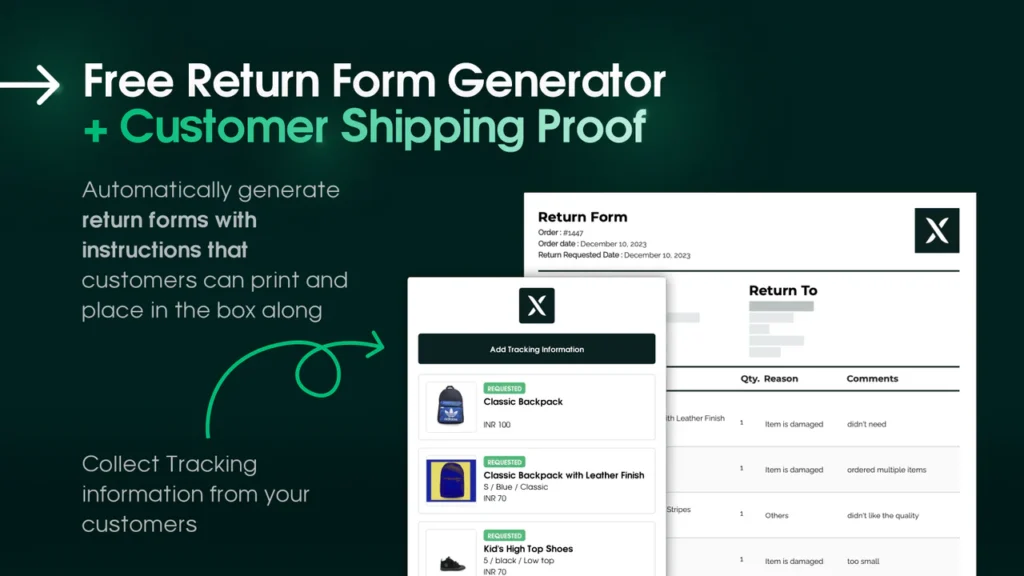
Managing returns manually strains customer support teams and drains valuable time. Intelligent automation modules seamlessly step in to act as autonomous support agents, handling up to 80% of routine return requests without requiring human review.
The system checks incoming return requests against your exact store policy parameters (e.g., verifying if the purchase was made within the 30-day window or checking if the item was marked as final sale).
Once validated, the platform utilizes smart disposition routing. If a heavy, low-margin item is returned, the system calculates that return shipping costs exceed the item’s residual value. It will automatically instruct the customer to keep or donate the item while issuing a store credit, completely saving your brand from paying a double shipping fee. For high-value items, it instantly routes the return package to the specific third-party logistics (3PL) warehouse closest to the customer’s geographic location, drastically reducing reverse logistics transit times.
Core Returns Management Feature Matrix
| AI Capabilities | Core Technical Function | Direct Bottom-Line Impact |
| Predictive Sizing Engines | Processes user body metrics and cross-brand purchase profiles to recommend a perfect fit. | Maximizes add-to-cart rates while reducing multi-size bracketing behavior. |
| Dynamic Exchange Upsells | Evaluates return reasons and cross-references live SKU availability to recommend alternative products. | Protects average order value (AOV) by shifting cash refunds to exchanges. |
| Autonomous Policy Guardrails | Validates order timestamps, promotional tag status, and customer history against store rules. | Eliminates manual customer support tickets and prevents return fraud. |
| Smart Logistics Routing | Calculates shipping distance, item weight, and warehouse capacity to optimize shipping labels. | Reduces reverse-logistics freight costs and speeds up back-to-stock times. |
4. Ingesting Post-Purchase Data to Protect Margins
The final piece of the automation loop involves translating return data into actionable brand intelligence. When an online store handles thousands of orders a month, it is impossible for human operators to manually read every single return comment field to discover why specific products are failing.
AI analytics engines read, categorize, and synthesize every single piece of customer feedback text. If multiple shoppers label a specific silk dress as “sheer” or “fragile,” the AI instantly flags the SKU inside your Shopify dashboard.
This gives founders the exact data needed to instantly update product descriptions, adjust product photography to accurately display colors under natural light, or coordinate directly with overseas manufacturers to rectify factory quality control errors before ordering the next inventory run.
Conclusion: Turning a Cost Center into a Competitive Advantage
Returns will always be an inherent part of the digital commerce experience, but they no longer have to devastate your business’s contribution margins. By moving away from static, passive return portals and adopting a comprehensive ecosystem driven by artificial intelligence, Shopify merchants can successfully lower return volumes by 23%, lower overhead costs, and turn a traditional logistical nightmare into a seamless, loyalty-building customer experience.
Frequently Asked Questions (FAQ)
How exactly does an AI sizing tool lower e-commerce return rates?
An AI sizing tool replaces static, confusing charts by evaluating a shopper’s height, weight, and cross-brand purchase history. By recommending the most accurate size variant for their unique build, it eliminates the practice of “bracketing”—where customers buy multiple sizes of the same item to test at home.
Can automated tools process exchanges without manual team approval?
Yes. Modern returns systems integrate natively into Shopify’s backend inventory. If a customer requests a different size or color and your return policy conditions are fully met, the software automatically approves the request, updates your stock tracking, and issues the new fulfillment order instantly.
What is smart disposition routing in reverse logistics?
Smart disposition routing is an automated process that determines the most cost-effective destination for a returned item. It calculates shipping fees against the item’s margin to decide whether a package should be sent to a specific local 3PL warehouse, liquidated, or kept by the customer as a courtesy.
Does implementing an AI return system hurt customer satisfaction?
Not at all. In fact, it dramatically improves the customer experience. Instead of forcing customers to email support teams and wait days for a manual shipping label, the system offers instant, 24/7 self-service resolutions, immediate exchange processing, and transparent updates.
How does post-purchase AI data help improve manufacturing processes?
The AI automatically scans, reads, and tags customer feedback text fields across thousands of returns. If a specific product line has recurring complaints regarding structural defects, poor stitching, or incorrect fabric weights, the software alerts the merchant to address those exact design flaws with their suppliers.