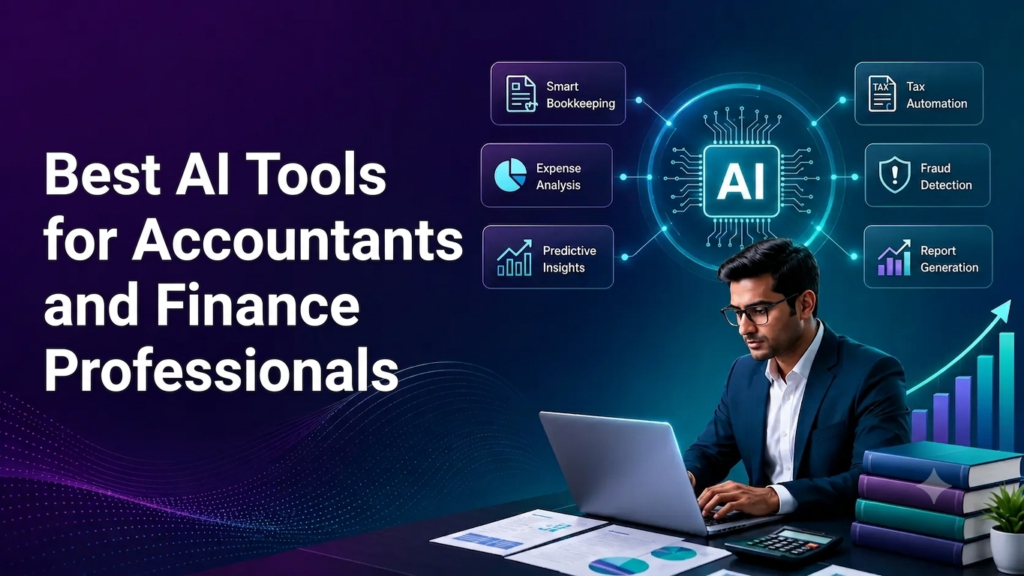
Modern AI accounting automation reduces client onboarding, receipt processing, and reconciliation timelines from days to minutes while establishing continuous audit readiness.
-
Instant Document Processing: AI-driven OCR engines process receipts, vendor invoices, and bank statements automatically with up to 99% data extraction accuracy.
-
Continuous Reconciliation: Machine learning algorithms continuously match bank feeds against general ledger transactions, flagging anomalies in real time.
-
Tax Code Intelligence: Specialized tax AI engines scan federal, state, and international tax laws to identify deduction opportunities and compliance risks.
-
Predictive Cash Flow Modeling: AI algorithms analyze historical ledger data to project 12-month rolling cash flow scenarios with multi-variable stress testing.
-
Fraud & Anomaly Detection: Behavioral algorithms flag duplicate invoices, unusual payment requests, and non-compliant expense reimbursements instantly.
-
Firm Scale & Capacity: Accounting firms utilizing finance automation increase client-to-bookkeeper capacity ratios without increasing headcounts.
The accounting and finance sectors are undergoing a massive technological shift. Manual entry, tedious bank reconciliations, receipt chasing, and complex tax compliance checks are rapidly being transformed by artificial intelligence.
Modern ai tools for accountants go far beyond basic spreadsheet macros. They leverage machine learning, intelligent document processing, and predictive analytics to handle high-volume data ingestion with near-zero error rates. Whether you need specialized ai for bookkeeping to reconcile ledgers automatically, robust ai accounting software for enterprise auditing, or targeted ai for tax preparation to navigate complex tax codes, implementing the right software stack is now essential for growth.
This guide provides a comprehensive review of the top financial AI solutions in 2026, evaluating their operational capabilities, integration capabilities, and real-world compliance standards.
1. Executive Matrix: Top Financial AI Tools Compared
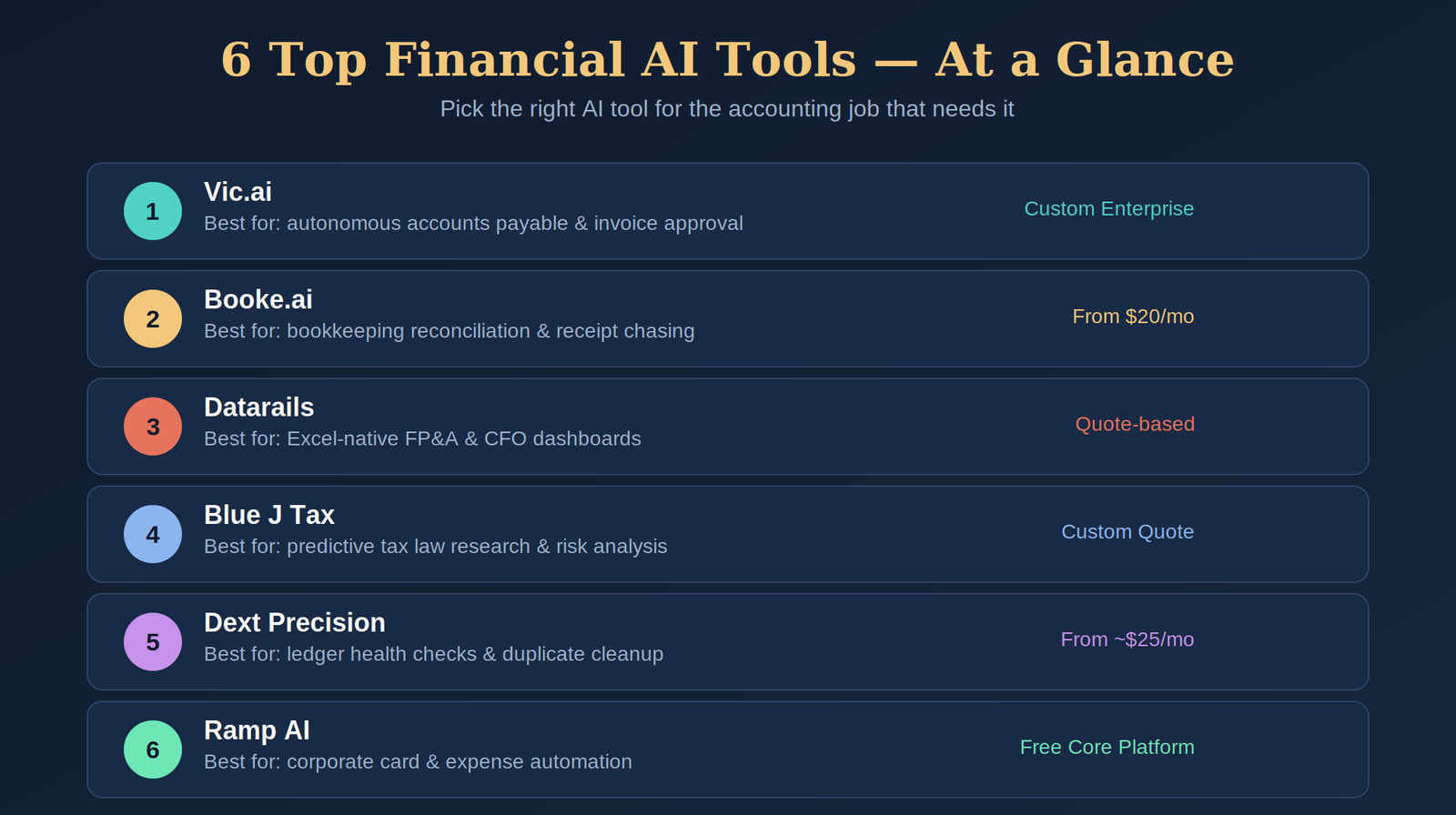
| Platform | Core Focus | Primary Benefit | Target Users | Integrations | Pricing Tier |
| Vic.ai | Autonomous Accounts Payable | Auto-coding & invoice approval workflows | Enterprise AP Teams & CFOs | SAP, NetSuite, Workday | Custom Enterprise |
| Booke.ai | AI for Bookkeeping & Reconciliation | Auto-categorizes transactions & chaser bot | CPAs & Bookkeeping Agencies | QuickBooks, Xero | Starts at $20/mo |
| Datarails | Financial Planning & Analysis (FP&A) | Transforms Excel sheets into AI dashboards | CFOs & Finance Directors | Excel, ERPs, CRMs | Quote-based |
| Blue J Tax | AI for Tax Preparation & Research | Structural tax law analysis & risk predicting | Tax Attorneys & CPAs | Tax Databases, Legal APIs | Custom Quote |
| Dext Precision | Ledger Health & Data Cleansing | Detects duplicated items & cleanup alerts | Accounting Firms | Xero, QuickBooks Online | Starts at ~$25/mo |
| Ramp AI | Corporate Cards & Expense Automation | Auto-collects receipts & enforces policies | Finance Managers & Startups | Slack, NetSuite, QBO | Free Core Platform |
2. Specialized Breakdown: AI Tools by Core Accounting Function
+--------------------------------------------------------------------+
|                   AUTONOMOUS AP/AR PIPELINE                        |
|                                                                    |
| [Vendor Invoice PDF] ---> [Vic.ai OCR & Line Extraction]           |
|                                      |                             |
|                                      v                             |
| [ERP Ledger Post] <--- [3-Way Matching & Fraud Check]              |
+--------------------------------------------------------------------+
Category A: Autonomous Bookkeeping & Accounts Payable (AP/AR)
1. Vic.ai: The Autonomous Accounts Payable Engine
Vic.ai utilizes proprietary algorithms trained on millions of invoices to automate accounts payable processes without requiring manual template rules.
-
Key Capabilities: Extracts line-item invoice data, performs 3-way matching against purchase orders, and predicts general ledger (GL) coding accounts automatically.
-
Best For: Mid-market and enterprise finance teams looking to process thousands of vendor invoices autonomously.
2. Booke.ai: Real-Time Reconciliations & Missing Document Retrieval
Booke.ai removes the manual friction from month-end closes by bringing real-time OCR and automated client communication into bookkeeping tools.
-
Key Capabilities: Automatically flags uncategorized transactions, predicts GL codes, and deploys an automated email/SMS assistant to chase clients for missing receipts.
-
Best For: Bookkeeping agencies managing high-volume client accounts on QuickBooks or Xero.
Category B: Financial Planning, Analysis & Corporate Reporting
3. Datarails (Flex AI): Excel-Native AI Financial Planning
Datarails allows corporate finance teams to retain their existing Microsoft Excel models while adding enterprise data consolidation, version control, and conversational AI querying.
-
Key Capabilities: “Flex AI” natural language assistant lets CFOs query balance sheets (e.g., “Show me Q3 marketing expenses vs Q2 budget variance”) and returns instant charts and drill-downs.
-
Best For: Corporate finance professionals and FP&A managers who want advanced AI modeling without abandoning Excel.
4. Ramp AI: Automated Expense Management & Spend Control
Ramp combines corporate cards with intelligence-driven finance automation ai to enforce corporate spending policies before money is spent.
-
Key Capabilities: Auto-collects receipts via SMS/Email, automatically matches receipts to credit card transactions, flags out-of-policy purchases, and identifies redundant software subscriptions.
-
Best For: Growing companies and finance teams aiming to streamline corporate expense workflows.
Category C: Tax Research, Compliance & Audit Cleansing
5. Blue J Tax: Predictive Tax Law & Legal Analysis
Navigating complex tax legislation requires extensive research time. Blue J uses machine learning to analyze tax statutes, revenue rulings, and legal precedents to predict tax position outcomes.
-
Key Capabilities: Maps legal tax scenarios, calculates risk probabilities for positions taken, and drafts technical tax research memorandums in minutes.
-
Best For: Specialized CPAs, tax attorneys, and corporate tax departments working on high-stakes tax advisory.
6. Dext Precision (formerly Xavier): Automated Ledger Health Auditing
Dext Precision continuously scans accounting ledgers to detect errors, duplicate entries, inconsistent tax code application, and dormant accounts before month-end reporting.
-
Key Capabilities: Provides a “Health Score” for client books, identifies missing tax numbers, and highlights multi-entry anomalies automatically.
-
Best For: Audit teams and accounting firms maintaining high data quality standards across client portfolios.
3. Implementation Framework: The 4-Stage AI Adoption Roadmap
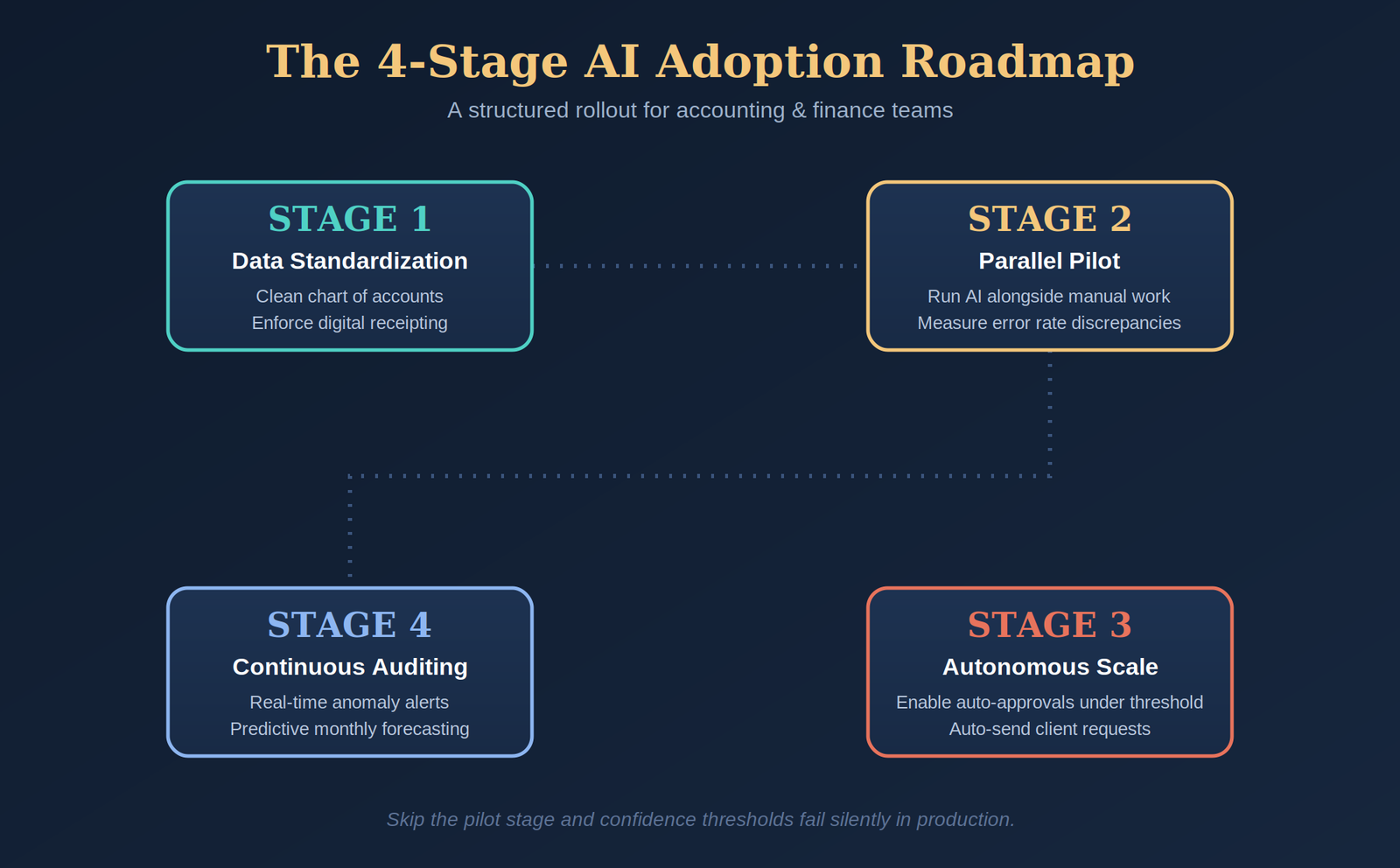
Implementing ai tools for accountants requires a structured deployment strategy to ensure security, team adoption, and system integration.
  [STAGE 1: Data Standardization]    ---->   [STAGE 2: Parallel Pilot]
  - Clean chart of accounts                  - Run AI alongside manual workflows
  - Enforce digital receipting                - Measure error rate discrepancies

                                                     |
                                                     v

  [STAGE 4: Continuous Auditing]     <----   [STAGE 3: Autonomous Scale]
  - Real-time anomaly alerts                 - Enable auto-approvals under threshold
  - Predictive monthly forecasting           - Auto-send client requests
-
Stage 1: Data Normalization & Hygiene
Standardize your chart of accounts across client files and transition all paper receipts/documents to digital ingestion channels.
-
Stage 2: Parallel Pilot Testing
Run chosen AI tools (e.g., Booke.ai or Vic.ai) alongside manual workflows for 30–60 days to compare accuracy rates and fine-tune machine learning models.
-
Stage 3: Setting Approval Guardrails
Establish confidence thresholds. For example, allow invoices with >95% AI confidence to auto-post, while routing lower-confidence items to human reviewers.
-
Stage 4: Continuous Monitoring & Advisory Shift
Shift saved operational hours toward high-value strategic financial advisory, tax planning, and client advisory services (CAS).
4. Data Security & Compliance Checklist for Financial AI
Accounting data contains highly sensitive financial and personally identifiable information (PII). Ensure every software vendor meets these strict baseline security standards:
-
SOC 1 & SOC 2 Type II Compliance: Verifies that the platform undergoes rigorous third-party security and data protection audits.
-
Zero-Retention Training Clauses: Ensure vendor AI models do not use your proprietary client financial data to train public foundation models.
-
Bank-Grade Encryption: Data must be encrypted using AES 256-bit standards at rest and TLS 1.3 in transit.
-
Granular Role-Based Access Control (RBAC): Restricts employee data access strictly to authorized client portfolios.
Conclusion
Integrating specialized ai tools for accountants is essential for firms and corporate finance departments aiming to stay competitive. From Vic.ai‘s autonomous AP processing to Booke.ai‘s ledger reconciliation and Blue J‘s predictive tax research, AI platforms eliminate manual processing bottlenecks while increasing accuracy.
By adopting an automated accounting framework paired with enterprise-grade data security, accounting professionals can spend less time managing spreadsheets and more time serving as strategic financial advisors. For more deep-dive software comparisons, finance tech reviews, and AI automation guides, visit OpenAIHit.
FAQs
Can AI tools for accountants replace certified CPAs?
No. AI automates repetitive tasks such as data entry, reconciliation, and initial document categorization. However, high-level financial strategy, tax law interpretation, ethical judgment, and client relationships require human CPAs.
Is AI for bookkeeping accurate enough for tax filing?
Yes, modern financial AI platforms achieve up to 99% accuracy on standardized documents. However, human review guardrails remain essential for checking unusual transactions, complex tax deductions, and policy edge cases.
How does AI for tax preparation reduce compliance risks?
Tax AI platforms cross-reference financial entries against updated tax databases, flagging potential audit triggers, incorrect tax code applications, and missed deductions before returns are submitted.
Which AI accounting software integrates best with QuickBooks and Xero?
Tools like Booke.ai, Dext Precision, and Ramp offer native, two-way API integrations with QuickBooks Online and Xero, keeping ledgers synchronized automatically.