The role of a content writer has fundamentally evolved. Writing high-ranking, high-converting content is no longer just about stringing words together, it is about orchestrating ideation, maintaining brand voice, analyzing search engine intent, and accelerating production without sacrificing factual accuracy or creative nuance.
A modern ai writing assistant does not replace human writers; it acts as an intelligent co-pilot. Whether you need ai for blog writing to conquer writer’s block, specialized ai copywriting tools to generate multi-channel ad campaigns, or comprehensive content creation tools ai to streamline search engine optimization, selecting the right software stack is crucial.
In this guide, we evaluate the best AI content creation tools of 2026, breaking down their specific use cases, output quality, pricing models, and real-world workflows.
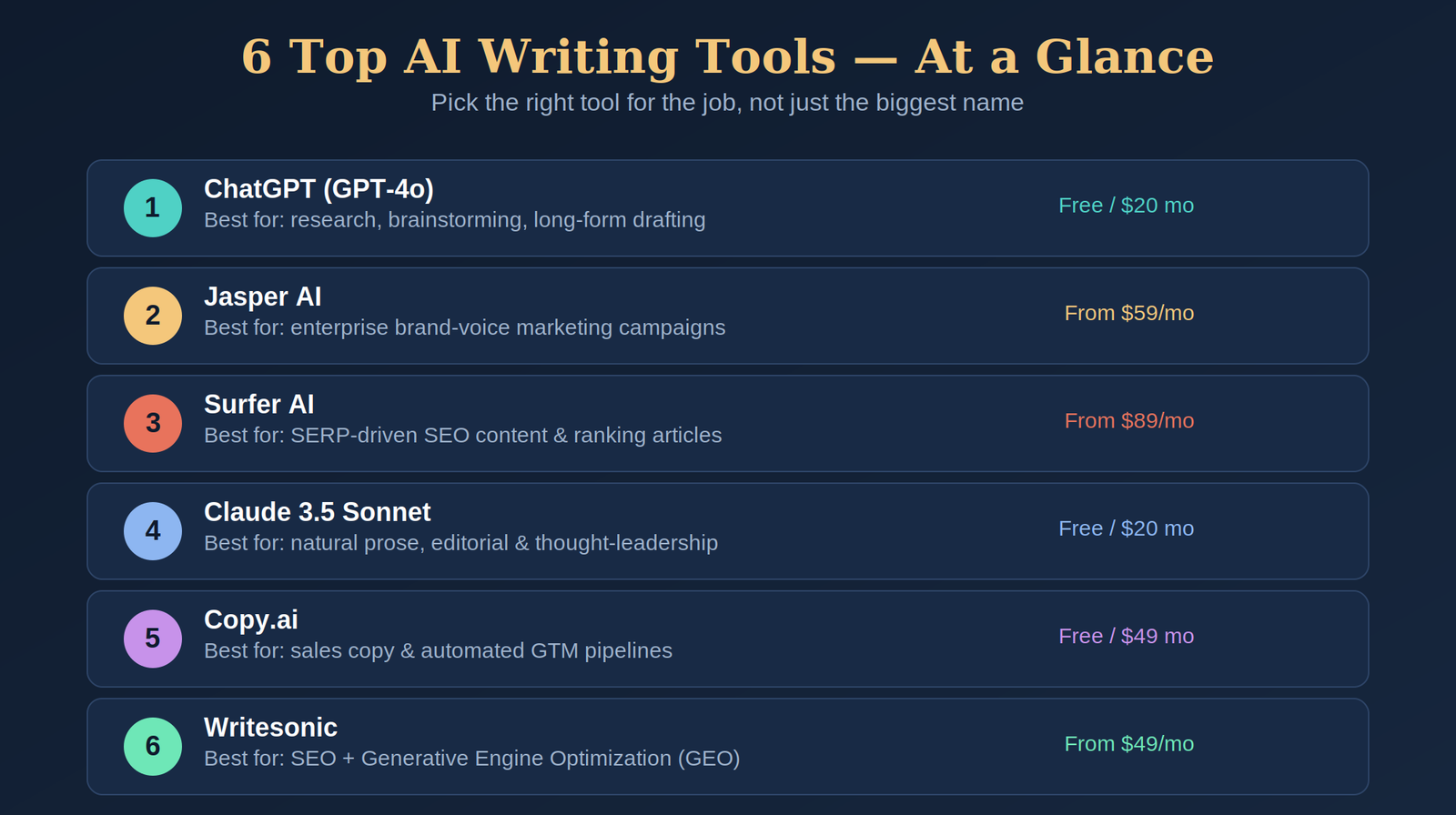
1. Quick Comparison: The Top AI Writing Tools at a Glance
| Tool | Core Specialization | Best For | Standout Feature | Pricing Model |
| ChatGPT (GPT-4o) | General Purpose & Research | Long-form drafting, brainstorming, research | Custom GPTs & Deep Research Mode | Free; $20/mo Plus |
| Jasper AI | Enterprise Marketing & Copywriting | Brand voice consistency & multi-asset campaigns | Brand Voice memory & 50+ marketing templates | Starts at $59/mo |
| Surfer AI | SEO & SERP Optimization | Ranking articles on Google & AI search engines | Real-time SERP content scoring | Starts at $89/mo |
| Claude 3.5 Sonnet | Natural Prose & Nuanced Tone | Editorial pieces, thought leadership, complex essays | Unmatched natural human phrasing | Free; $20/mo Pro |
| Copy.ai | Automated Marketing Pipelines | Sales copy, social posts, Go-To-Market (GTM) OS | Workflow automation & multi-channel generation | Free plan; $49/mo |
| Writesonic | SEO Content & AI Search Visibility | Search-focused blog posts & GEO (Generative Engine Optimization) | Integrated SEO writer & AI search tracking | Starts at $49/mo |
2. Deep Dive: Best AI Tools Categorized by Writer Need
Category A: Ideation, Deep Research & Flexible Drafting
1. ChatGPT (OpenAI): The Most Versatile Research & Drafting Partner
ChatGPT remains the gold standard for versatility. With the integration of advanced reasoning models and deep web search, it serves as a brainstorming engine, outline generator, and multi-format drafting assistant.
-
Why Writers Love It: Custom GPTs allow you to upload style guides, past articles, and brand documents, creating a dedicated assistant that writes strictly in your tone.
-
Best Use Case: Ideation, outlining long-form articles, drafting complex technical copy, and conducting initial research.
-
Strengths: Exceptional versatility, highly customizable, affordable pricing.
-
Limitations: Requires detailed prompt engineering to avoid generic “AI-sounding” phrasing.
2. Claude 3.5 Sonnet (Anthropic): The Best for Human-Like Prose
If you find traditional AI text repetitive or overly formal, Claude 3.5 Sonnet is widely considered by professional editorial teams to produce the most natural, varied, and emotionally resonant prose available.
-
Why Writers Love It: It grasps subtle tone shifts, avoids clichéd buzzwords (like “delve,” “game-changer,” or “landscape”), and excels at long-context comprehension (up to 200,000 tokens).
-
Best Use Case: Thought leadership essays, narrative blog posts, and complex content rewriting.
Category B: Marketing Copywriting & Brand Voice Automation
3. Jasper AI : The Enterprise Marketing Copywriting Engine
Jasper AI was built from the ground up specifically for marketing teams. Rather than operating as a raw chatbot, it wraps foundation models in a structured dashboard packed with 50+ templates, campaign workflows, and brand voice controls.
+------------------------------------------------------------------+
|                   JASPER BRAND VOICE WORKFLOW                    |
|                                                                  |
| [Upload Brand Guidelines / Style Sheet]                          |
|                  |                                               |
|                  v                                               |
| [Jasper Brand Memory Engine] ---> Applies Tone across All Outputs|
|                                     - Blog Posts                 |
|                                     - Social Media Copy          |
|                                     - Ad Campaigns               |
+------------------------------------------------------------------+
-
Key Features: “Brand Voice” scanning, asset campaign builder (turns one brief into a blog post, social captions, and email copy simultaneously), and browser extension integration.
-
Best Use Case: High-volume ai copywriting tools for enterprise marketing teams requiring strict brand consistency.
4. Copy.ai : The Go-To-Market & Sales Copy Generator
Copy.ai has transitioned from a simple sentence expander into a powerful GTM (Go-To-Market) platform that automates full content creation workflows.
-
Key Features: Automated content pipelines, real-time scraping, and pre-built templates for landing pages, cold emails, and social ads.
-
Best Use Case: Direct-response copywriters, growth marketers, and e-commerce stores producing high volumes of ad copy.
Category C: SEO & Search Engine Optimization Tools
5. Surfer AI: SERP-Driven Content Generation
Surfer AI bridges the gap between AI generation and search engine ranking algorithms. It analyzes the top-ranking pages on Google for your target query and automatically generates a structured, fully optimized draft complete with live content scores.
                     SURFER AI OPTIMIZATION LOOP

  [Target Keyword] ---> [Live SERP Analysis] ---> [Content Score Radar]
                                                          |
                                                          v
  [Published SEO Article] <--- [Live NLP Keyword Insertion]
-
Key Features: SERP-informed tone analysis, real-time keyword density scoring, internal link suggestions, and direct WordPress/Google Docs integrations.
-
Best Use Case: ai for blog writing focused purely on organic keyword ranking and topical authority.
6. Writesonic: AI Writing Combined with Generative Engine Optimization (GEO)
Writesonic stands out by optimizing content not only for traditional search engines like Google, but also for visibility inside AI answer engines like ChatGPT, Perplexity, and Google AI Overviews.
-
Key Features: Article Writer 6.0, real-time web citations, GEO visibility tracking, and automated publishing to CMS platforms.
-
Best Use Case: Content agencies looking to rank in both traditional search engine results pages (SERPs) and conversational AI platforms.
3. The 3-Step Human-in-the-Loop Writing Framework
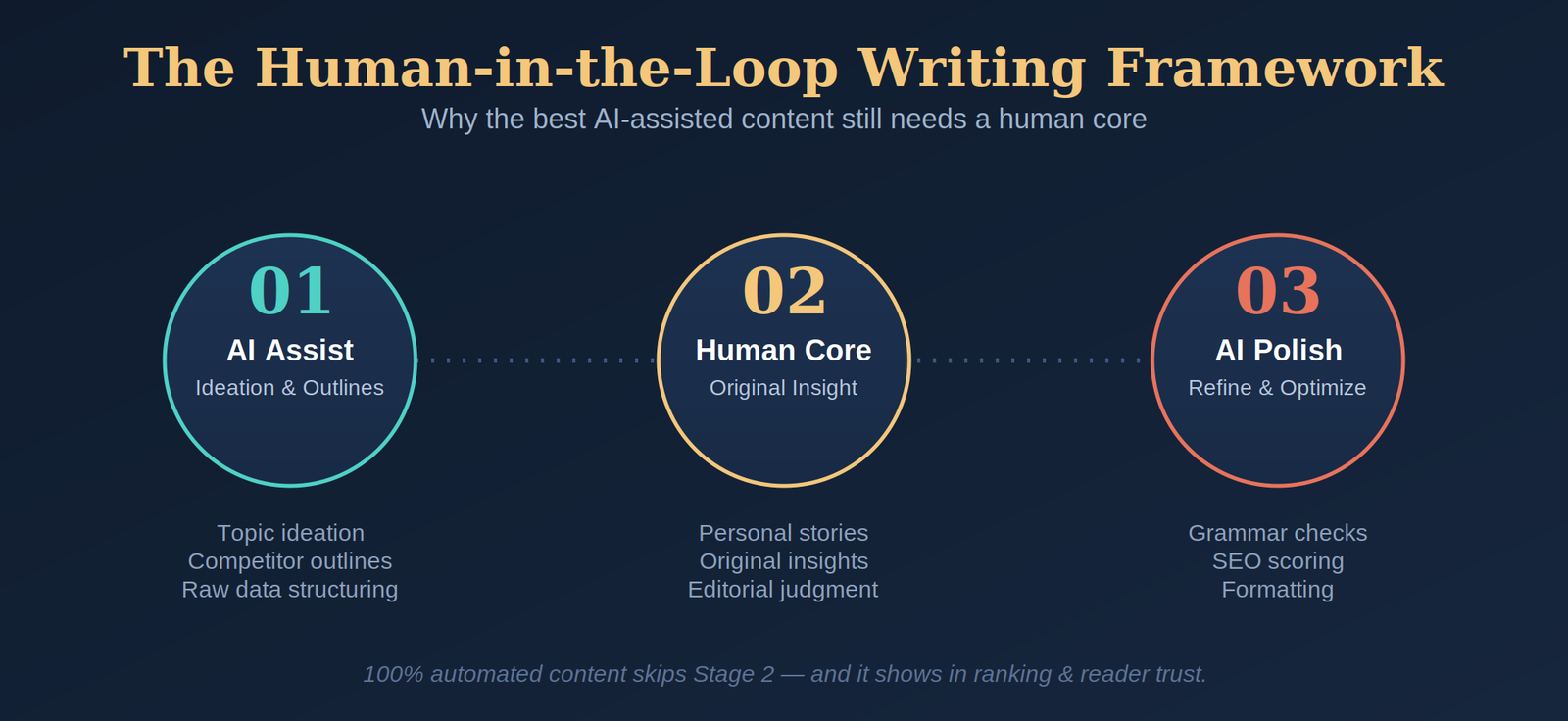
To get the best results from any content creation tools ai, professional writers follow a “Human-in-the-Loop” methodology. Relying 100% on automated generation yields flat, uninspired articles.
  [STAGE 1: AI Assist]        [STAGE 2: Human Core]         [STAGE 3: AI Polish]
  - Topic Ideation             - Personal Stories            - Grammar Checks
  - Competitor Outlines        - Original Insights           - SEO Scoring
  - Raw Data Structuring       - Editorial Judgment          - Formatting
-
Stage 1: AI-Powered Research & Outlining
Use an ai writing assistant like ChatGPT or Claude to analyze user intent, generate outline ideas, and find key statistics or angles.
-
Stage 2: Human First Draft & Subject Matter Expertise
Fill in the outline with original insights, personal anecdotes, unique brand opinions, and expert interviews that AI cannot replicate.
-
Stage 3: AI Editing & SEO Optimization
Pass the completed draft through tools like Surfer AI or Grammarly to polish readability, verify keyword distribution, and fix structural pacing.
4. Master Prompting Cheat-Sheet for Content Writers
Copy and adapt these expert prompts to get immediate, high-quality output from your preferred AI model:
Prompt 1: Long-Form Blog Outline Generator
“Act as a senior content strategist. Create a comprehensive, SEO-friendly outline for an article titled ‘[TOPIC]’. Include H2 and H3 headings addressing key search intent questions. Add bullet points under each heading specifying what key concept, stat, or example to cover.”
Prompt 2: Tone & Brand Voice Adjuster
“Rewrite the following text to sound more conversational, authoritative, and engaging. Remove passive voice, eliminate corporate jargon, and shorten sentences for mobile readability:
Prompt 3: High-Converting Copywriting Hook Generator
“Generate 5 attention-grabbing opening hooks for an article about [TOPIC]. Use different copywriting psychological frameworks: 1) Problem-Agitate-Solve (PAS), 2) Curiosity Gap, 3) Bold Industry Statistic, 4) Storytelling, and 5) Direct Question.”
Conclusion
Mastering the use of an ai writing assistant is no longer a luxury for digital writers, it is a core competitive advantage. Whether you leverage ChatGPT for deep creative research, Jasper AI for brand-aligned copywriting, or Surfer AI for SERP rankings, the key lies in maintaining a strong human editorial touch.
By pairing powerful content creation tools ai with original insights and strategic prompts, writers can produce higher quality content in a fraction of the time. For more in-depth software reviews, AI prompts, and content creation strategies, visit OpenAIHit.
FAQs
What is the best AI writing assistant for long-form blog posts?
For flexible research and natural prose, ChatGPT (GPT-4o) and Claude 3.5 Sonnet are top choices. If you want automated SEO keyword integration while drafting, Surfer AI and Writesonic lead the industry.
Will using AI content tools hurt my Google rankings?
Google explicitly states that its search algorithms reward high-quality content regardless of how it is produced. However, automated content that lacks original research, expertise, or human value (violating Google’s E-E-A-T guidelines) will perform poorly.
Can AI replace human content writers?
No. AI excels at speed, research synthesis, and pattern matching, but it lacks original experience, emotional empathy, and real-world domain expertise. The most successful writers use AI as a productivity tool rather than a replacement.
What is the difference between AI copywriting tools and AI blog writing tools?
AI copywriting tools (like Copy.ai and Jasper) focus on short-form, persuasive sales copy designed for immediate conversion (ads, emails, landing pages). AI blog writing tools (like Surfer AI or ChatGPT) focus on informative, structured, long-form content optimized for search intent and readability.