
Discover how AI data analysis tools in 2026 are transforming business intelligence from static reports to real-time, decision-driven insights. This guide explores leading platforms like Microsoft Power BI, Tableau, and Databricks, highlighting features such as natural language queries, predictive analytics, and autonomous trend detection—empowering teams to uncover insights faster and act smarter.
The data landscape of 2026 is no longer about who has the most information—it is about who can interpret it the fastest. For years, businesses were “data-rich but insight-poor,” buried under static dashboards that required manual updates and complex SQL queries. Today, that bottleneck has been shattered. The rise of ai data analysis tools has shifted the paradigm from “building reports” to “asking questions.”
At openaihit.com, we have seen the transformation of the modern analyst. In 2026, the most successful professionals aren’t just experts in Excel; they are orchestrators of ai analytics tools that can sift through petabytes of data to find the “why” behind the “what.” In this comprehensive 1,800-word guide, we explore the software and strategies defining the future of business data ai.
1. The 2026 Revolution: From Dashboards to Decisions
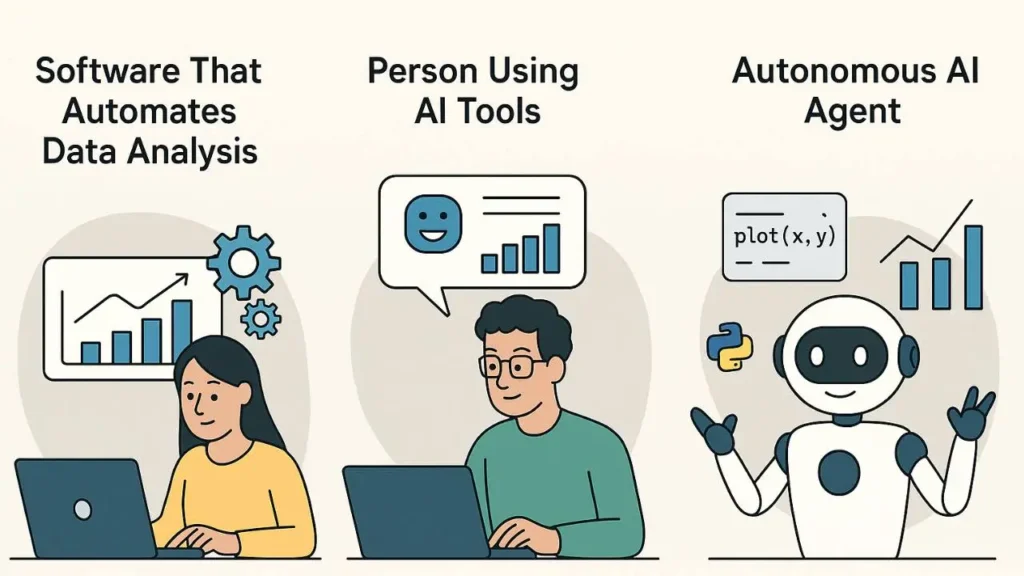
In the early 2020s, data analysis was a reactive process. You waited for a weekly report to see that sales had dipped. By 2026, ai reporting tools have made analysis proactive and prescriptive. We have moved into the era of Agentic Analytics, where AI doesn’t just display data—it acts on it.
What Makes 2026 AI Tools Different?
-
Natural Language to SQL (NL2SQL): You no longer need to write code to speak to a database. You can ask, “Show me why our churn rate in the Northeast increased last Tuesday,” and the AI will write the join queries, pull the data, and generate the visualization instantly.
-
Autonomous Trend Discovery: Modern ai analytics tools run in the background 24/7. They don’t wait for you to ask a question; they alert you when an anomaly occurs that deviates from the historical norm.
-
Semantic Layer Intelligence: 2026 tools like Connecty AI and Databricks Genie understand the logic of your business—knowing the difference between “Gross Revenue” and “Net Profit” without being reminded.
2. Top AI Data Analysis Tools of 2026: The Leaderboard
The market has branched into specialized categories. Whether you are a solo entrepreneur or a Fortune 500 enterprise, there is a business data ai solution tailored to your scale.
| Tool Name | Best For | Standout AI Feature | Integration Level |
| Connecty AI | Decision Intelligence | Day Zero Semantic Layer | Enterprise Data Warehouses |
| Microsoft Power BI | Ecosystem Integration | Copilot for Report Generation | Full Microsoft 365 Stack |
| Tableau Pulse | Proactive Monitoring | Automated Metric Narratives | Salesforce & Cloud Data |
| Julius AI | Speed & Simplicity | Instant Visual Answers | Spreadsheets & SQL |
| ThoughtSpot Sage | Search-Driven Analytics | LLM-Powered Insight Search | Cloud-Native Apps |
| Akkio | Predictive Modeling | No-Code Lead Scoring | Lead Gen & Sales Ops |
3. Deep Dive: Leading Enterprise AI Analytics Tools
Connecty AI: Beyond the Dashboard
In 2026, Connecty AI has emerged as a leader by focusing on “decisions, not just dashboards.” While traditional tools show you a graph, Connecty builds a “game plan.” It integrates with Snowflake and BigQuery to not only analyze data but also recommend specific business actions via Slack or email. Its “Autonomous Semantic Graph” learns your business rules, ensuring that the insights it provides are grounded in your specific reality.
Microsoft Power BI + Copilot
For organizations already within the Microsoft ecosystem, Power BI with Copilot is the 2026 standard. The integration has moved beyond simple chat. You can now prompt Copilot to “Create a 5-page executive report on Q3 performance with a focus on supply chain bottlenecks,” and it will build the layout, select the charts, and write the summaries in seconds.
Tableau Pulse: Proactive Insight Delivery
Tableau Pulse represents the death of the “manual check-in.” Instead of you going to the data, Pulse brings the data to you. It uses AI to identify drivers of change—telling you why a metric moved. If your shipping costs spiked, Pulse doesn’t just show a red arrow; it identifies the specific carrier and region causing the outlier.
4. The Rise of “Business Data AI” for Non-Technical Teams
One of the most significant shifts in 2026 is the democratization of data. You no longer need a Master’s degree in Statistics to gain high-level insights. AI data analysis tools have become the “Great Equalizer.”
-
Julius AI: This tool has become the favorite for marketing and sales managers. By simply uploading a CSV or connecting a Google Sheet, users can use a chat interface to perform complex regressions or create stunning data visualizations for presentations.
-
Polymer: Known for its “Automated Data Storytelling,” Polymer takes messy spreadsheets and turns them into searchable, interactive web pages. It is the gold standard for teams that need to share data externally with clients without building a custom portal.
5. How to Implement AI Reporting Tools: A 5-Step Framework
Deploying ai reporting tools requires more than just a subscription. To ensure your business actually benefits, follow this 2026 implementation framework:
Step 1: Clean the “Data Swamp”
AI is only as good as the data it consumes. Before connecting an ai analytics tool, use automated data cleaning software (like Netwrix) to remove redundant, outdated, or trivial (ROT) files.
Step 2: Establish the Semantic Layer
Define your “Ground Truth.” Ensure your AI knows that “Customer” in the Sales database is the same as “Client” in the Billing database. Tools like dbt or Looker are essential for creating this unified logic.
Step 3: Start with “Low-Hanging” Questions
Don’t ask the AI to “Fix the business” on Day 1. Start with specific, measurable questions like, “Which ad creative had the highest ROI in April?” This builds trust in the AI’s accuracy.
Step 4: Enable Natural Language Search
Encourage your team to stop building static PDFs. Move your reporting into search-based platforms where stakeholders can ask their own follow-up questions in real-time during meetings.
Step 5: Monitor for “Model Drift”
In 2026, data environments change fast. Regularly audit your AI’s outputs to ensure the logic hasn’t “drifted” as new data sources are added to the mix.
6. The Role of Predictive Analytics in 2026
We have moved past “Descriptive Analytics” (what happened) into “Predictive Analytics” (what will happen). Ai data analysis tools like Akkio and Qlik AutoML are now being used by mid-market companies to:
-
Forecast Churn: Identify which customers are likely to leave 30 days before they do.
-
Dynamic Pricing: Automatically adjust prices based on real-time competitor data and inventory levels.
-
Predictive Maintenance: For manufacturing firms, AI analyzes sensor data to predict machine failure before it halts production.
7. Security and Ethics in Business Data AI
With the power of ai reporting tools comes the responsibility of data governance. In 2026, “Privacy by Design” is non-negotiable.
-
Data Masking: Top-tier ai analytics tools automatically mask PII (Personally Identifiable Information) so that the AI can analyze trends without seeing individual customer names or credit card numbers.
-
Explainable AI (XAI): You should never trust a “Black Box.” The best 2026 tools provide a “Reasoning Path,” showing you the exact SQL logic or statistical model used to reach a conclusion.
-
On-Premise AI: For highly regulated industries (Finance, Healthcare), many business data ai providers now offer “Local LLMs” that stay entirely within the company’s private cloud, ensuring no data ever touches the public internet.
8. The Financial Impact: AI vs. Manual Analysis
The ROI of ai data analysis tools is measured in “Time to Insight.”
| Task | Manual (2022) | AI-Enhanced (2026) | Efficiency Gain |
| Data Cleaning | 10 Hours | 15 Minutes | 40x |
| Building a Dashboard | 3 Days | 10 Minutes | 144x |
| Monthly Reporting | 2 Days | Real-Time/Auto | Instant |
| Anomaly Detection | Weekly Review | Instant Alerts | 10,000% |
At openaihit.com, we argue that the cost of not using AI is the highest expense on your balance sheet. The ability to pivot your strategy based on real-time data is the difference between leading the market and being disrupted by it.
Conclusion: The Future belongs to the Data-Fluent
As we move toward 2027, the distinction between “Data Analyst” and “Business Leader” is blurring. With ai data analysis tools handling the technical heavy lifting, the most valuable skill is now Critical Inquiry—knowing which questions to ask and how to turn the answers into revenue.
The era of the “Static Report” is dead. Long live the era of the Autonomous Insight. Explore our latest reviews and tutorials at openaihit.com to stay ahead of the curve in the world of ai reporting tools.
FAQs
Q1: Do I need to know Python or SQL to use these tools?
In 2026, no. Most ai analytics tools are designed for natural language. However, having a basic understanding of data logic will help you craft better “prompts” for the AI.
Q2: Can I connect these tools to my existing Excel sheets?
Absolutely. Tools like Julius AI and Power BI have advanced connectors that allow you to sync your local spreadsheets with AI-powered cloud environments.
Q3: How much do AI data analysis tools cost?
Prices range from $10/month for solo tools (like Julius) to several thousand dollars for enterprise suites (like Domo or Tableau). Many offer “Free Forever” tiers for small datasets.
Q4: Will AI replace human data analysts?
No. It replaces the “grunt work” of data entry and cleaning. Humans are still required for the high-level strategy, ethical oversight, and contextual storytelling that machines cannot replicate.
Q5: Is my data used to train the AI?
Most professional business data ai tools offer a “Privacy Mode” where your data is siloed and never used to train global models. Always check the “Data Processing Agreement” before connecting your warehouse.