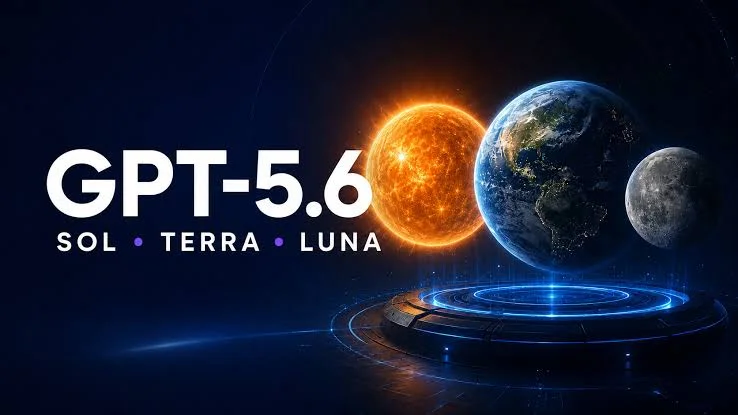
The latest models are designed for complex reasoning, coding, research, computer use, design, cybersecurity, science and long running professional workflows.
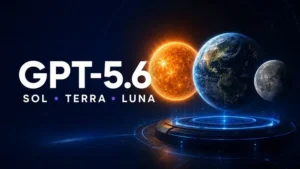
The GPT-5.6 family includes GPT-5.6 Sol, GPT-5.6 Terra, and GPT-5.6 Luna, with each model targeting a different point on the capability, speed, and cost spectrum. OpenAI launched the family for general availability in July 2026, while subsequent updates have expanded access and improved efficiency.
For readers following AI developments through openaihit, the important question isn’t simply what GPT-5.6 is called. It’s what the new features actually mean for everyday users, developers, businesses, and professionals.
What Is GPT-5.6?
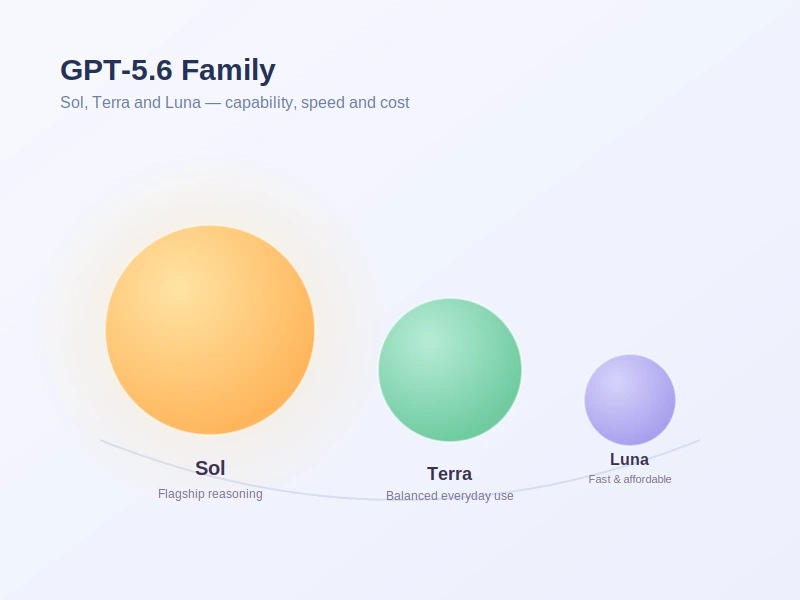
GPT-5.6 is OpenAI’s latest model family, built around three tiers:
- GPT-5.6 Sol: The flagship model for demanding reasoning, coding, research, agentic workflows, science, cybersecurity, and computer-use tasks.
- GPT-5.6 Terra: A more balanced option designed to provide strong capability at a lower cost.
- GPT-5.6 Luna: The fastest and most affordable member of the family, intended for everyday and cost sensitive workloads.
OpenAI describes the generation as being designed to get more useful work from every token. Instead of simply producing longer answers, GPT-5.6 is optimized to complete tasks with fewer tokens, fewer model interactions, and less unnecessary work.
Key Takeaways
GPT-5.6 is more than a conventional model upgrade. Its biggest improvements are aimed at making AI more capable of finishing real work.
The most important points are:
- GPT-5.6 comes in Sol, Terra and Luna tiers.
- Sol is designed for the most demanding workloads.
- Reasoning effort can be adjusted for harder tasks.
- Ultra can coordinate multiple agents.
- Coding and long running software workflows are major strengths.
- Computer use capabilities are stronger.
- Design and interface refinement have improved.
- Programmatic Tool Calling can make tool heavy workflows more efficient.
GPT-5.6 Features at a Glance
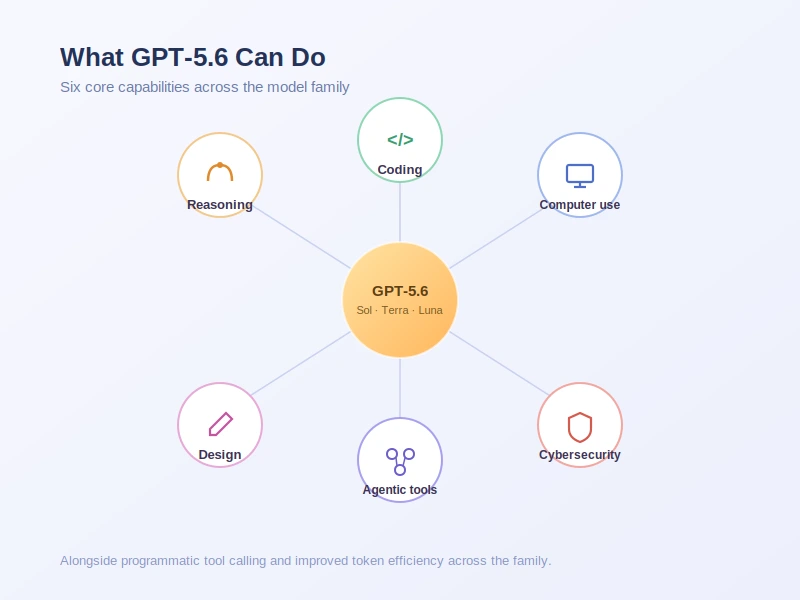
The most important GPT-5.6 features include:
| Feature | What it means |
| Advanced reasoning | More effort can be allocated to difficult problems |
| Multiple model tiers | Sol, Terra, and Luna target different workloads |
| Max reasoning | Gives the model more time to explore and verify difficult tasks |
| Ultra mode | Coordinates multiple agents for demanding workflows |
| Advanced coding | Better performance on long-running software tasks |
| Computer use | Can inspect and interact with computer environments |
| Design judgment | Better at creating and refining functional interfaces |
| Agentic workflows | Can plan, use tools, iterate, and complete multi-step work |
| Programmatic Tool Calling | Lets the model process tool results programmatically |
| Professional knowledge work | Improved documents, presentations, spreadsheets, and research |
| Cybersecurity capabilities | Stronger vulnerability research and defensive security work |
| Improved efficiency | More work can be completed with fewer tokens and tool calls |
These features make GPT-5.6 less about simple chatbot conversations and more about AI-assisted task completion.
1. Advanced Reasoning and More Control
One of the biggest GPT-5.6 features is greater control over reasoning effort.
Instead of treating every question equally, GPT-5.6 can devote more computational effort to difficult tasks. In ChatGPT, eligible paid users can select different reasoning levels, including Medium, High, and Extra High, while GPT-5.6 Sol Pro is available for the highest-capability workflows on eligible plans.
This creates a useful trade-off.
For a simple request such as rewriting a sentence, maximum reasoning isn’t necessary. But for tasks such as analyzing a complex business problem, debugging a large codebase, or evaluating competing technical approaches additional reasoning can improve the result.
2. GPT-5.6 Is Built for Agentic Work
A major change in modern AI is the movement from answering prompts to completing workflows.
GPT-5.6 is designed to plan tasks, use tools, process intermediate results, evaluate progress, and determine what should happen next.
OpenAI’s Programmatic Tool Calling allows GPT-5.6 to write and run lightweight programs that coordinate tools and process intermediate information. Rather than sending every piece of tool output back through the model, the system can filter and process information before deciding what matters.
A basic workflow might repeatedly send information to the model:
Data → model → tool → model → tool → model
A more efficient agentic workflow can instead process large amounts of intermediate information programmatically and return only relevant results.
3. Stronger Coding Capabilities
Coding is one of the areas where GPT-5.6 Sol has received particularly strong attention.
OpenAI describes Sol as its strongest coding model, with improvements in long-horizon engineering tasks, command line workflows, codebase navigation, debugging and tool coordination.
The model achieved a score of 80 on the Artificial Analysis Coding Agent Index in OpenAI’s reported evaluation, while also showing improvements on Terminal-Bench 2.1 and DeepSWE.
Independent coverage also points toward improved follow through on coding agent tasks. CodeRabbit’s testing focused specifically on where GPT-5.6 Sol fits into coding agents and code review workflows.
4. Better Computer Use
Another important GPT-5.6 feature is stronger computer use capability.
The model can work with computer environments rather than being limited to generating text or code. OpenAI reports improvements in OSWorld 2.0 an evaluation designed around computer use tasks.
This opens the door to workflows such as:
- Understanding a task.
- Navigating an application.
- Entering or modifying information.
- Inspecting the result.
- Correcting mistakes.
- Completing the workflow.
This is especially important for AI agents because real-world work often involves software interfaces, not just APIs.
5. A Major Improvement in Design and UI Work
GPT-5.6 isn’t focused exclusively on technical reasoning.
OpenAI highlights stronger design judgment, allowing the model to create interfaces with better visual hierarchy, usability, spacing and overall polish.
More importantly, GPT-5.6 can inspect rendered results and refine them.
Prompt → code
toward:
Prompt → code → rendered interface → inspection → refinement
For web developers and designers, this distinction is valuable because an application can be technically correct while still looking awkward or being difficult to use.
6. End-to-End Knowledge Work
GPT-5.6 is also designed for professional knowledge work involving documents, presentations, spreadsheets, research, and business analysis.
OpenAI reports improvements in creating polished documents and presentations, following reference templates, handling spreadsheets, and maintaining design systems across generated materials.
GPT-5.6 can infer elements such as:
- Layout patterns
- Typography
- Spacing
- Visual hierarchy
- Repeated slide structures
- Design conventions
This is particularly useful for organizations that need consistent deliverables rather than generic AI-generated documents.
7. Science and Cybersecurity
GPT-5.6 also pushes into specialized areas such as scientific research and cybersecurity.
OpenAI reports significant gains in cybersecurity evaluations, including ExploitBench and ExploitGym while emphasizing that the models have safeguards designed around higher risk capabilities.
GPT-5.6 can support defensive tasks such as:
- Secure code review
- Vulnerability analysis
- Threat modeling
- Patch development
- Detection engineering
- Malware analysis in authorized environments
- Security validation
The same general principle applies to scientific work. GPT-5.6 is intended to help researchers with long running analytical workflows including biology and quantitative research tasks.
8. GPT-5.6 Sol vs Terra vs Luna
Choosing the right GPT-5.6 model is more useful than simply choosing the newest model.
| Model | Best for | Main advantage |
| Sol | Complex reasoning, coding, research, agents | Highest capability |
| Terra | Everyday professional workloads | Balance of performance and cost |
| Luna | Fast, frequent, cost-sensitive tasks | Lowest cost and fast responses |
OpenAI describes Sol as the flagship, Terra as the balanced tier, and Luna as the fastest and most affordable option.
9. GPT-5.6 Pricing and Efficiency
The GPT-5.6 family was designed with efficiency in mind.
At launch, OpenAI listed API pricing of $5 per million input tokens and $30 per million output tokens for Sol, $2.50/$15 for Terra, and $1/$6 for Luna. OpenAI subsequently reduced Terra and Luna API pricing, while Sol also received a later promotional price reduction.
The exact economics depend on where and how the model is being used so users should check current OpenAI pricing before making purchasing decisions.
A model that completes a complicated workflow using fewer tool calls and fewer output tokens can potentially be more economical even when its headline token price is higher.
10. Is GPT-5.6 Available in ChatGPT?
Availability depends on the ChatGPT plan and product.
OpenAI’s current documentation says eligible paid ChatGPT users can access GPT-5.6 Sol through different reasoning levels. Pro users can access Sol Pro, while Free and Go users receive GPT-5.6 Luna as the default model as the rollout expands.
Terra and Luna are also available in ChatGPT Work, Codex, and the OpenAI API although exactly which models can be selected depends on the product and plan.
If GPT-5.6 Sol isn’t appearing in your model picker, OpenAI recommends checking whether your plan includes it and whether the rollout has reached your account or workspace.
Final Verdict
GPT-5.6 is best understood as a shift from AI that generates responses toward AI that can execute workflows.
Its strongest features aren’t limited to bigger benchmark numbers. The combination of reasoning controls, coding ability, computer use, tool coordination, multi agent workflows, design refinement and professional knowledge work makes the family considerably more practical for complex projects.
GPT-5.6 Sol is the obvious choice when maximum capability matters. Terra offers a more balanced option while Luna makes the technology more economical for high volume and everyday workloads.
Frequently Asked Questions
What are the main GPT-5.6 features?
The major features include advanced reasoning, stronger coding, agentic workflows, computer use, improved design judgment, professional knowledge work, programmatic tool calling and stronger capabilities in science and cybersecurity.
What is the difference between GPT-5.6 Sol, Terra and Luna?
Sol is the flagship model for demanding tasks. Terra focuses on balancing capability and cost, while Luna is designed for speed and affordability.
Is GPT-5.6 better for coding?
Yes. Coding and long horizon software engineering are among GPT-5.6 Sol’s major strengths. OpenAI reports state of the art results on several coding-agent evaluations although real world performance can vary by project and workflow.
Can GPT-5.6 use tools?
Yes. GPT-5.6 is designed for tool-heavy workflows and supports Programmatic Tool Calling in the Responses API. This allows programs to coordinate tools and process intermediate results before passing relevant information back to the model.
Is GPT-5.6 free?
Access depends on the specific GPT-5.6 model and ChatGPT plan. Current OpenAI documentation says Free and Go users receive GPT-5.6 Luna, while GPT-5.6 Sol is available to eligible paid plans.
Is GPT-5.6 worth using?
For complex coding, research, analysis, automation, design, and other long running workflows, GPT-5.6 can be a significant upgrade. For simple tasks, a faster and cheaper model may provide better value.