Modern ai tools for translation leverage advanced Neural Machine Translation (NMT) and contextual Large Language Models (LLMs) to instantly convert text, documents, audio, and web pages across hundreds of languages with human-like accuracy, natural phrasing, and cultural context awareness.
-
Contemporary ai language translator platforms deliver real-time content translation with up to 95%+ grammatical accuracy.
-
Context-aware AI algorithms preserve localized idioms, brand tone, and industry-specific terminology across languages.
-
Modern translation engines significantly reduce localization overhead and turnaround times compared to traditional manual agency workflows.
-
Advanced platforms integrate multiple LLM translation engines to give creators precise control over localized content tone and depth.
-
Free online tools offer instant multi-language translation for casual tasks, while enterprise options deliver API access and workflow integrations.
-
Native document parsing features allow users to translate PDFs, Word documents, and slides while preserving original layouts and formatting.
-
Integrated privacy protocols guarantee end-to-end encryption to safeguard sensitive corporate and personal translation inputs.
Introduction
In today’s interconnected digital ecosystem, content globalization is no longer just a luxury for multinational corporations, it is an absolute necessity for businesses, creators, marketers, and researchers worldwide. As internet access expands globally, audiences expect to engage with websites, software, social media, and educational resources in their native languages.
However, relying strictly on traditional manual translation presents significant operational bottlenecks. Manual translation is notoriously slow, expensive, and difficult to scale when publishing large volumes of content on a daily basis. On the other hand, early automated translation systems often produced robotic, literal, and grammatically awkward outputs that damaged brand credibility.
Fortunately, the evolution of modern ai tools for translation has completely bridged this gap. Powered by deep neural networks and advanced contextual models, current AI translation software understands nuance, tone, and sentence structure rather than just replacing words one-by-one.
In this comprehensive 2026 guide, we explore the top best ai translation tool solutions available, analyzing their accuracy, feature sets, pricing tiers, and ideal use cases to help you choose the right platform for your international growth strategy.
Why Businesses/Creators Need AI Translation Tools
Expanding your reach beyond native language boundaries is one of the most effective ways to unlock new growth channels. Whether you run an e-commerce storefront, publish educational articles, or manage a SaaS product, using an ai language translator transforms how you connect with international audiences.
Expanding Global Audience Reach
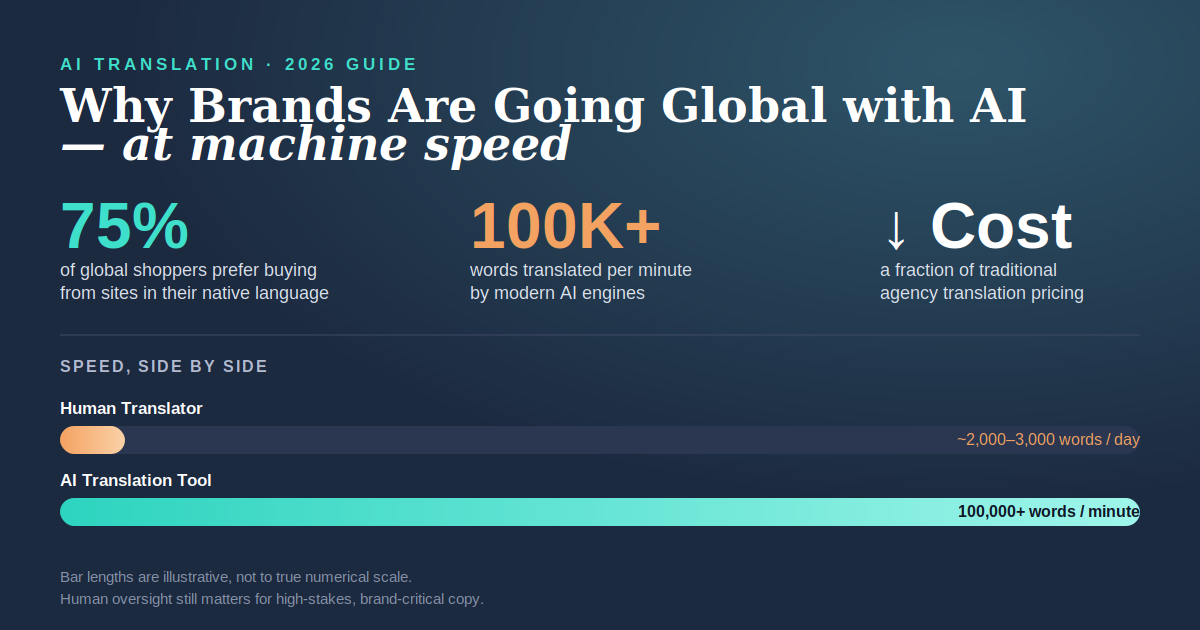
Over 75% of global consumers prefer buying products and reading content in their native language. By translating your landing pages, articles, and product guides, you instantly open your brand to millions of potential customers across Asia, Europe, Latin America, and Africa without setting up local physical offices.
Unmatched Time and Cost Savings
Hiring human translation agencies for every blog post, product update, or support ticket costs hundreds of dollars per document and takes days to execute. AI translation tools process tens of thousands of words in seconds at a tiny fraction of the cost, empowering small teams to operate with the agility of global enterprises.
Scaling Multilingual Content Marketing
Building a successful international brand requires consistent ai for multilingual content distribution. Publishing localized social posts, email newsletters, and SEO blog posts simultaneously across multiple languages ensures consistent global brand messaging while boosting international organic search rankings. If your localization strategy also touches SEO content at scale, our guide on SEO trends in 2026 covers how multilingual publishing affects rankings.
Speed & Scale Comparison
While human translators average around 2,000 to 3,000 words per day, an ai tools for translation workflow can process over 100,000 words per minute. While human oversight remains valuable for high-stakes localized marketing, AI provides the speed and scale required to handle massive digital workloads effortlessly.
How to Choose the Right AI Translation Tool
Before selecting an ai translation tool, it is essential to evaluate your specific technical requirements, budget, and workflow demands. Not all translation engines perform equally across all scenarios.
Here are the primary decision-making criteria to consider:
-
Translation Accuracy & Language Coverage: Ensure the tool supports your target regional dialects and maintains high grammatical accuracy for your required language pairs.
-
Contextual & Cultural Nuance: The engine should understand idiomatic expressions, formal vs. informal address, and specialized industry jargon (legal, technical, medical, or marketing).
-
Integration & API Capabilities: Look for direct integrations with your Content Management System (CMS), web browsers, desktop apps, or API endpoints for automated software localization.
-
Free vs. Paid Value: Assess whether an ai text summarizer free or free translation tier provides enough volume for your needs, or if enterprise security, batch document processing, and team features justify a paid subscription. If you want a wider view of no-cost options across categories, not just translation, check our list of best free AI tools in 2026.
Best AI Tools for Translating Content in 2026
openaihit : Best All-in-One AI Translation & Localization Ecosystem
When you need an advanced platform that combines translation precision with customizable content adaptation, openaihit stands out as a leading solution in 2026. Designed for creators, growth marketers, and business teams, openaihit leverages a multi-engine AI framework that goes beyond simple word swapping to ensure fully localized, context-aware content.
Whether you are translating complex technical whitepapers, localized marketing copy, or long-form blog articles, openaihit allows you to adjust output tone (formal, casual, persuasive) and preserve custom brand terminology. It acts as a comprehensive workspace for generating and managing high-performing ai for multilingual content.
-
Key Features: Multi-engine AI routing, tone and formality customization, custom terminology glossaries, batch document parsing, and seamless workflow integration.
-
Pros: Highly accurate contextual adaptation, preserves original document structure, versatile prompt controls, and fast processing speeds.
-
Cons: Advanced enterprise batch features require a paid tier subscription.
-
Best For: Marketing agencies, global businesses, content creators, and startups seeking a flexible best ai translation tool.
-
Pricing: Generous free access tier available; affordable premium plans for scaled workflows.
DeepL Translator: Unmatched Nuance and Natural Phrasing
DeepL Translator is widely recognized across the industry for delivering some of the most natural-sounding machine translations available today. Powered by advanced neural networks trained on high-quality multilingual data, DeepL excels at capturing subtle linguistic nuances and idiomatic expressions that other basic engines miss.
It provides intuitive desktop and browser extensions, full document translation (PDF, DOCX, PPTX), and custom glossary controls to maintain brand voice across localized collateral.
-
Key Features: High-accuracy NMT engine, custom glossaries, formal/informal tone switching, and full file document translation.
-
Pros: Exceptionally natural-sounding text, minimal post-editing required, robust desktop apps.
-
Cons: Fewer total languages supported compared to Google Translate (around 30+ core languages).
-
Best For: Professional writers, legal translators, and corporate communications requiring maximum linguistic polish.
-
Pricing: Free web version with character limits; Pro plans start at $8.74/user/month.
Google Translate: Versatile & Comprehensive Language Support
Google Translate remains the most ubiquitous free ai translator online tool on the planet. Powered by Google’s continuous advancements in AI and Neural Machine Translation, it supports over 130 languages, covering virtually every written dialect in active digital use.
Google Translate offers instant web page translation, real-time camera translation for mobile users, voice input translation, and direct Google Workspace integrations, making it an indispensable daily utility.
-
Key Features: 130+ languages, real-time image/camera OCR translation, voice speech-to-text, and browser extensions.
-
Pros: Completely free, massive language library, instant mobile accessibility.
-
Cons: Can occasionally miss complex industry context or literary nuance compared to specialized engines.
-
Best For: Casual users, travelers, and quick everyday multi-language references.
-
Pricing: 100% Free.
Microsoft Translator: Enterprise-Grade Cloud Localization
Microsoft Translator (part of Azure AI Services) is built specifically for scalable enterprise integration. It powers translation across Microsoft 365 applications (Word, PowerPoint, Outlook), Skype, and Edge browsers while offering robust cloud API pipelines for developers.
It excels at customizable real-time speech and document translation, allowing businesses to create custom translation models trained on proprietary industry terms.
-
Key Features: Azure Cloud API integration, real-time multi-device conversation translation, and custom NMT training.
-
Pros: Enterprise-level security compliance, seamless Microsoft product ecosystem integration.
-
Cons: Setting up custom models and APIs requires developer expertise.
-
Best For: Enterprise organizations, cloud developers, and Microsoft 365 power users.
-
Pricing: Free tier up to 2 million characters per month; pay-as-you-go cloud pricing thereafter.
ChatGPT & Claude for Translation: Context-Aware Conversational Translation
Generative AI models like ChatGPT (OpenAI) and Claude (Anthropic) have redefined what an ai language translator can achieve. Instead of treating translation as a static input-output process, these conversational models allow you to provide explicit instructions regarding tone, target persona, cultural context, and formatting. If you’re deciding which of these general-purpose models to rely on for everyday tasks beyond translation, our ChatGPT vs Gemini vs Claude comparison breaks down their strengths.
For example, you can prompt Claude: “Translate this English SaaS landing page into Spanish, keeping the tone upbeat and tailored for a Latin American startup founder.”
-
Key Features: Dynamic prompting, custom tone/persona adaptation, simultaneous translation and editing, and multi-turn feedback.
-
Pros: Unmatched flexibility for adapting marketing copy and creative writing across cultures.
-
Cons: Requires clear prompting skills to achieve consistent formatting across large document batches.
-
Best For: Creative copywriters, localized email marketers, and storytellers.
-
Pricing: Free access tiers available; Plus/Pro subscriptions at $20/month.
Reverso: Best Grammar & Context Combination Tool
Reverso is a specialized translation and language-learning tool that combines machine translation with contextual dictionary examples. When you translate a phrase, Reverso shows real-world bilingual sentence pairs from movies, official documents, and news articles, helping you verify how native speakers use the phrasing.
-
Key Features: Contextual sentence examples, built-in grammar checker, verb conjugation tables, and pronunciation audio.
-
Pros: Excellent educational tool for verifying exact word usage and context.
-
Cons: Free version has strict character length caps per search.
-
Best For: Language learners, students, and writers double-checking localized phrase usage.
-
Pricing: Free web version; Premium plans starting at ~$3.50/month.
Systran Translate: Business-Focused Security & Compliance
Systran is one of the pioneers in machine translation technology, offering enterprise-grade translation software tailored for heavily regulated industries such as defense, finance, and healthcare.
Systran provides specialized domain translation engines (pre-trained on legal, medical, or engineering terminologies) and can be deployed entirely on-premise or in private clouds to guarantee total data sovereignty.
-
Key Features: On-premise private deployment, industry-specific domain dictionaries, and high-volume batch processing.
-
Pros: Absolute data security compliance; no public cloud exposure.
-
Cons: Higher cost structure and complex setup compared to simple web apps.
-
Best For: Legal firms, healthcare organizations, and government agencies.
-
Pricing: Custom enterprise quotes; specialized desktop licenses available.
Smartling: Localization Management for Global Marketing Teams
Smartling is a comprehensive enterprise Translation Management System (TMS) that pairs AI machine translation engines with workflow automation tools for global marketing teams.
Instead of managing manual spreadsheets, Smartling automatically pulls content from your CMS (WordPress, HubSpot, Contentful), routes it through top-tier AI translation engines, enables human proofreading, and pushes localized content back to your site automatically.
-
Key Features: Automated CMS connectors, visual context editor, hybrid AI + human workflow management.
-
Pros: Streamlines complex global website localization without developer intervention.
-
Cons: Enterprise-focused platform with a higher cost barrier for small blogs.
-
Best For: E-commerce stores, global marketing teams, and enterprise SaaS companies.
-
Pricing: Custom enterprise plans based on translation volume.
Wordvice AI: Academic & Professional Document Translator
Wordvice AI is tailored specifically for academic researchers, graduate students, and scientific authors who need to translate research papers, journal submissions, and technical manuscripts into fluent English or other major languages.
In addition to translation, Wordvice integrates academic proofreading AI that fixes structural grammar, improves clarity, and ensures compliance with academic writing style guides.
-
Key Features: Academic vocabulary tuning, integrated AI grammar checker, style tone selector, and document layout preservation.
-
Pros: Maintains formal academic tone and technical accuracy for scientific terminology.
-
Cons: Tailored primarily for formal writing rather than casual marketing or social media copy.
-
Best For: Researchers, professors, medical writers, and graduate scholars.
-
Pricing: Free tier with basic word limits; Premium plans starting at $15/month.
Amazon Translate: Developer-Friendly Scalable Cloud API
Amazon Translate is a high-speed, neural machine translation service hosted on Amazon Web Services (AWS). It enables developers to integrate fast multi-language translation directly into mobile applications, websites, and cloud pipelines with a single API call.
It features automatic language detection, custom terminology support, and seamless integration with AWS services like Amazon S3 and Lambda for processing automated user-generated content (such as customer reviews and live chat feeds).
-
Key Features: Pay-as-you-go AWS infrastructure, custom terminology files, real-time dynamic text translation, and batch processing.
-
Pros: Extremely fast API response times and highly cost-effective for high-volume developer applications.
-
Cons: Lacks a friendly no-code interface for non-technical content creators.
-
Best For: Mobile app developers, software engineers, and cloud architects.
-
Pricing: Free tier includes 2 million characters/month for 12 months; $15 per million characters thereafter.
iTranslate: Mobile-First Personal & Travel Companion
iTranslate is a top-rated mobile translation app designed for iOS, Android, and watchOS. It offers a convenient free ai translator online and offline experience for on-the-go travelers, field workers, and casual voice conversations.
With support for camera text scanning, voice-to-voice translation, and offline regional language packs, iTranslate makes real-time multi-language communication effortless on mobile devices.
-
Key Features: Voice-to-voice conversation mode, offline translation dictionaries, camera lens translation, and Apple Watch support.
-
Pros: Clean mobile interface, fast voice recognition, works without active internet connection in offline mode.
-
Cons: Advanced features require a Pro subscription.
-
Best For: Travelers, field workers, and mobile-first users.
-
Pricing: Free download with basic features; Pro subscription at $5.99/month.
Free vs. Paid AI Translation Tools: Quick Comparison
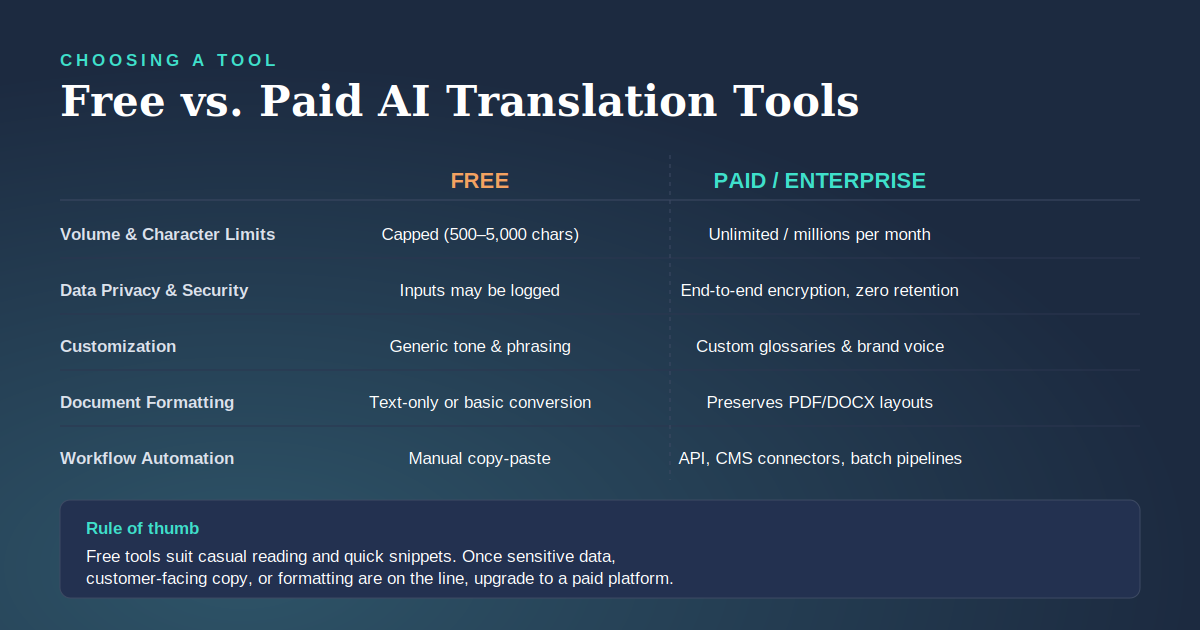
To help you decide between a free ai translator online solution and a dedicated paid platform, here is a structured comparison of feature capabilities:
| Feature Dimension | Free AI Translation Tools | Paid / Enterprise AI Translation Tools |
|---|---|---|
| Character & Volume Limits | Capped (e.g., 500 – 5,000 chars per query) | Unlimited or millions of characters per month |
| Data Privacy & Security | Inputs may be logged for model training | Strict end-to-end encryption & zero data retention |
| Customization Options | Generic default tone and phrasing | Custom glossaries, brand voice rules, & tone toggles |
| Document Formatting | Text-only or basic file conversion | Preserves complex PDF/DOCX design layouts seamlessly |
| Workflow Automation | Manual copy-pasting required | API access, CMS connectors, & batch pipeline integrations |
| Primary Platform Example | Google Translate / Basic Web Tiers | openaihit / DeepL Pro / Smartling |
When is a free tool sufficient?
Free translation tools are perfect for casual reading, quick email replies, travel phrases, or translating short snippets of non-confidential text.
When should you upgrade to a paid solution?
You should invest in a paid platform or dedicated tool when handling sensitive business data, publishing customer-facing localized marketing campaigns, preserving custom document formatting, or automating translation across software platforms.
Tips to Get Accurate AI Translations
Even the best ai translation tool yields significantly better results when provided with clean, structured input. Follow these tactical best practices to maximize translation quality:
-
Use Simple and Direct Sentence Structures: Avoid overly verbose sentences, double negatives, or ambiguous passive voice in your source draft.
-
Provide Contextual Prompts: When using flexible LLM tools like or ChatGPT, explicitly specify your topic, target audience, and preferred tone (e.g., “Translate for a professional B2B software audience in Germany”).
-
Create a Brand Terminology Glossary: Define non-translatable terms (such as brand names, trademarked feature names, and technical codes) so the AI engine leaves them intact.
-
Incorporate Human Review (Post-Editing): For mission-critical legal documents or major marketing launches, always have a native speaker quickly review the AI draft to ensure cultural sensitivity and zero awkward phrasing.
The Future of AI in Translation
The world of AI-driven localization is evolving at an unprecedented pace. As we move further into 2026, several key technological shifts are transforming how multilingual communication operates:
-
Real-Time Zero-Latency Voice Translation: Ultra-fast neural models are enabling seamless live voice translation during international video calls and webinars without noticeable delay.
-
Multimodal Context Awareness: Future AI translation models will simultaneously process text, surrounding visual layout, and spoken audio tone to infer exact intent and deliver hyper-accurate localization.
-
Autonomous Localization Workflows: AI agents will automatically monitor website updates, translate fresh copy into dozens of languages, verify layout formatting, and publish updates across global servers autonomously.
Conclusion
Adopting modern ai tools for translation is the fastest, most scalable way to break language barriers and connect with a global audience in 2026. Whether you need the instant universal accessibility of Google Translate, the linguistic precision of DeepL, or the comprehensive multi-engine power of openaihit, there is a specialized translation solution designed for your unique workflow.
By combining the speed and scale of advanced AI translation software with strategic human oversight, you can expand your brand’s international presence, save thousands of hours, and deliver meaningful localized experiences worldwide.
Frequently Asked Questions
Q1: Are free AI translation tools accurate enough for business use?
Free AI translation tools like Google Translate are great for casual comprehension and short messages. However, for public business marketing, customer support, or legal contracts, using paid tools or specialized platforms ensures higher accuracy, custom brand tone, and data privacy protection.
Q2: Will using AI translated content hurt my website’s Google SEO rankings?
No, Google’s search guidelines explicitly state that automatically translated content is acceptable as long as it is high quality, accurate, and helpful to users. To rank well, ensure your translated pages are properly localized, readable, and configured with correct hreflang tags.
Q3: What is the most accurate AI language translator available?
DeepL Translator is widely considered one of the most accurate tools for natural phrasing in major European and Asian languages. However, versatile AI platforms offer comparable precision with added flexibility to adjust tone, style, and brand context.
Q4: Can AI translation tools preserve original PDF document formatting?
Yes, modern tools like DeepL, and Wordvice AI can parse uploaded PDFs, Word documents, or slides, translate the underlying text, and re-export the file while keeping tables, headers, and images in their original positions.