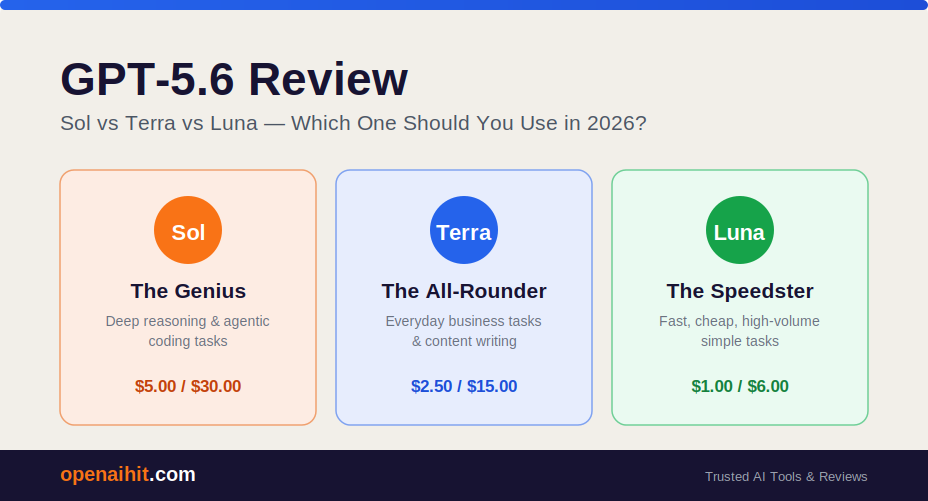
OpenAI has officially launched GPT-5.6, and they’ve changed how things work! Instead of giving us just one single model, they have introduced three different tiers: Sol (the ultra-smart reasoning champion), Terra (the balanced, budget-friendly workhorse), and Luna (the super-fast option for quick tasks). While Sol is priced the same as the older GPT-5.5 ($5/$30 per MTok), Openaihit suggests that most businesses can easily move up to 75% of their daily tasks to Terra or Luna. Doing this can slash your API bills by 50% to 80% without losing out on quality. As confirmed in OpenAI’s official announcement, the GPT-5.6 family launched with three distinct capability tiers rather than a single model.
Key Takeaways:
-
Release Date: Fully rolled out on July 9, 2026.
-
The Big Change: “5.6” is the version, and Sol, Terra, and Luna are the permanent tiers you can choose from.
-
Best for Coding: GPT-5.6 Sol is the undisputed king here, scoring a massive 80 on the Coding Agent Index.
-
Pricing: Sol ($5/$30 per MTok), Terra ($2.50/$15 per MTok), and Luna ($1/$6 per MTok).
-
Smart Caching: Save big with predictable prompt caching that gives you a 90% discount on repeat queries.
Introduction: Say Goodbye to “One Size Fits All” AI
Remember when using OpenAI’s best model meant choosing between a slow, expensive flagship or a fast but simplified version? On July 9, 2026, OpenAI officially changed the game with GPT-5.6.
Instead of forcing everyone to use the exact same model, OpenAI has split GPT-5.6 into three specialized versions. You can now choose the perfect model based on how fast you need it, what your budget is, and how complex your task is:
-
GPT-5.6 Sol (The Genius)
-
GPT-5.6 Terra (The All-Rounder)
-
GPT-5.6 Luna (The Speedster)
In this easy-to-understand guide, we’ll break down the real-world benchmarks, pricing, coding capabilities, and key updates to help you decide which model is the right match for you.
Meet the Family: Sol, Terra, and Luna
                  ┌──────────────────────────────┐
                  │      GPT-5.6 Model Family    │
                  └──────────────┬───────────────┘
                                 │
         ┌───────────────────────┼───────────────────────┐
         ▼                       ▼                       ▼
┌─────────────────┐     ┌─────────────────┐     ┌─────────────────┐
│       SOL       │     │      TERRA      │     │      LUNA       │
│  The Genius     │     │  The All-Rounder│     │  The Speedster  │
│  $5.00 / $30.00 │     │  $2.50 / $15.00 │     │  $1.00 / $6.00  │
└─────────────────┐     └─────────────────┘     └─────────────────┘
GPT-5.6 Sol: The Genius
Sol is the absolute smartest model in this lineup. It is built for tasks that require deep thinking, heavy logic, and autonomous agent operations. Sol features a new Max Reasoning Effort setting. This allows the model to think through a problem, test different solutions, write files, and double-check its own work before giving you the final answer.
If you are building advanced medical tools, complex financial analyzers, or multi-step developer workflows, Sol’s high-level cognitive layer is unmatched.
GPT-5.6 Terra: The All-Rounder
Terra is designed to be the default choice for everyday business tasks. The best part? It matches or beats the older GPT-5.5 in performance, but costs exactly half the price. If you need to extract structured data, write standard blog posts, or run everyday business applications, Terra is your best friend.
Terra strikes a highly calculated balance between cost and capability, meaning most product managers can use it to build robust apps without burning through venture funding.
GPT-5.6 Luna: The Speedster
Luna is built for pure speed and high volume. It is incredibly cheap and lightning-fast. Luna is perfect for quick, simple tasks like sorting customer support tickets, translating text, summarizing long articles, or powering real-time chat features where speed is everything.
It serves as the foundation for modern microservices that require thousands of sub-second decisions every minute.
Exciting New Features in GPT-5.6
OpenAI didn’t just update the numbers; they added some highly practical features that make building applications much easier.
Smarter Memory (GPT-Live)
The entire GPT-5.6 family now features an expanded context window and a brand-new memory system called GPT-Live. This allows the AI to remember your preferences and coding style across different chat sessions, so you don’t have to keep repeating your instructions. It cuts down on manual setup time and keeps your workflow seamless.
Robust Security and Refusal Guardrails
As AI models become more autonomous, security is a major concern. GPT-5.6 Sol debuts with OpenAI’s most secure system design to date. It is engineered to spot malicious prompt injections, detect secure network exploits, and prevent misuse. OpenAI spent weeks testing this defense mechanism to ensure enterprise data remains safe and protected.
Better and Easier Prompt Caching
In the past, prompt caching could feel a bit random. Sometimes the cache would expire just when you needed it. OpenAI has fixed this with two major updates:
-
Custom Breakpoints: You can now tell the AI exactly which parts of your prompt should stay saved in its memory.
-
30-Minute Guarantee: Saved prompts are guaranteed to stay active for at least 30 minutes, giving you faster responses and lower costs.
Cost Tip: While saving a new prompt to the cache costs slightly more (1.25x), reading from that saved cache later gives you a massive 90% discount.
Let’s Talk Money: Pricing Breakdown
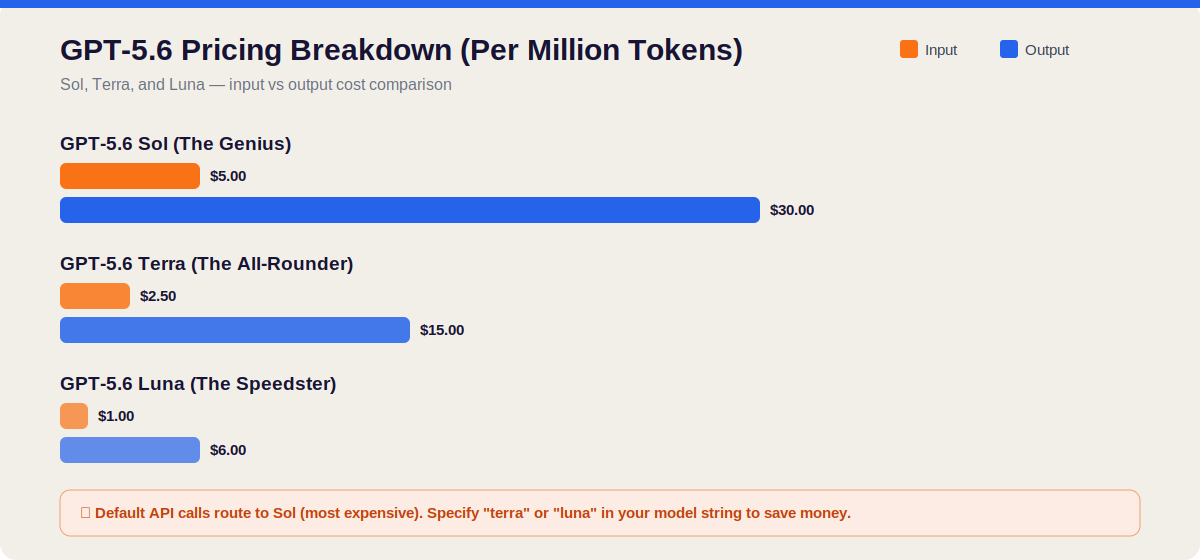
To make your decision easier, here is a simple look at how much each model costs per 1 million tokens.
| Model Name | Input Cost (per 1M) | Output Cost (per 1M) | Saved Cache Read | Best Suited For |
| GPT-5.6 Sol | $5.00 | $30.00 | $0.50 | Complex coding, deep research, security audits |
| GPT-5.6 Terra | $2.50 | $15.00 | $0.25 | Everyday business tools, data extraction, writing |
| GPT-5.6 Luna | $1.00 | $6.00 | $0.10 | Customer routing, fast translations, quick summaries |
-
A Quick Warning: If you simply type
gpt-5.6into your API code, OpenAI will automatically route you to the most expensive model (Sol). If you want to save money, make sure to typegpt-5.6-terraorgpt-5.6-lunainstead!
Coding Comparison: Which One Should Developers Use?
┌────────────────────────────────────────────────────────┐
│               Coding Complexity Spectrum               │
└────────────────────────────────────────────────────────┘
  Luna                      Terra                  Sol
  ───►                      ───►                   ───►
  Simple scripts            Standard reviews       Multi-file projects
  Fast boilerplates         Single-file updates    Deep self-debugging
Sol: The Best Coding Partner
If you are working on software development, GPT-5.6 Sol is the best choice. It scored a massive 80 points on the Coding Agent Index, easily beating older models. Sol can look at multiple files at once, write backend code, generate testing scripts, and even run the code to find and fix its own bugs.
Its deep integration with GitHub Copilot and Cursor means it can draft complex architectural maps in real time. If you’re evaluating coding assistants specifically, our Cursor vs GitHub Copilot vs Claude Code comparison is a useful next read.
Terra: The Helpful Assistant
Terra behaves like a capable junior developer. It scored 52.5% on CodeRabbit’s tests. While it might take a bit more guidance and step-by-step instructions compared to Sol, it is excellent for writing boilerplate code, creating unit tests, and making simple updates.
Standard Benchmarks: How Do They Score?
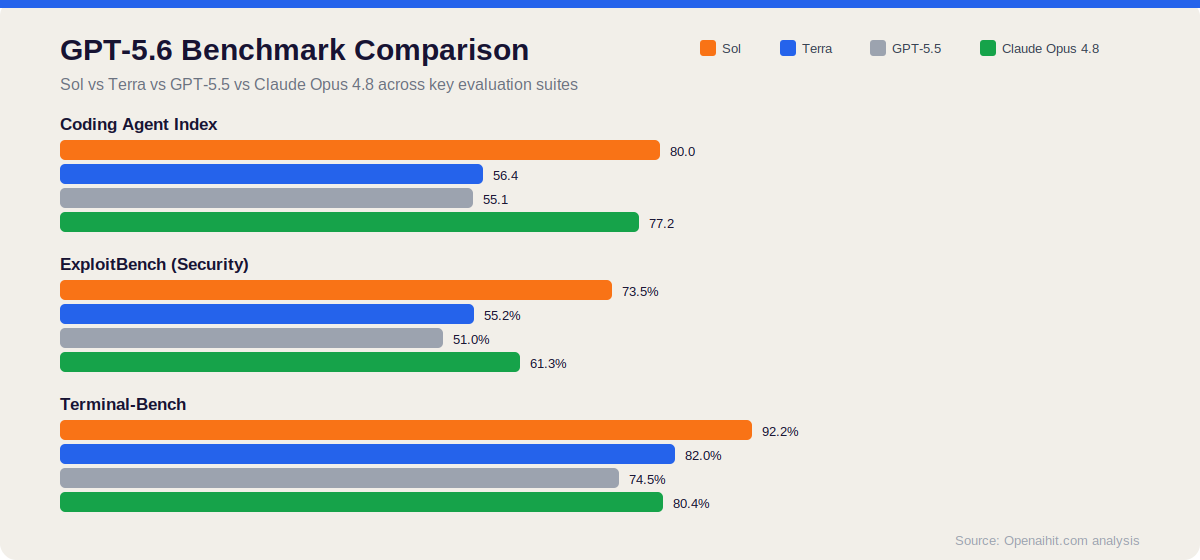
Here is how the new GPT-5.6 models compare to older versions and top competitors in independent tests:
| Test Name | GPT-5.6 Sol | GPT-5.6 Terra | GPT-5.5 (Older) | Claude Opus 4.8 | What It Measures |
| Agent’s Last Exam | 53.6 | 42.2 | 40.5 | 44.2 | Hard professional tasks |
| Coding Agent Index | 80.0 | 56.4 | 55.1 | 77.2 | Automated coding skills |
| ExploitBench | 73.5% | 55.2% | 51.0% | 61.3% | Security and bug finding |
| Terminal-Bench | 92.2% | 82.0% | 74.5% | 80.4% | Using command lines |
Key Takeaways:
-
Sol is incredibly smart: On the ultra-hard Agent’s Last Exam, Sol scored a record-breaking 53.6, putting it far ahead of other models.
-
Terra is a massive bargain: Terra easily matches or beats the older GPT-5.5 in tests, but costs 50% less to run.
-
Luna is surprisingly capable: Even though it is the cheapest tier, Luna still scored over 82% on Terminal-Bench, making it highly reliable for simple command-line tasks. For how this stacks up against Anthropic’s lineup, see our Grok 4.5 vs Claude Opus vs ChatGPT comparison.
GPT-5.5 vs GPT-5.6: Is It Time to Switch?
If you are currently using GPT-5.5, upgrading is a no-brainer.
┌────────────────────────────────────────────────────────┐
│                    Your Migration Path                 │
└────────────────────────────────────────────────────────┘
                       GPT-5.5
                          │
         ┌────────────────┴────────────────┐
         ▼                                 ▼
   Switch to Terra (Save 50%)        Switch to Sol (Same Price)
   • For everyday tasks              • For advanced coding
   • For content and data            • For complex reasoning
-
Want to save money? Switch to Terra. You will get the exact same (or better) quality of GPT-5.5, but your API bill will be cut in half.
-
Need maximum power? Switch to Sol. It costs the exact same as GPT-5.5, but it is vastly smarter, handles code much better, and reasons through problems effortlessly. Track all the latest updates in our running list of ChatGPT new features for 2026.
Pros & Cons of GPT-5.6
Pros
-
Flexible pricing: Luna and Terra let you save money by choosing the right tier for the right task.
-
Incredible reasoning: Sol sets brand-new records for coding and complex logic.
-
Better caching: Guaranteed 30-minute caching makes things highly predictable and cheaper.
-
Super fast: Luna offers lightning-fast responses.
Cons
-
Tricky default settings: If you aren’t careful, the API will default to the premium Sol model.
-
Thinking mode can be expensive: If you let Sol use “Max reasoning effort,” it can consume a lot of tokens quickly.
The Final Verdict: Which One Should You Choose?
The new GPT-5.6 lineup makes choosing an AI model much easier:
-
Go with Luna if you want maximum speed, high volume, and the absolute lowest price.
-
Go with Terra for your everyday tasks—it is the perfect balance of great quality and low cost.
-
Go with Sol if you are building complex systems, working with large codebases, or need deep reasoning.
Conclusion
GPT-5.6’s tri-tier family—Sol, Terra, and Luna marks a massive shift in how we build and scale AI applications in 2026. By moving away from a single, rigid model, OpenAI has given developers the ultimate freedom to optimize their systems based on cost, speed, and intelligence. Teams no longer have to pay premium prices for simple classification tasks, nor do they have to compromise on logic when building complex agents, making AI integration more dynamic and practical than ever.
For businesses looking to stay ahead, Openaihit recommends a smart routing approach: default to Terra or Luna for high-volume pipelines like customer routing, standard data extraction, and fast translations to dramatically slash API costs. Save the flagship GPT-5.6 Sol model for high-cognition tasks like multi-file codebase refactoring, advanced debugging, and security auditing, where its unmatched reasoning power is worth every penny.
FAQs
Q1: What is the main difference between Sol, Terra, and Luna?
-
Sol is the premium model for complex reasoning and deep coding.
-
Terra is the balanced, cost-effective model for everyday work.
-
Luna is the ultra-fast, cheap option for basic tasks.
Q2: Which model is best for writing code?
GPT-5.6 Sol is easily the best choice. It can understand entire codebases and self-debug its own errors.
Q3: How much cheaper is the new pricing?
While Sol is priced the same as GPT-5.5, Terra is 50% cheaper ($2.50/MTok vs $5/MTok), and Luna is 80% cheaper ($1/MTok), making it much more affordable to build applications.
Q4: Can I use these models on ChatGPT Plus?
Yes! ChatGPT Plus, Pro, and Enterprise subscribers can access Sol, Terra, and Luna directly.