Claude Sonnet 5 (released June 30, 2026) is Anthropic’s most advanced and agentic mid-tier model. It effectively closes the performance gap with the flagship Opus 4.8 at a fraction of the cost, offering a 1 Million token context window and dynamic Adaptive Thinking. While Opus 4.8 still holds a slight 6% edge in ultra-complex, long-horizon coding tasks, Openaihit recommends Claude Sonnet 5 as the smarter, faster, and more cost-efficient default for 90% of development and enterprise workflows.
Key Takeaways for Search Engines:
-
Release Date: June 30, 2026, alongside Fable 5 and Mythos 5.
-
Standard Pricing: $3.00/MTok input and $15.00/MTok output (effective September 1, 2026).
-
Token Inflation: A new tokenizer processes ~30% more tokens for the same English text, slightly increasing effective costs.
-
Reasoning Power: Adaptive thinking is on by default with dynamic compute allocation (Low to X-High Effort).
-
Agentic Capabilities: Dominated OSWorld benchmarks at 81.2% with native computer and browser tool use.
Introduction
On June 30, 2026, Anthropic completely disrupted the artificial intelligence ecosystem by launching its latest generative model: Claude Sonnet 5. Positioned by Anthropic’s engineering division as its “most agentic Sonnet yet,” this model has sent shockwaves through the developer community and enterprise cloud infrastructures alike. In today’s fast-evolving search landscape where LLMs, AEO (Answer Engine Optimization), and GEO (Generative Engine Optimization) dictate web visibility, understanding the strengths and limitations of these foundation models is crucial.
Our comprehensive Claude Sonnet 5 review digs deep into performance benchmarks, architectural updates, and how it fits into your daily AI stack.
One-Line Thesis: Claude Sonnet 5 successfully bridges the performance gap to Anthropic’s flagship Opus 4.8, providing developers and enterprise systems with tier-one reasoning capacities at a mere fraction of the cost.
In this exhaustive review, we will dissect Sonnet 5’s pricing structure, highlight its standout agentic features, analyze official and third-party benchmark performances, and contrast it directly with both Claude Opus 4.8 and OpenAI’s GPT-5.6.
What Is Claude Sonnet 5?
Claude Sonnet 5 is the mid-tier, high-efficiency centerpiece of Anthropic’s third-generation “Pentagon” model suite. Released on June 30, 2026, alongside its creative peer Fable 5 and the logical heavyweight Mythos 5, Sonnet 5 has immediately become the default operational model across all of Anthropic’s offerings—including Free and Pro plans. It is also natively available across Max, Team, and Enterprise channels, the Claude Platform API, and Claude Code environments.
Architecturally, Sonnet 5 brings a major fundamental change: a newly optimized tokenizer that translates to roughly 30% more tokens processed for the same amount of raw English text. While this enhances context retention and dense computational processing, it has direct, non-negligible implications on effective API pricing (which we will break down honestly below).
Furthermore, Anthropic has fully integrated adaptive thinking by default, deprecating manual “extended thinking” switches in favor of automated, dynamically adjusting logic gates that allocate compute based on prompt complexity.
Key Anthropic Sonnet 5 Features
Claude Sonnet 5 is designed to function not just as an interactive chat companion, but as an autonomous system that plans, executes, and self-corrects.
Massive Context & Flexible Output Windows
-
1 Million Token Context Window: Sonnet 5 retains its market-leading 1M-token context capability, enabling ingestion of entire codebases, dense legal dossiers, and hundreds of research articles in a single prompt.
-
128K Output Token Limit: Unlike previous models capped at 8K or 16K, Sonnet 5 allows developers to prompt for massive outputs essential for writing fully developed backend modules or book chapters without truncation.
Adaptive/Hybrid Reasoning & Selectable Effort Levels
Sonnet 5 utilizes a dynamic “Compute-over-Reasoning” paradigm. Instead of using uniform computing power for every query, users and API configurations can target explicit reasoning efforts depending on task complexity:
-
Low / Medium Effort: Optimized for standard text generation, routing, and simple data extractions with immediate response times. -
High / Max / X-High Effort: Intended for debugging logic flows, complex mathematical models, and architectural engineering. Under these modes, the model actively logs internal thoughts before spitting out answers.
Advanced Agentic and Tool-Use Architecture
As Anthropic’s “most agentic Sonnet yet,” Sonnet 5 excels in autonomous multi-step planning, featuring native system integrations:
-
Computer and Browser Tool Use: The model natively executes visual clicks, scrolls, keystrokes, and file creations within simulated desktop sandboxes to perform manual tasks autonomously.
-
Interactive Terminal Execution: In integrated IDE tools like Claude Code, Sonnet 5 operates localized terminals, running tests and troubleshooting output loops on the fly.
Caching, Guardrails, and Multi-Cloud Ecosystems
-
Real-Time Cybersecurity Safeguards: This is the first Sonnet-tier model with specialized security gates. Sonnet 5 flags prompt injection strategies, potential code vulnerabilities, and logical bypasses before executing tasks.
-
Prompt Caching & JSON Schema Support: Save massive API costs via fast-access caching of repetitive documents and prompt blocks, and receive clean, production-ready structured JSON.
-
Cloud Integration: Available natively across AWS Bedrock, Google Cloud Vertex AI, and Microsoft Azure Foundry, alongside the standard Anthropic API.
Claude Sonnet 5 Pricing Breakdown
To evaluate whether this model fits your budget, we have broken down the standard API rates, dynamic modifiers, and the crucial tokenizer token inflation. For the most current and official rates, always cross-check against Anthropic’s official pricing documentation before budgeting production workloads.
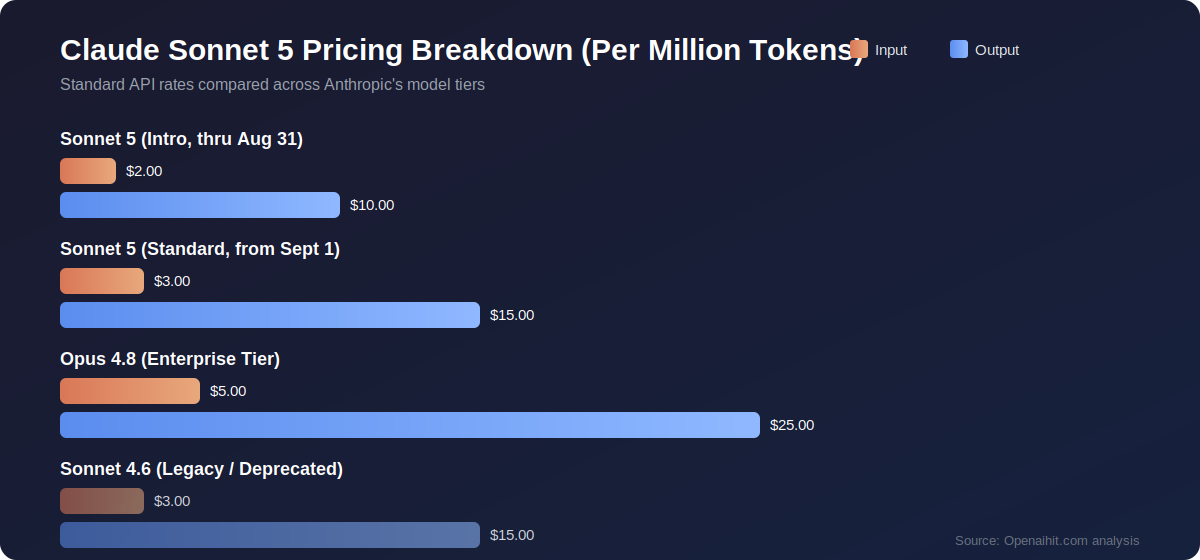
| Pricing Tier / Model Reference | Input (per MTok) | Output (per MTok) | Status / Effective Date |
| Sonnet 5 (Introductory Pricing) | $2.00 | $10.00 | Valid through August 31, 2026 |
| Sonnet 5 (Standard Pricing) | $3.00 | $15.00 | Effective from September 1, 2026 |
| Opus 4.8 (Comparison) | $5.00 | $25.00 | Standard Enterprise Pricing |
| Sonnet 4.6 (Legacy Reference) | $3.00 | $15.00 | Deprecated (Predecessor) |
Honest Caveat – Tokenizer Token Inflation:
The newly updated tokenizer in Sonnet 5 generates approximately 30% more tokens for the exact same input text block compared to legacy models like Sonnet 4.6. This means that while standard pricing sits at $3/$15, real-world testing shows that your effective API cost might feel closer to $3.90/$19.50 relative to historical token usage. Keep this in mind when projecting production expenses!
-
Prompt Caching Savings: Using cached prompts reduces input token costs by up to 90%, transforming high-frequency enterprise workflows into highly affordable processes.
-
Batch Processing: For non-urgent processing, standard API batch queries enjoy a flat 50% discount on both input and output parameters.
-
US-Only Dedicated Inference: Organizations seeking high reliability and low latency on US-only servers can opt for dedicated inference zones at a premium modifier of 1.1x pricing.
Benchmark Performance
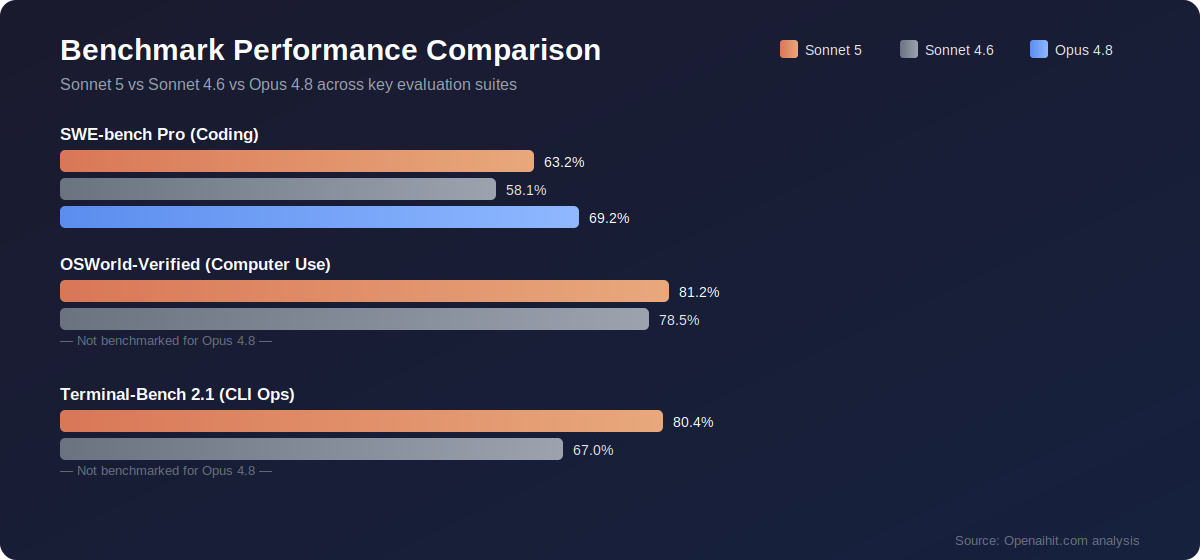
How does Claude Sonnet 5 perform on standardized tests? We compiled performance metrics across SWE-bench Pro, OSWorld, Terminal-Bench 2.1, and general reasoning matrices.
| Benchmark Evaluation Suite | Sonnet 5 Score | Sonnet 4.6 Score | Opus 4.8 Score | Performance Insight |
| SWE-bench Pro (Coding Tasks) | 63.2% | 58.1% | 69.2% | Opus 4.8 retains a thin edge in ultra-complex codebase refactoring. |
| OSWorld-Verified (Computer Use) | 81.2% | 78.5% | — | Sonnet 5 dominates in tool usage and direct environment navigation. |
| Terminal-Bench 2.1 (CLI Operations) | 80.4% | 67.0% | — | Significant progress in terminal script automation. |
| Humanity’s Last Exam (With Tools) | 57.4% | — | 57.9% | Sonnet 5 nearly matches the reasoning limit of Anthropic’s flagship. |
| GDPval-AA v2 (Knowledge Work) | 1,618 | — | 1,615 | Sonnet 5 takes a leading role in general information aggregation. |
Key Performance Takeaway: Claude Sonnet 5 comfortably matches or exceeds the flagship Opus 4.8 in general knowledge work (GDPval) and baseline reasoning (HLE with tools). However, for highly complex, multi-layered SWE engineering tasks, Opus 4.8 maintains its performance crown by a margin of 6%.
Claude Sonnet 5 vs Opus 4.8: Is It Better?
For product managers and developers alike, the ultimate decision points to one central question: Is Claude Sonnet 5 better than Opus 4.8?
The short answer is: Yes, for 90% of use cases, but with notable exceptions.
For a broader look at how Claude stacks up against other frontier models, see our ChatGPT vs Gemini vs Claude comparison.
Where Sonnet 5 Wins
-
Unmatched Price-to-Performance: Standard pricing of $3 / $15 per MTok for Sonnet 5 versus $5 / $25 per MTok for Opus 4.8 delivers massive cost efficiencies for startups and scaled businesses.
-
Fast Everyday Coding: Sonnet 5 features exceptional terminal, file, and browser tool integrations. Standard engineering routines (e.g., API migrations, boilerplate updates, boilerplate test generation) process significantly faster on Sonnet 5.
-
Production Agent Deployment: With lower latency and prompt caching enabled, Sonnet 5 is the premier model for active, autonomous agents that require low operational costs.
Where Opus 4.8 Still Wins
-
Deep-Level Coding Architecture: As evidenced by its 69.2% score on SWE-bench Pro, Opus 4.8 remains the gold standard for long-horizon code modification, algorithmic research, and system-level debugging.
-
Cost Nuance at X-High Effort: When Sonnet 5 is pushed to “X-High” adaptive thinking effort, it burns through tokens quickly due to internal thinking steps. Under high reasoning load, the overall transaction cost can sometimes meet or exceed standard Opus 4.8 pricing.
Verdict: Do not treat Sonnet 5 as a straight, linear upgrade over Opus 4.8. Instead, we recommend considering Sonnet 5 as your high-speed, cost-effective default, reserving Opus 4.8 for specialized, high-cognition reasoning problems.
Deep-Dive: Understanding Tokenizer Token Inflation
One of the most critical aspects of evaluating LLM updates is looking past the headline-grabbing benchmark numbers and looking at the actual execution costs.
Historically, Anthropic’s tokenizers have maintained a relatively stable text-to-token ratio. However, in Claude Sonnet 5, Anthropic introduced a newly designed tokenizer engineered to compress structured data formats, nested JSON outputs, and multilingual syntaxes more efficiently.
While this design works wonders for programmatic efficiency, it has a side effect known as Tokenizer Token Inflation on standard English prose. For average English prompts and outputs, the new system logs roughly 30% more tokens compared to Sonnet 4.6. Because LLM API charges are metered per individual token rather than raw characters, this change results in a hidden markup. Developers running massive loops must calculate their budgets based on an effective pricing model that assumes a slightly higher actual token count.
Deep-Dive: Adaptive Reasoning and the “Extended Thinking” Era
Previously, users had to choose between a standard low-latency response or manual “extended thinking” modes that used extensive computing power to calculate complex tasks. Claude Sonnet 5 marks a permanent shift toward Adaptive Thinking.
Under this paradigm, the model analyzes the logical complexity of the prompt incoming to the system. Simple queries like “Write an email draft” bypass the deep reasoning layer completely, resulting in fast speeds and low latency. On the other hand, prompts like “Optimize this multi-threaded database index” trigger dynamic logical compute. The model internally drafts, refutes, and corrects its own plans in a hidden reasoning state before generating the final output. This means users no longer have to manually toggle modes to get optimal results.
Who Should Use Claude Sonnet 5?
To optimize your operational spending, map your user persona to the ideal deployment tiers below:
-
Production Developers: Ideal if you are deploying complex agent pipelines, autonomous code assistants, and visual tools. Take advantage of prompt caching to run multi-agent scripts cheaply.
-
Knowledge Professionals & Content Teams: If you summarize massive PDFs, run compliance workflows, or maintain deep knowledge portals, Sonnet 5’s top-tier knowledge work capability is a perfect match.
-
Systems Architects: Ideal for designing systems where latency and standard cost constraints are as important as pure capability.Production developers exploring autonomous pipelines should also check our roundup of the best AI agents in 2026.
Pros & Cons
Pros
-
Significantly cheaper than Opus 4.8 with comparable high-tier performance.
-
1-million-token context with a generous 128k output buffer.
-
Extremely effective computer use and terminal tools.
-
Prompt caching yields huge savings on repeat tasks.
Cons
-
New tokenizer inflates token counts by roughly ~30% for same-length English text.
-
Extreme-high effort levels can quickly become expensive.
-
Advanced cybersecurity safeguards can occasionally cause overly sensitive refusals in testing/vulnerability workflows.
Conclusion & Final Verdict
Claude Sonnet 5 represents a monumental step forward in agentic AI. By balancing pricing with extreme capabilities, Anthropic has provided a tool that handles complex coding, visual operations, and analytical workflows with ease.
Openaihit’s If you are building AI agents or optimizing your production pipelines, Claude Sonnet 5 is the absolute gold standard for 2026. Ready to test the boundaries of Claude Sonnet 5? Sign up on Claude.ai or access the API via the Claude Console today!
FAQs
Q1: Is Claude Sonnet 5 free to use?
Yes, Anthropic offers Claude Sonnet 5 with standard usage limits on the Free tier at Claude.ai. For expanded limits and premium features, users can subscribe to Claude Pro.
Q2: How much does Claude Sonnet 5 cost per million tokens?
For standard API access from September 1, 2026, the price is set at $3.00 per million input tokens and $15.00 per million output tokens.
Q3: Is Claude Sonnet 5 better than Opus 4.8?
For everyday tasks, standard coding, and general knowledge work, yes—it is faster, cheaper, and nearly as capable. However, Opus 4.8 still retains a slight edge on complex software engineering tasks.
Q4: What happened to the introductory pricing after August 31, 2026?
The temporary promotional pricing ($2.00 input / $10.00 output per MTok) expired, and standard pricing ($3.00 input / $15.00 output) went into effect on September 1, 2026.