A few months ago, I was managing content production for three different clients simultaneously. Each one was using a different AI writing tool. Each one had received an update email from their platform within the same week claiming to have completely transformed how their product worked.
I spent two days testing every new feature that had been announced.
Some of them were genuinely game changing. Others were rebranded buttons that had existed for a year. And one major platform had quietly changed something that broke my entire content workflow without putting it in any announcement at all.
That experience taught me something important about ai writing tools updates 2026. The platforms are updating faster than ever. But the updates that actually matter for your daily work are very different from the updates getting the most marketing attention.
This guide cuts through the noise.
-
Every major update across the leading ai writing tools updates 2026 broken down step by step.
-
Honest assessments of which updates are genuinely useful versus which are just marketing gimmicks.
-
Exactly how these changes affect writers, marketers, developers, and SEO professionals in practice.
AI Overview The State of AI Writing in 2026
Google broad core algorithm updates, specifically the major rollouts in March and May of 2026, have fundamentally transformed how search engines value text. Google broad core algorithm updates, specifically the major rollouts in March and May of 2026, have fundamentally transformed how search engines value text. Official details on these rollouts are documented directly in Google’s Search Central blog, which publishes all core update announcements. The standalone AI content generators that dominated previous years are no longer viable for high tier organic visibility.
Google upgraded quality systems now actively evaluate the human and operational footprint behind every piece of published material. To achieve sustained organic rankings and secure citations within Google AI Overviews, digital publishers must transition away from isolated chatbot prompts. Success requires constructing advanced multi agent editorial workflows that ingest custom proprietary knowledge assets and focus heavily on information novelty.
The Survival Metric of 2026: Information Gain has evolved into a primary ranking signal. Articles that merely aggregate or rephrase existing SERP results are systematically suppressed by the search engines.
What Has Actually Changed in AI Writing Tools in 2026
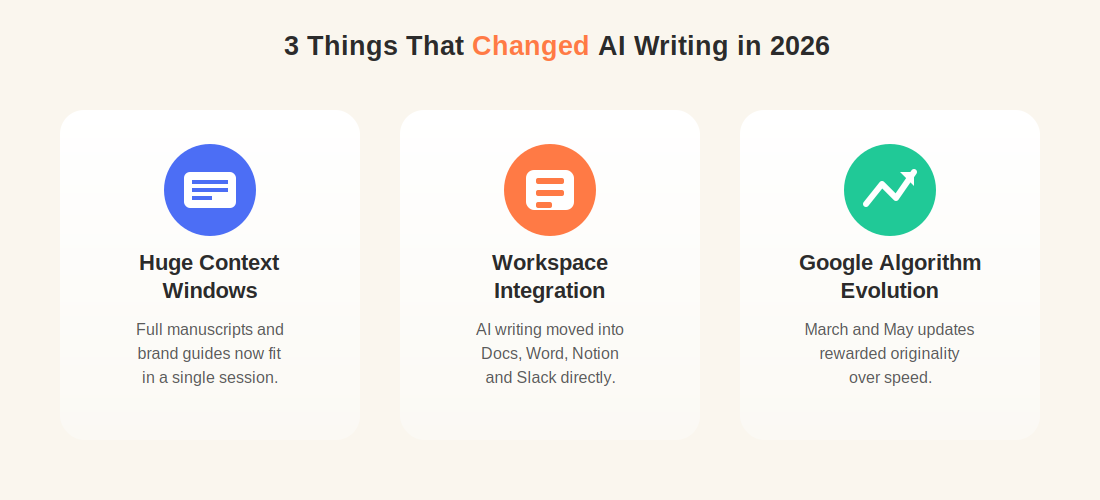
Before diving into individual platforms, it helps to understand the broader shifts happening across the industry in 2026. Three things have fundamentally changed how AI writing tools work this year.
1. Enormous Context Windows
The ability to feed entire manuscripts, full brand guidelines, and lengthy research documents into a single session, without losing context partway through, has transformed long form content production. This was a theoretical feature in 2025. In 2026, it became practically reliable for the first time.
2. Workspace Integration Replaced Standalone Tools
The biggest shift in ai writing tools updates 2026 is not a new feature inside any specific platform. It is the movement of AI writing capabilities directly into the tools people already use. Google Docs, Microsoft Word, Notion, and Slack all received significant AI writing upgrades this year. For many professionals, this means the standalone AI writing tool they were paying for has become partially redundant.
3. Google Algorithm Evolution
The March and May 2026 core updates specifically impacted how content produced with AI tools performs in search. This has forced every major AI writing platform to rethink how they help users create content that ranks rather than content that simply gets generated quickly.
AI Writing Tools Updates 2026 Month by Month Breakdown
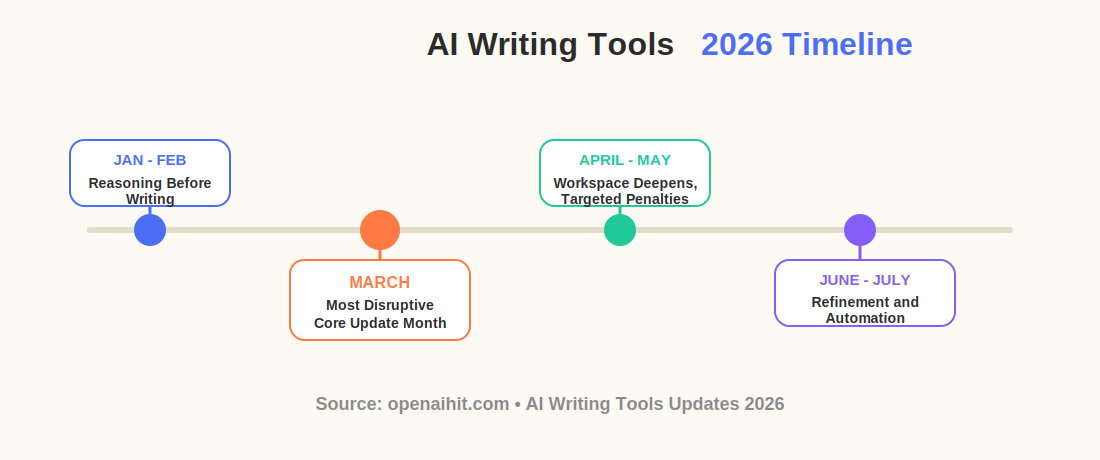
January and February 2026 Reasoning Before Writing
The first two months of 2026 were defined by one trend, which is reasoning before writing.
-
ChatGPT Extended Thinking: ChatGPT introduced extended thinking capabilities for long form content in January 2026. Instead of generating a 3000 word article from a single prompt in one pass, the model now spends time planning structure, identifying gaps in the argument, and flagging potential factual uncertainties before drafting begins.
-
Claude Projects: Claude released Projects in early 2026, a feature allowing users to maintain persistent context across multiple sessions. For writers working on a series of articles, a book, or ongoing client content, this eliminated the frustrating process of re-uploading brand guidelines every session. If you’re comparing coding-focused AI assistants too, our guide on Claude Code vs GitHub Copilot breaks down a similar head-to-head for developers.
-
Jasper and Writesonic: February 2026 saw Jasper release multi agent campaign workflows. Instead of generating individual content pieces, marketing teams can now set up automated sequences with different AI processes handling each stage. Writesonic updated its real time SERP analysis in February to pull live search result data to help writers understand the current top ranking pages before drafting begins.
March 2026 The Most Disruptive Month
March 2026 was the most significant month for ai writing tools updates 2026 this year, and the most disruptive. Google March 2026 core algorithm update rolled out and directly impacted content produced through automated AI workflows.
-
Surfer SEO Update: Surfer SEO released a major content scoring update in March 2026 that now evaluates not just keyword coverage but information novelty. It measures whether a piece of content adds something that existing top ranking pages do not already say. This directly ties into the broader shift covered in our guide on Generative Engine Optimization (GEO), which explains how to get cited by ChatGPT, Gemini, and Perplexity.
-
Grammarly Brand Voice: Grammarly launched its most significant update since the original product, which is a brand voice consistency system that learns from your existing content and flags when new AI generated drafts drift away from your established style.
-
ChatGPT Memory and Frase: ChatGPT released memory improvements in March that allow the platform to retain preferences, writing style notes, and recurring project details across conversations. For SEO professionals, Frase added AI citation suggestion features that help writers identify and link to authoritative external sources during the drafting process.
April and May 2026 Workspace Deepening and Targeted Penalties
-
Google Workspace and Copilot Upgrades: April brought a massive ecosystem level update when Google announced deep AI writing integration across its entire Workspace suite at Cloud Next 2026. Google Gemini in Docs, Gmail, and Slides received upgrades that allow users to maintain a consistent writing style across all documents linked to a Google Workspace account. Microsoft Copilot in Word received parallel updates, including deeper integration with organizational SharePoint data.
-
Notion AI Briefs: Notion AI quietly released an incredibly useful update in April, which is the ability to generate content briefs automatically from a URL or a topic, pulling from Notion existing workspace data to align new content with what the team has already established.
-
May 2026 Core Update: May 2026 brought the second major Google algorithm update. Unlike March, which broadly impacted AI content quality, the May update was more targeted, specifically affecting thin listicle formats and templated content that lacked original perspective or proprietary data. Jasper responded with template redesigns that prompt users to add original data and first person observations. Writesonic added real time competitor gap analysis features.
June and July 2026 Refinement and Automation
-
Claude Document Analysis: The summer months brought refinement rather than revolution. Claude released significant improvements to its document analysis capabilities, including the ability to process longer files, compare multiple documents simultaneously, and produce structured summaries that maintain the relationships between ideas.
-
QuillBot and Copy.ai: QuillBot updated its paraphrasing engine with improved contextual awareness, allowing the tool to distinguish between academic, conversational, and professional tones more reliably. Copy.ai released a major workflow automation update allowing marketing teams to build end to end content pipelines with human approval checkpoints built into each stage.
Genuinely Game Changing vs Marketing Buzz An Honest Assessment
Every platform sends update emails claiming revolutionary improvements. After testing the major updates across all the platforms above, here is an honest assessment of which changes actually affect daily work. For a deeper comparison of the top three assistants overall, see our full breakdown of ChatGPT vs Gemini vs Claude as the best AI chatbot in 2026.
| Genuinely Game Changing Real Value | Overhyped Marketing Buzz Limited Value |
| Claude Projects: Persistent context solves a real daily frustration for everyone doing ongoing work. The productivity gain is immediate. | Real Time SERP Analysis: The data is fresher but limited by the speed of web crawling, so it is not as fresh as the marketing implies. |
| Gemini Workspace Integration: For teams already inside Google ecosystem, the reduction in tool switching saves significant time. | Multi Agent Pipelines for Small Teams: These require significant setup time that small content teams under five people do not have. |
| Surfer SEO Novelty Scoring: This directly addresses the information gain signals that Google is now measuring in search results. | Incremental Paraphrasing QuillBot: The tool is slightly better, but the fundamental limitations of paraphrasing remain. |
| ChatGPT Persistent Memory: The ability to stop re explaining your writing style and target audience at the start of every session. |
Strategy Shift How to Use AI Writing Tools Post Updates
Before March 2026, the dominant AI writing tool strategy was to generate more and publish faster. After the March and May 2026 updates, that strategy collapsed for thousands of sites. The practical implication for how you use AI writing tools has changed in three specific ways.
-
Draft Accelerators Not Final Output: AI writing tools are now best used for first drafts, not final content. The tools that get this right are explicitly positioning themselves as draft accelerators that require human editing, fact checking, and original perspective to be complete.
-
Input Determines Output: Generic prompts produce generic content that now struggles to rank. The writers seeing the best results from AI writing tools in 2026 are those who inject specific brief details, proprietary data, client examples, and first person observations into their prompts before generating text.
-
Originality as a Strategic Input: Whether your AI writing tool helps you include original data, unique perspectives, and information that competing pages do not contain has become the primary differentiator between content that performs and content that does not.
AI Writing Tools 2026 Pricing Structure
Pricing has changed significantly across the major platforms this year with the following approximate structures.
-
ChatGPT Plus: Remains at approximately $20 per month, and the Pro plan is at $200 per month. The Pro tier is where most of the advanced reasoning upgrades landed first.
-
Claude Pro: Approximately $20 per month, and the Projects feature is available on this plan.
-
Surfer SEO: Restructured pricing includes the Standard tier at approximately $99 per month annually, Pro at $182 per month annually, and Peace of Mind at $299 per month annually. AI article generation is only included in the highest tier.
-
Jasper: Team pricing starts at approximately $49 per month, while multi agent campaign features have moved toward enterprise focused pricing.
-
Grammarly Pro: Approximately $12 per month annually, and the brand voice update is available on paid plans.
-
Writesonic: Offers a free tier for basic use with paid plans starting around $16 per month.
Practical Checklist Publishing Content in 2026
Before publishing any AI assisted content in 2026, run through this checklist based on what the March and May algorithm updates specifically targeted.
-
Does your content include at least one piece of information, data point, or perspective that the top three ranking competitor pages do not contain?
-
Has a human editor reviewed the draft for voice consistency, factual accuracy, and genuine helpfulness to the reader?
-
Is the content structured to directly answer the specific question the reader has rather than covering the topic generally?
-
Are external citations added to support key claims rather than leaving them as unsourced assertions?
-
Does the content reflect actual experience or knowledge rather than a synthesis of what other pages already say?
Conclusion
Looking back at the platforms that genuinely improved productivity in 2026, they were not the ones with the most impressive marketing announcements. They were the ones that quietly removed friction from the daily writing process through persistent context, workspace integration, and smarter first drafts.
At Openaihit, we believe that the ai writing tools updates 2026 story is not about which platform has the most new features. It is about which updates actually change how long it takes to produce something worth publishing. These changes are designed to make human creative and strategic work faster and better rather than trying to replace it entirely.
Frequently Asked Questions
What are the biggest ai writing tools updates in 2026?
The most significant updates in 2026 include Claude persistent Projects feature for long form context, ChatGPT memory and extended reasoning improvements, Google Gemini deep Workspace integration announced at Cloud Next 2026, Surfer SEO information novelty scoring update in March, Grammarly brand voice consistency system, and Jasper multi agent campaign workflow release.
How did Google March 2026 update affect AI writing tools?
Google March 2026 core update targeted content that lacked original perspective, proprietary data, and genuine human value regardless of how it was produced. AI writing tools responded by adding features focused on originality signals, information novelty scoring, competitor gap analysis, and workflows that prompt users to add first person observations.
Are ai writing tools updates in February and March 2026 significant?
Yes. February 2026 brought extended reasoning for drafting in ChatGPT and real time SERP analysis updates in Writesonic. March 2026 was the most significant month of the year because Google algorithm update forced every major platform to release quality focused updates.
Do the 2026 AI writing tool updates affect SEO content specifically?
Yes significantly. Surfer SEO March 2026 update directly addresses the information novelty signals Google is now measuring. Writesonic competitor gap analysis helps writers understand what their draft is missing before publishing. Frase updated its citation suggestion features to help writers add authoritative sources during drafting.