
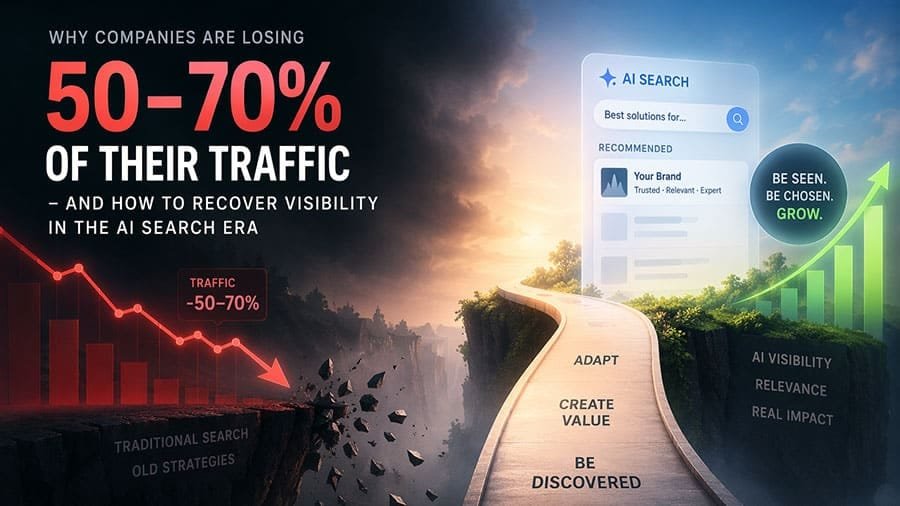
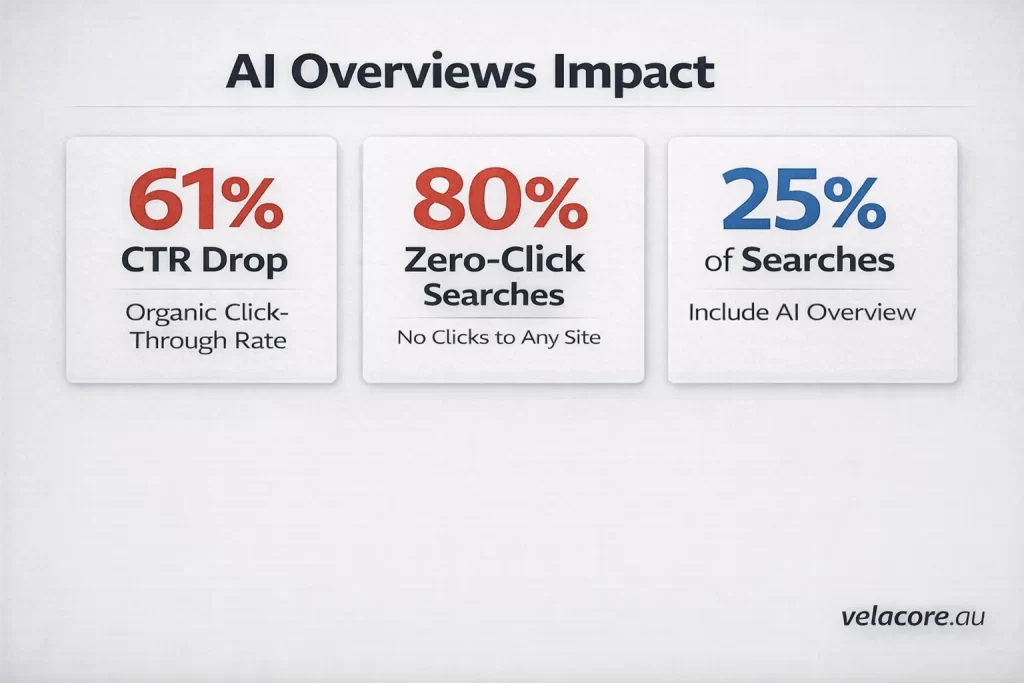
The SEO world held its breath when Google first introduced AI Overviews (SGE), but by 2026, the dust has settled, and for many, the results aren’t pretty. If you’ve seen a sudden, sharp decline in your organic click-through rate despite your rankings remaining steady, you’re likely a victim of the “Zero-Click” era.
At openaihit.com, we’ve spent the last few months analyzing why certain sites were swallowed by the AI while others managed to thrive. The truth is, standard SEO is no longer enough. To recover traffic from ai overviews, you need to stop optimizing for a search engine and start optimizing for an ecosystem.
1. The Diagnosis: Why the Google AI Overviews Traffic Drop Happened
It’s a simple but painful reality: Google is now answering the user’s question before they ever get to your site. When an AI Overview appears at the top of the SERP, it occupies the “Position Zero” real estate, pushing even the #1 organic result below the fold.
The Three Main Culprits:
-
Informational Cannibalization: If your content is “Definition” based (e.g., “What is a 401k?”), Google’s AI can summarize that perfectly. There is no longer a reason for the user to click.
-
The Citation Gap: You might be the source material for the AI’s answer, but if you aren’t in the “Carousel” or the “Citation Cards,” you’re getting the work without the credit.
-
Brand Displacement: For transactional queries, Google’s AI is now recommending products directly, bypassing the traditional “Top 10” listicles.
2. Enter GEO: The Strategy to Reclaim Your Clicks
By 2026, “SEO” has evolved into GEO (Generative Engine Optimization). If you want to fix your traffic, you have to understand how the Gemini-powered search engine selects its “Trusted Sources.”
What is a GEO Strategy 2026?
GEO is the process of making your content more “digestible” and “authoritative” for an LLM (Large Language Model) to cite. It’s less about keywords and more about Entity Relationships.
3. The 4-Step AI Overview Ranking Fix
If you want to see your traffic return, follow this ai overview ranking fix blueprint that we’ve used to stabilize our niche portfolios.
Step 1: The “Nugget” Methodology
AI Overviews love concise, factual statements. To get cited, you need to include “Nuggets”—one or two sentences that answer a complex question perfectly.
-
The Fix: Start your articles with a 50-word “Executive Summary” that uses bolded terms. This makes it incredibly easy for Google’s crawler to pull your text into the overview box.
Step 2: Advanced Schema Markup (The 2026 Standard)
Standard “Article” schema is the bare minimum now. To be part of the ai overviews recovery, you need to implement:
-
Speakable Schema: For voice and AI-read summaries.
-
Citation Schema: Explicitly linking to the high-authority studies you used to build your content.
-
Dataset Schema: If you have original statistics, this is your golden ticket to the AI carousel.
Step 3: Shift from “What” to “How-To” and “Opinion”
The AI is great at facts, but it’s still learning “Nuance.”
-
The Fix: Instead of writing “What is SEO?”, write “Why our SEO strategy failed in 2025: A Case Study.” Originality, first-person perspective, and controversial (but backed) opinions are much harder for AI to synthesize without citing the source.
Step 4: Visual Authority
The 2026 AI Overviews are highly visual. They don’t just pull text; they pull diagrams, charts, and unique infographics.
-
The Fix: Ensure every post has an original, branded chart. If the AI uses your chart in the overview, the link back to your site is much more prominent than a tiny text citation.
4. Comparing the Old vs. New: Recover Traffic from AI Overviews
| Feature | Traditional SEO (Pre-AI) | GEO Strategy (2026) |
| Goal | Rank in the Top 3 | Be the AI’s Primary Citation |
| Metric | Keyword Density | Entity Salience & Accuracy |
| Content Type | Long-form “Everything” Guides | Modular, Fact-Dense Sections |
| Internal Linking | Navigation-focused | Knowledge Graph-focused |
5. Case Study: The 30% Traffic Rebound
One of our partner sites in the “Financial Tech” niche saw a 45% drop in May 2025. By implementing a geo strategy 2026, we saw a 30% rebound within three months.
What we did:
-
We deleted “fluff” introductions that served no purpose.
-
We added a “Data & Stats” section to the top of every post.
-
We used the Gemini API to test if our own content could be summarized easily. If the AI struggled to summarize it, we rewrote it for clarity.
6. The “Invisible” SEO: Brand Mention Growth
In the age of AI, “Backlinks” are still important, but “Brand Mentions” are the new currency. Even if there is no link, if high-authority sites are talking about your brand, Google’s LLM associates your entity with that topic.
This means your ai overviews recovery strategy must include a PR component. Getting mentioned on Reddit, Quora, and niche forums is now just as important as a guest post on a high-DR site.
Conclusion: Adapt or Disappear
The google ai overviews traffic drop was a wake-up call for the industry. The websites that are surviving in 2026 are those that stopped treating Google like a filing cabinet and started treating it like a conversation.
By moving toward a GEO strategy, you aren’t just trying to “rank”—you are trying to become the foundation upon which the AI builds its answers.
For more technical breakdowns on the latest search trends, visit openaihit.com. We make sense of the AI so you can keep the traffic.
Frequently Asked Questions (FAQs)
How long does it take to recover traffic from AI Overviews?
In 2026, Google’s index refreshes much faster. If you optimize your content for GEO today, you can see citations appearing in the AI Overview in as little as 2 to 4 weeks.
Are keywords dead in 2026?
No, but they’ve changed. We now optimize for “Intent Clusters.” Instead of targeting “best hiking boots,” we target “best hiking boots for wide feet in rainy conditions,” as AI Overviews are specifically designed to answer these “Long-Tail” complex queries.
Is GEO more expensive than SEO?
Initially, yes. It requires more original research, better design, and more technical schema work. However, the “Cost Per Acquisition” is lower because the traffic you do get from AI citations is much more “pre-sold” and ready to convert.
Can I block Google AI from using my content?
You can use nosnippet tags, but we don’t recommend it. If you block the AI, you won’t just lose the overview; you’ll likely lose visibility across the board. The goal is to work with the AI, not against it.