AI Overview:
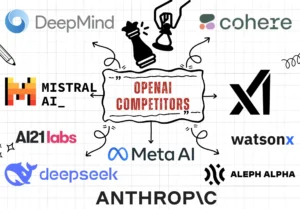
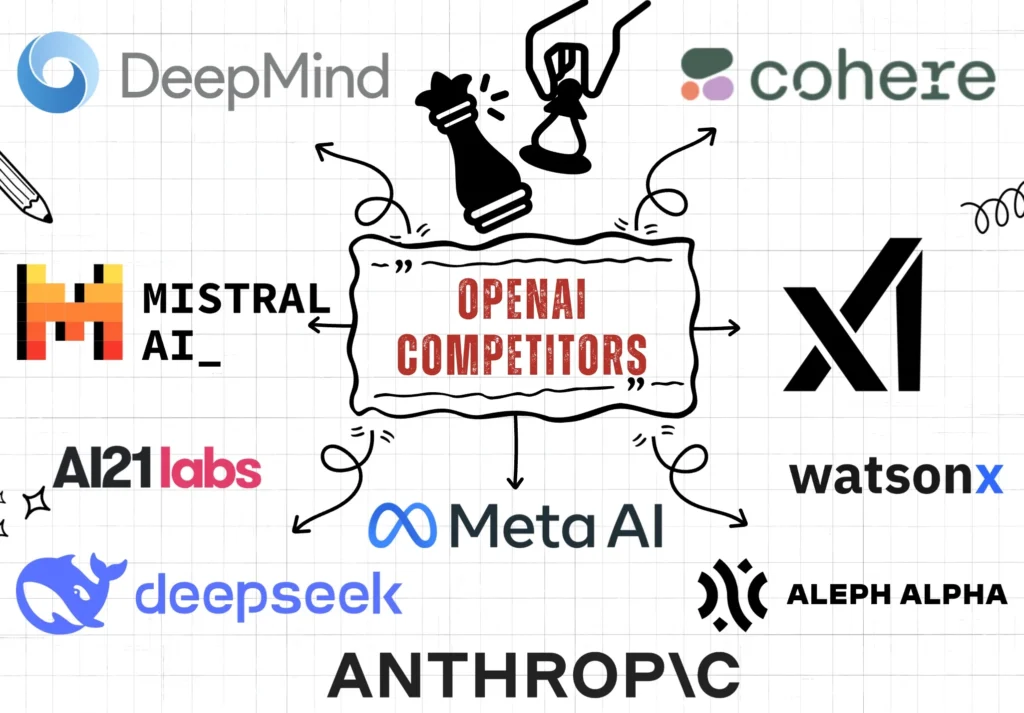
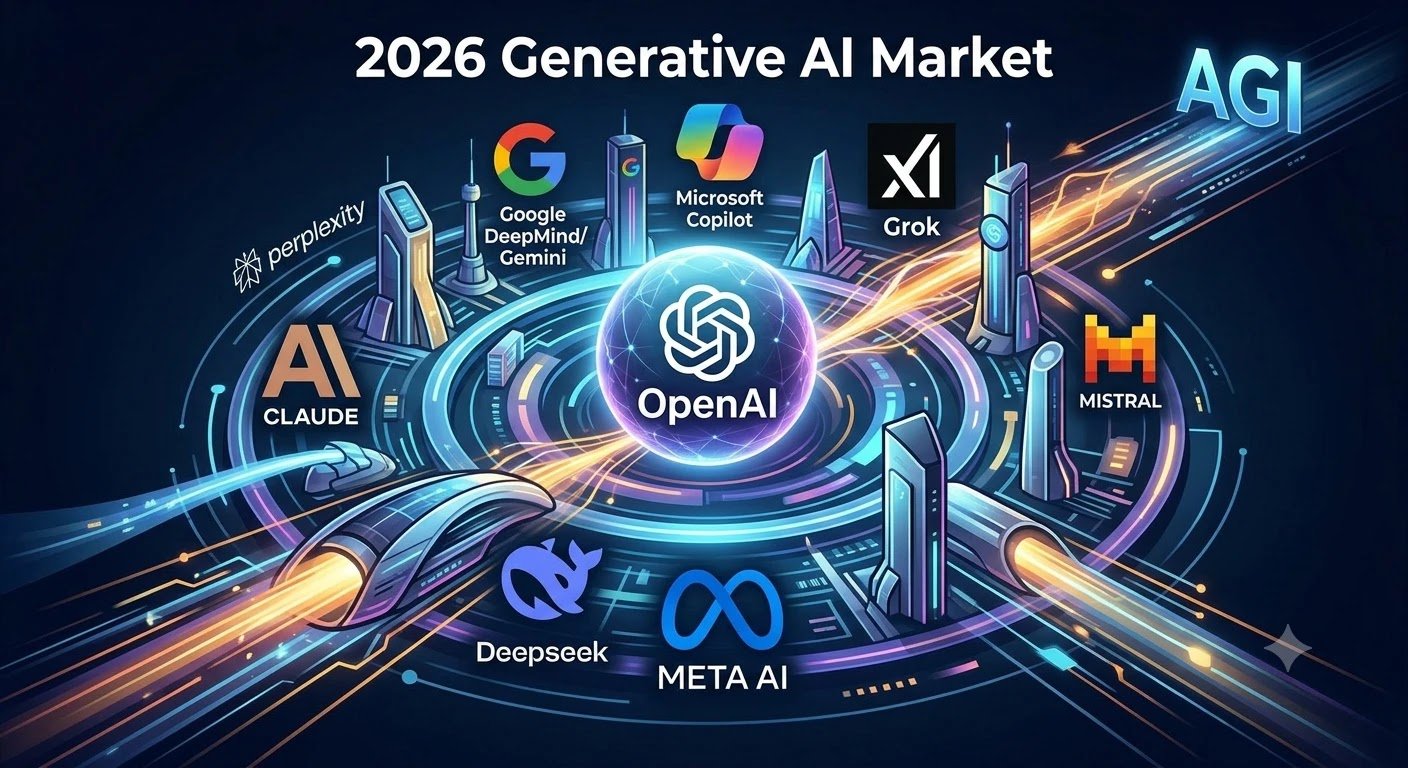
OpenAI helped turn generative AI into a mainstream technology, but it no longer operates in an AI market with one obvious leader and a group of distant followers. In 2026, companies such as Anthropic, Google, Microsoft, xAI, Meta, DeepSeek, Mistral and Perplexity compete with OpenAI from very different positions.
The biggest OpenAI competitors in 2026 are Anthropic, Google DeepMind, Microsoft, xAI, Meta, DeepSeek, Mistral AI and Perplexity. Anthropic is arguably the closest direct rival, while Google has one of the strongest overall competitive positions because it combines frontier AI research with Search, Android, Cloud and Workspace distribution.
The right competitor depends on what you need. Claude is particularly strong for writing, reasoning and coding; Gemini benefits from Google’s ecosystem; Perplexity focuses on web research and citations; Microsoft Copilot is deeply connected to Microsoft’s productivity environment; and open-weight players such as DeepSeek, Meta and Mistral compete heavily on accessibility, customization and cost.
Key Takeaways
- Anthropic’s Claude is OpenAI’s closest like-for-like frontier AI competitor.
- Google Gemini competes through advanced models plus Search, Android and Google Workspace integration.
- Microsoft Copilot turns Microsoft’s enormous software ecosystem into a major competitive advantage.
- Perplexity challenges OpenAI primarily in AI-powered search and research.
- xAI’s Grok competes through real-time information, its relationship with X and aggressive model development.
- Meta uses open-weight models and massive consumer distribution to challenge the proprietary AI model market.
- DeepSeek has increased competitive pressure through low-cost, highly capable models.
- Mistral AI is an important European and open-weight competitor, particularly for organizations seeking greater model and deployment control.
Who Are OpenAI’s Biggest Competitors?
There isn’t one definitive list because OpenAI competes across several markets.
OpenAI operates across consumer AI assistants, foundation models, APIs, coding tools, enterprise AI and increasingly agentic software. As a result, a company can compete with OpenAI without offering an exact ChatGPT equivalent.
A useful way to understand the competitive landscape is to divide it into four groups:
| Competitive category | Major competitors | Main area of competition |
| Frontier AI labs | Anthropic, Google DeepMind, xAI | Advanced foundation models |
| Enterprise & productivity | Microsoft, Google, Anthropic | Workplace AI and business software |
| Open-weight AI | Meta, DeepSeek, Mistral | Cost, customization and deployment |
| AI search & applications | Perplexity and specialist AI companies | Research, search and specialized workflows |
This broader definition is important because OpenAI competitors and ChatGPT alternatives are not exactly the same thing.
A ChatGPT alternative primarily competes for users of the ChatGPT application. An OpenAI competitor can challenge the company at the model, API, enterprise, infrastructure or application level.
1. Anthropic: OpenAI’s Closest Direct Rival
Claude by Anthropic:
Anthropic is probably the most direct competitor to OpenAI’s core AI business.
Its Claude family competes with OpenAI’s models across writing, reasoning, coding, document analysis and professional workflows. Anthropic describes Claude as an AI platform designed for language, reasoning, analysis and coding, with products for individuals, teams, enterprises and developers.
Claude’s competitive position has also strengthened considerably in 2026. Anthropic recently introduced Claude Sonnet 5, positioning it for coding, agents and professional work at scale.
Why Claude competes with OpenAI
Claude is particularly attractive to users who prioritize:
- Long-form writing and analysis
- Complex reasoning
- Coding
- Working with large documents
- Enterprise workflows
- AI agents and developer tools
Recent user-satisfaction research also put Claude ahead of Gemini and ChatGPT among surveyed UK users, although satisfaction surveys should not be treated as a universal measure of model quality.
Best alternative for: writing, coding, analysis and professional AI workflows.
2. Google DeepMind: The Biggest Ecosystem Threat
Google Gemini:
Google is arguably OpenAI’s most powerful competitor when resources, distribution and ecosystem are considered.
Its Gemini models compete directly with OpenAI’s models, but Google’s advantage extends far beyond the model itself. Gemini can be connected to products such as Gmail and Docs, while Google’s AI strategy also reaches Search, Android, Chrome, Cloud and other major platforms.
Google’s current AI offerings include advanced models, Deep Research, long-context capabilities, image and video generation, and AI features integrated into its broader ecosystem.
Where Gemini has an advantage
For someone already using Google products throughout the day, Gemini can be more convenient than switching between unrelated applications.
For example, a marketer working in Gmail, Google Docs and Sheets may value AI that fits directly into an existing workflow rather than an AI assistant that operates separately.
Best alternative for: Google Workspace users, multimodal work and users deeply invested in Google’s ecosystem.
3. Microsoft: The Enterprise Distribution Powerhouse
Microsoft Copilot:
Microsoft’s competitive relationship with OpenAI is unusually complicated because Microsoft has also been one of OpenAI’s most important strategic partners.
Nevertheless, Microsoft competes directly through Copilot and its broader AI ecosystem.
Copilot is integrated across Microsoft’s software environment, including productivity applications and business workflows. Microsoft’s original Copilot strategy was designed around making AI available across products such as Bing, Edge and Microsoft 365.
The major advantage is distribution.
Millions of businesses already depend on Microsoft products. If AI becomes embedded directly into Word, Excel, PowerPoint, Outlook and Teams, Microsoft does not need to convince every organization to adopt an entirely separate AI platform.
Best alternative for: businesses already using Microsoft 365.
4. Perplexity: A Major OpenAI Competitor in AI Search
Perplexity:
Perplexity approaches the AI market differently.
Instead of positioning itself primarily as a general-purpose chatbot, Perplexity focuses heavily on AI-powered search and research. Its system searches the web in real time and provides answers supported by citations and links to sources.
That makes it especially useful when the user’s question depends on current information.
For example, someone researching today’s AI industry developments may prefer an answer engine that searches current web sources rather than relying only on a model’s training knowledge.
Best alternative for: research, current information and source-backed answers.
5. xAI: Grok and the Real Time AI Race
xAI:
xAI, founded by Elon Musk, competes with OpenAI through the Grok family of AI models.
Grok’s differentiation is closely connected to real-time information and its relationship with the X platform. That creates a potentially valuable advantage for users who want AI connected to fast-moving online conversations and social content.
xAI is also competing aggressively at the infrastructure level, making it more than simply another chatbot company.
Its strategy is essentially to compete on model capability, speed of development, infrastructure and distribution simultaneously.
Best alternative for: users interested in real-time information, X-related context and an alternative frontier-model ecosystem.
6. Meta: Open Weight AI and Massive Distribution
Meta AI:
Meta’s AI strategy differs significantly from OpenAI’s.
Rather than relying only on a closed consumer chatbot model, Meta has invested heavily in open-weight AI and the Llama ecosystem while also placing AI directly into products used by billions of people.
This creates two competitive advantages.
First, developers and organizations can gain more flexibility from models that are available for broader experimentation and deployment. Second, Meta can distribute AI through its existing consumer platforms.
That combination makes Meta an important competitor even when its products do not look exactly like ChatGPT.
Best alternative for: developers interested in open-weight models and consumers already using Meta’s platforms.
7. DeepSeek: The Cost Disruption Challenger
DeepSeek:
DeepSeek has become an important part of the OpenAI competitive landscape because it challenges assumptions about how expensive advanced AI needs to be.
Its rise has increased pressure on leading AI companies to improve model efficiency and reduce costs.
DeepSeek is especially relevant to developers, researchers and users looking for capable AI without necessarily paying premium prices.
The larger significance is strategic: competition is no longer just about building the most powerful model. Efficiency, inference costs and accessibility matter too.
Best alternative for: budget-conscious users, experimentation and developers interested in efficient AI models.
8. Mistral AI: Europe’s Important AI Challenger
Mistral AI:
Mistral AI is another significant OpenAI competitor, particularly for organizations interested in open-weight models, customization and greater control over AI deployment.
Its importance goes beyond consumer chatbots. Mistral competes in enterprise AI and foundation models while representing a major European alternative to US-based AI giants.
This can matter for organizations concerned about deployment flexibility, data governance, regional requirements and reducing dependence on a single AI provider.
Best alternative for: organizations seeking model flexibility, European AI options and deployment control.
OpenAI vs Competitors: Which AI Is Best?
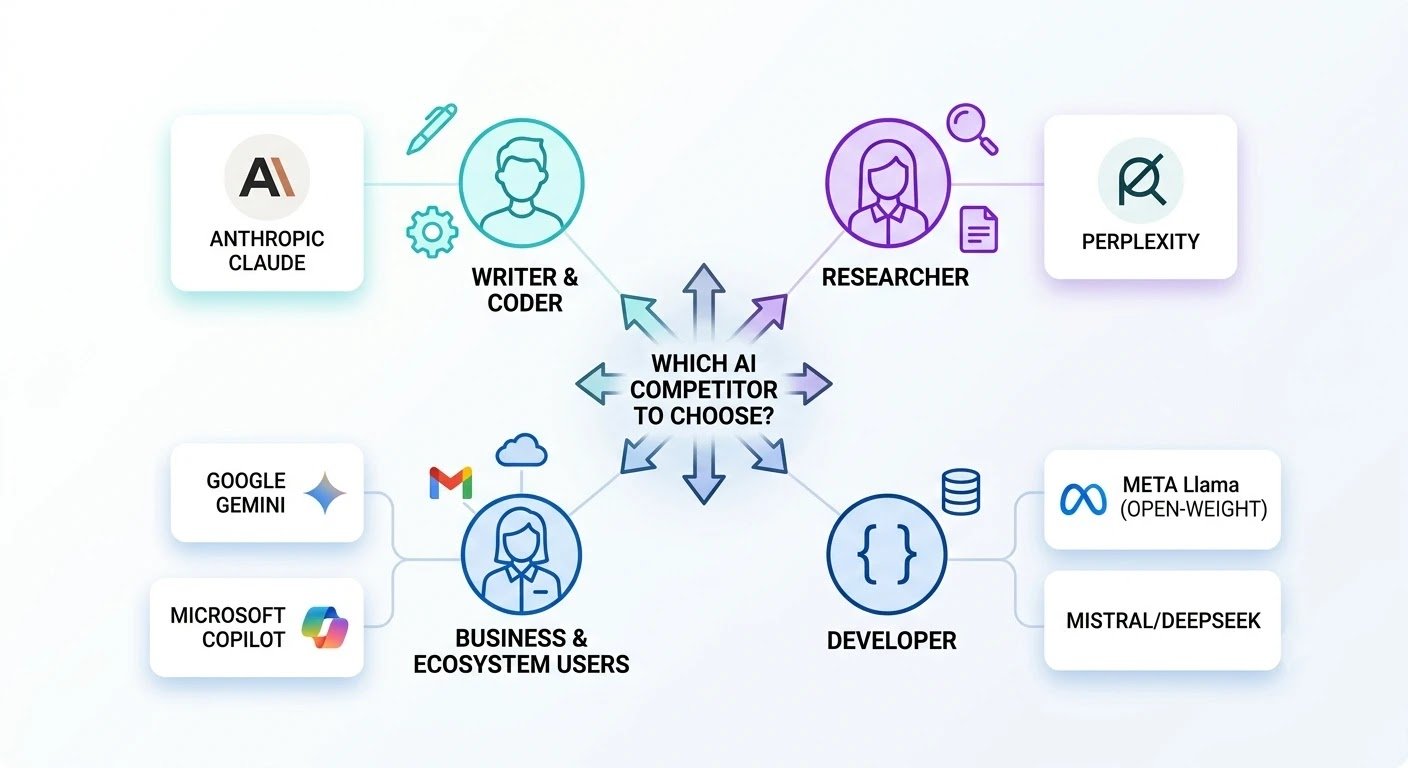
There is no universal winner.
The better question is: Which competitor is strongest for your specific job?
| If you care most about… | Consider |
| Writing and complex analysis | Claude |
| Google apps and ecosystem integration | Gemini |
| Microsoft 365 productivity | Copilot |
| Web research and citations | Perplexity |
| Open-weight AI | Meta or Mistral |
| Low-cost AI experimentation | DeepSeek |
| Real-time X-related information | Grok |
| Broad all-purpose AI workflows | ChatGPT |
This is why simplistic best AI rankings can be misleading.
A writer may prefer Claude, a researcher may prefer Perplexity, a Google Workspace employee may prefer Gemini, and an enterprise team already using Microsoft 365 may get more value from Copilot.
What Makes OpenAI Different From Its Competitors?
OpenAI’s advantage is not simply the quality of one model.
Its strength comes from combining several layers:
- ChatGPT gives OpenAI a huge consumer-facing AI product.
- Developer APIs allow companies to build applications around its models.
- Coding products extend its reach into software development.
- Enterprise offerings target organizations and professional workflows.
- Multimodal capabilities allow AI to work with more than text.
- Agentic capabilities push AI toward completing tasks rather than merely answering questions.
The competitive battle is therefore becoming less about “which chatbot writes the best answer?” and more about which AI ecosystem becomes the most useful platform for everyday work.
The Biggest Competitive Threats to OpenAI
If the market is viewed strategically, three competitors stand out for different reasons.
Anthropic is the closest direct model competitor. Its focus on reasoning, coding and professional workflows puts it directly against OpenAI’s core strengths.
Google may represent the biggest ecosystem threat because it can connect frontier AI with Search, Android, Workspace, Chrome and Cloud.
Microsoft has an enormous enterprise distribution advantage because AI can be delivered through software businesses already use every day.
Meanwhile, Perplexity, Meta, DeepSeek, Mistral and xAI attack specific parts of OpenAI’s position rather than necessarily competing identically across every category.
How to Choose an OpenAI Alternative
Before switching from OpenAI, identify the actual problem you are trying to solve.
For writers
Test Claude and Gemini alongside ChatGPT using the same long-form writing prompt. Compare clarity, factual accuracy, editing quality and how much rewriting you need to do.
For researchers
Try Perplexity when current information and source verification matter. Its core product is designed around real-time web research and cited answers.
For businesses
Look beyond model benchmarks. Consider integrations, security, administration, data controls, deployment options and how easily employees can use the tool inside their existing software.
For developers
Compare API pricing, latency, model capabilities, context limits, tooling, coding performance and deployment flexibility rather than choosing based solely on chatbot quality.
What the Future of OpenAI Competition Looks Like
The AI market is moving toward ecosystem competition.
The winners will not necessarily be the companies with the single highest benchmark score. They will be the companies that successfully combine strong models with distribution, useful applications, developer platforms, infrastructure and reliable workflows.
Recent industry developments illustrate how quickly the competitive balance can change. Anthropic’s reported revenue growth has accelerated dramatically, while OpenAI has faced increasing pressure around growth, costs and competition.
At the same time, Google’s ecosystem, Microsoft’s enterprise reach, Meta’s open-weight strategy, DeepSeek’s efficiency and Perplexity’s search-first approach give users more choices than ever.
Conclusion
The OpenAI competitors in 2026 are no longer limited to companies building another ChatGPT style chatbot.
Anthropic challenges OpenAI directly with Claude. Google combines frontier AI with one of the world’s largest technology ecosystems. Microsoft brings AI into enterprise productivity. Perplexity competes in AI search. xAI focuses on Grok and real-time information. Meta pushes open weight AI and massive distribution, while DeepSeek and Mistral add pressure through efficiency, openness and deployment flexibility.
The most important takeaway is simple: there is no single best OpenAI alternative for everyone.
If you want the closest direct alternative, start with Claude. If you live inside Google Workspace, test Gemini. If research and citations are your priority, consider Perplexity. For Microsoft-heavy businesses, Copilot deserves serious consideration. Developers seeking openness or lower-cost experimentation should also evaluate Meta, Mistral and DeepSeek. Stay connected with Openaihit to get verified reviews, performance tests, and updated rankings on the world’s leading AI technologies
FAQs About OpenAI Competitors
Who is OpenAI’s biggest competitor?
Anthropic is arguably OpenAI’s closest direct competitor because Claude competes with OpenAI across general-purpose AI, reasoning, coding, enterprise applications and developer tools. Google is arguably the larger ecosystem-level competitor because of its AI research, products and distribution.
Is Claude better than ChatGPT?
Neither is universally better. Claude can be particularly attractive for writing, coding and complex analysis, while ChatGPT remains a broad all-purpose AI platform. The better choice depends on your workflow and the specific models and features available to you.
Is Google Gemini an OpenAI competitor?
Yes. Google Gemini directly competes with OpenAI’s AI models and ChatGPT while benefiting from Google’s broader ecosystem, including Workspace and other Google products.
Is Perplexity a competitor to OpenAI?
Yes, particularly at the application level. Perplexity competes for users who want AI-powered search and research. It distinguishes itself by searching the web in real time and presenting citations with its answers.
What is the best free alternative to OpenAI?
There is no single best free alternative for everyone. DeepSeek, Gemini, Claude and other platforms offer different free-access options, but availability and limits can change. Choose based on whether you prioritize writing, research, coding, integrations or cost.
Are OpenAI competitors better than ChatGPT?
Some are better for specific tasks. Claude may be preferable for certain writing and coding workflows, Gemini for Google-centric work, Perplexity for source-backed research, and Copilot for Microsoft 365 workflows. The strongest choice depends on the task rather than a universal ranking.