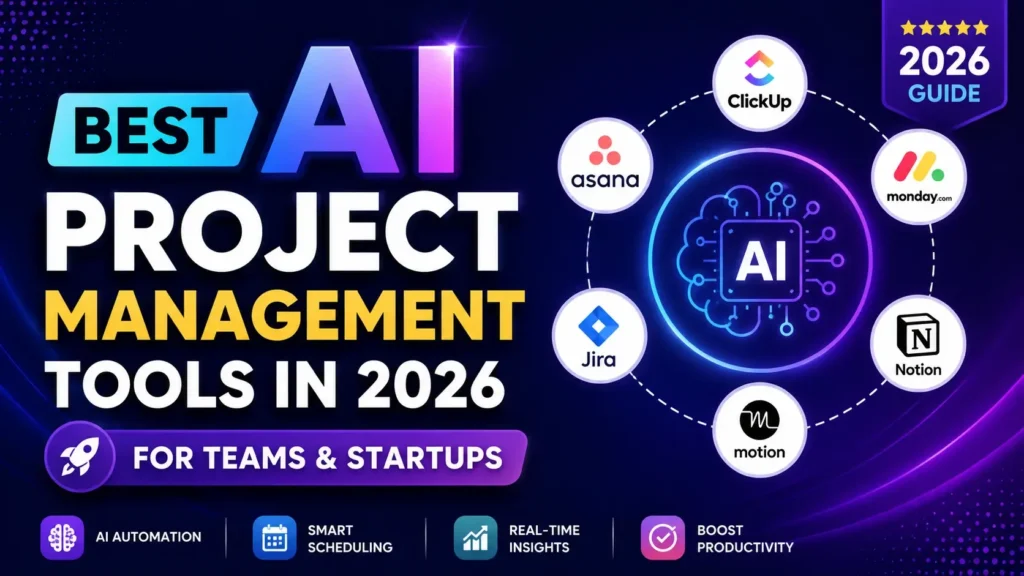
Modern ai tools for project managers are transforming work execution by replacing manual administration with proactive operational automation. In 2026, leading platforms like Motion, ClickUp, monday.com, Asana, and Wrike leverage advanced ai project planning and ai for task management to automatically build work breakdown structures, auto-schedule daily team calendars, and predict timeline bottlenecks. These top-rated ai productivity tools reduce weekly administrative work by up to 40% through automated status updates, capacity tracking, and intelligent project automation ai engines. By streamlining resource allocation and routine handoffs, project leaders can eliminate project delays, prevent team burnout, and maximize client profitability.
Keytakeaways
AI powered project management platforms eliminate administrative friction by turning raw project briefs into actionable timelines, automated resource allocation models, and predictive risk alerts.
-
Automated Project Plan Generation: Natural language processing engines convert project briefs, scope documents, or client emails into structured work breakdowns in seconds.
-
Dynamic Smart Rescheduling: Algorithms re-balance team calendars and timeline dependencies automatically when deadlines shift or capacity changes occur.
-
Workload & Burnout Protection: Real-time capacity trackers flag resource over-allocation before team members experience burnout.
-
Predictive Risk & Margin Forecasting: Machine learning models identify projects at risk of budget overruns or timeline delays early in the execution cycle.
-
Instant Automated Summaries: Built-in AI assistants condense complex comment threads and task logs into executive status updates automatically.
Managing modern projects requires balancing complex timelines, shifting team capacity, multi channel stakeholder communications, and scope expansion. Project managers often spend up to 40 percent of their workweek handling administrative overhead updating status boards, manually rescheduling missed deadlines, drafting meeting summaries, and chasing progress reports across disjointed software systems.
In 2026, artificial intelligence has fundamentally transformed how teams deliver work. Dedicated ai tools for project managers have evolved from basic text summary bots into proactive operational engines. By automating resource scheduling, predicting timeline bottlenecks, and generating predictive risk reports, these tools allow PMs to shift away from manual administrative work and focus on strategic execution.
Whether you need intelligent ai project planning to build project structures from briefs, dedicated ai for task management to balance workloads, or comprehensive project automation ai engines to streamline multi project portfolios, choosing the right software stack is vital. This guide breaks down the top AI platforms for project leaders in 2026.
1. Executive Comparison: Top AI Tools for Project Leaders
| Platform | Core Strength | Key AI Feature | Target Audience | Starting Pricing (2026) |
| Motion | Autonomous Scheduling | Dynamic auto-rescheduling calendar | Solo PMs, Executives, Agile Leads | $19 per month |
| ClickUp (ClickUp Brain) | All-in-One Knowledge Hub | Neural network for docs, tasks & chat | Cross-functional Teams & Agencies | $7 per user per month |
| monday.com (AI Workspace) | Visual Workflow Customization | Automated workflow & formula generation | Growing Teams & Operations | $9 per user per month |
| Asana AI | Enterprise Workflow Rules | Smart goal alignment & status reports | Enterprise & Matrix Organizations | $10.99 per user per month |
| Wrike (Wrike Copilot) | Enterprise Governance & Proofing | Predictive risk engine & work balancing | Complex Operations & PMOs | $10 per user per month |
| Teamwork.com | Client Work & Profitability | AI Project Wizard & Margin Forecaster | Client Agencies & Professional Services | $9.99 per user per month |
2. Deep Dive: Top AI Tools for Project Management
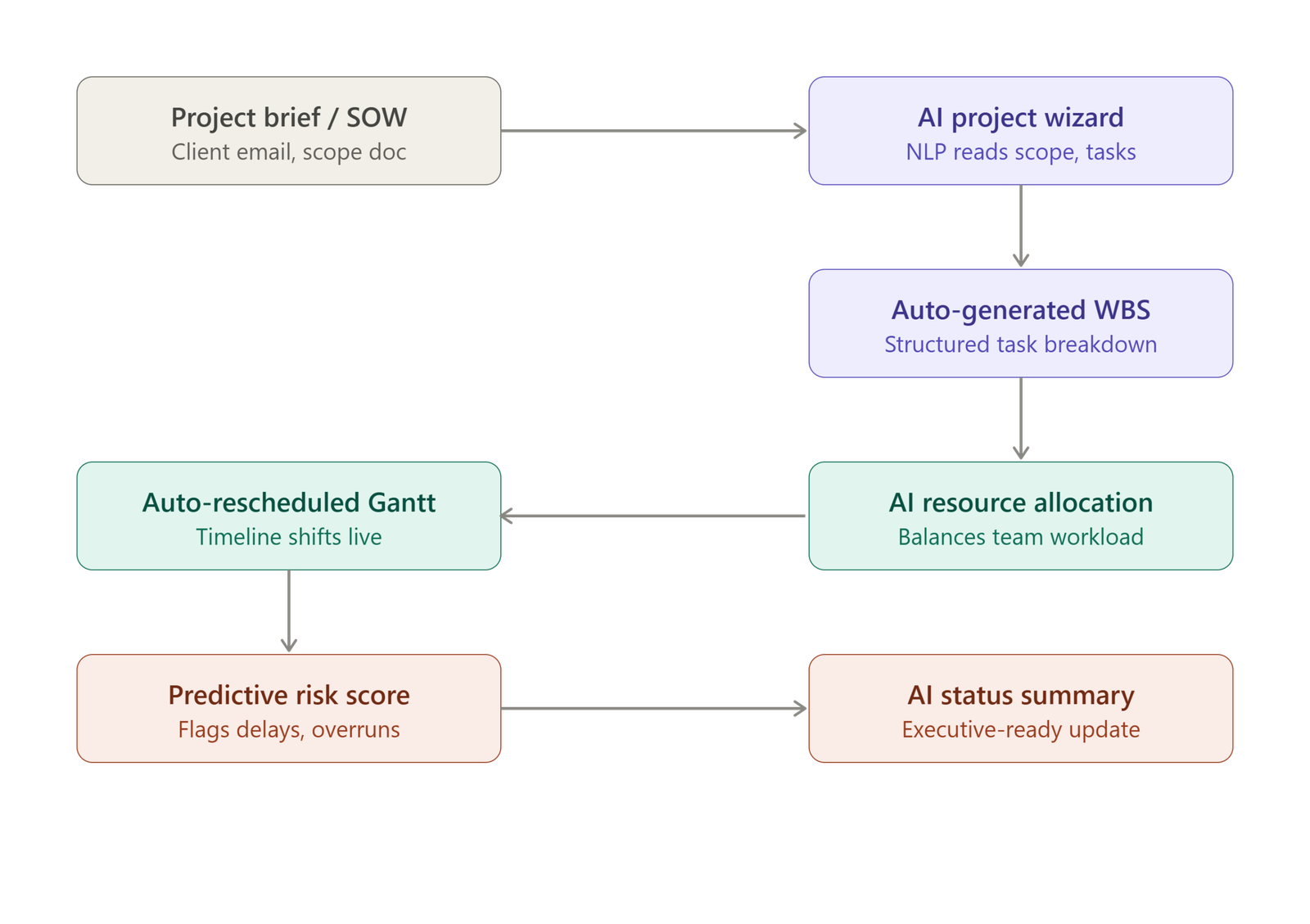
+-------------------------------------------------------------------------+
|                  THE AI PROJECT MANAGEMENT PIPELINE                      |
|                                                                         |
|  [Project Brief / SOW]  --->  [AI Project Wizard]  ---> [Auto-WBS]      |
|                                        |                                |
|                                        v                                |
|  [Auto-Rescheduled GANTT] <--- [AI Resource Allocation]                  |
+-------------------------------------------------------------------------+
Category A: Autonomous Scheduling & Dynamic Task Management
1. Motion: Best for Dynamic Auto-Scheduling and Time Blocking
Motion acts as an automated project manager and daily calendar engine. Instead of requiring you to manually place tasks onto a calendar, Motion’s AI algorithm evaluates task priorities, deadlines, working hours, and existing meetings to build an optimal daily schedule for every team member.
-
Key Features: Automated time blocking, dynamic task prioritization, meeting assistant, and multi project dependency tracking. If you want to compare more dedicated AI scheduling and calendar tools beyond Motion, we’ve covered the top options in a separate guide.
-
Why Project Managers Love It: When a task takes longer than expected or an urgent fire arises, Motion automatically reschedules remaining work without manual intervention. Non-technical managers can set up multi-step automated workflows using plain English prompts. For a deeper look at AI workflow automation tools across business functions, see our dedicated breakdown.
-
Best For: High-velocity teams, agency leaders, and busy project managers struggling with chaotic daily schedules.
2. ClickUp (ClickUp Brain): Best Unified Workspace Engine
ClickUp combines tasks, documents, goals, and team chat into a single platform. Its native neural network, ClickUp Brain, sits across all your workspace data to connect knowledge and automate manual task updates.
-
Key Features: Automated standup report generation, instant task creation from chat messages, contextual documentation writing, and workspace data Q&A.
-
Why Project Managers Love It: PMs can ask natural language questions (e.g., “What were the key decisions made in the Q3 product roadmap meeting?”) and receive immediate answers linked to source documents.
-
Best For: Teams seeking a customizable workspace that eliminates the need for separate doc, task, and communication tools.
Category B: Enterprise Governance, Workflow & Risk Prediction
3. monday.com (monday AI Workspace): Best for Visual Workflow Automation
monday.com combines visual work tracking with accessible project automation ai tools. Its AI assistants help teams build custom automated workflows, construct complex formulas, and summarize project statuses instantly.
                  MONDAY AI WORKFLOW CYCLE

  [Form Submit / Webhook] ---> [monday AI Categorization]
                                        |
                                        v
  [Executive Dashboard] <--- [Auto-Assign Task & Due Date]
-
Key Features: AI formula builders, automated email summary generation, custom board building, and smart no-code automation recipes.
-
Why Project Managers Love It: Non-technical managers can set up multi-step automated workflows using plain English prompts.
-
Best For: Operations teams and growing businesses moving away from manual spreadsheets.
4. Asana AI: Best for Structured Enterprise Dependencies
Asana AI focuses on helping large organizations connect operational task execution directly to strategic company goals.
-
Key Features: Smart status report generation, automatic workflow bottleneck identification, goal tracking, and natural language rule builders.
-
Why Project Managers Love It: Reduces time spent writing weekly executive updates by extracting key milestone metrics from project boards automatically.
-
Best For: Enterprise organizations requiring structured milestone tracking and cross-functional visibility.
5. Wrike (Wrike Copilot): Best for Predictive Risk Analysis and Proofing
Wrike provides enterprise grade governance built for complex operational environments. Wrike Copilot continuously analyzes historical project performance to predict potential delays before they occur.
-
Key Features: Predictive project risk scoring, automated workload balancing, natural language query engines, and AI asset proofing.
-
Why Project Managers Love It: Flags projects heading off-track weeks before milestone deadlines are missed.
-
Best For: Enterprise PMOs, marketing operations, and large scale cross-departmental initiatives.
Category C: Agency Delivery & Client Profitability
6. Teamwork.com: Best for Client Work and Profitability Forecasting
Teamwork.com is built specifically for client facing agencies and professional services teams where tracking billable hours and margin health is critical.
-
Key Features: AI Project Wizard (turns client briefs into work breakdown structures in minutes), AI Smart Scheduler, and AI Profitability Forecaster.
-
Why Project Managers Love It: Predicts budget burn rates early in the project lifecycle, letting PMs adjust scope before margins decline.
-
Best For: Digital agencies, consulting firms, and client delivery teams.
3. Implementation Framework: The 4-Stage AI PM Roadmap
Implementing ai tools for project managers requires a structured deployment plan to ensure team adoption and data integrity.
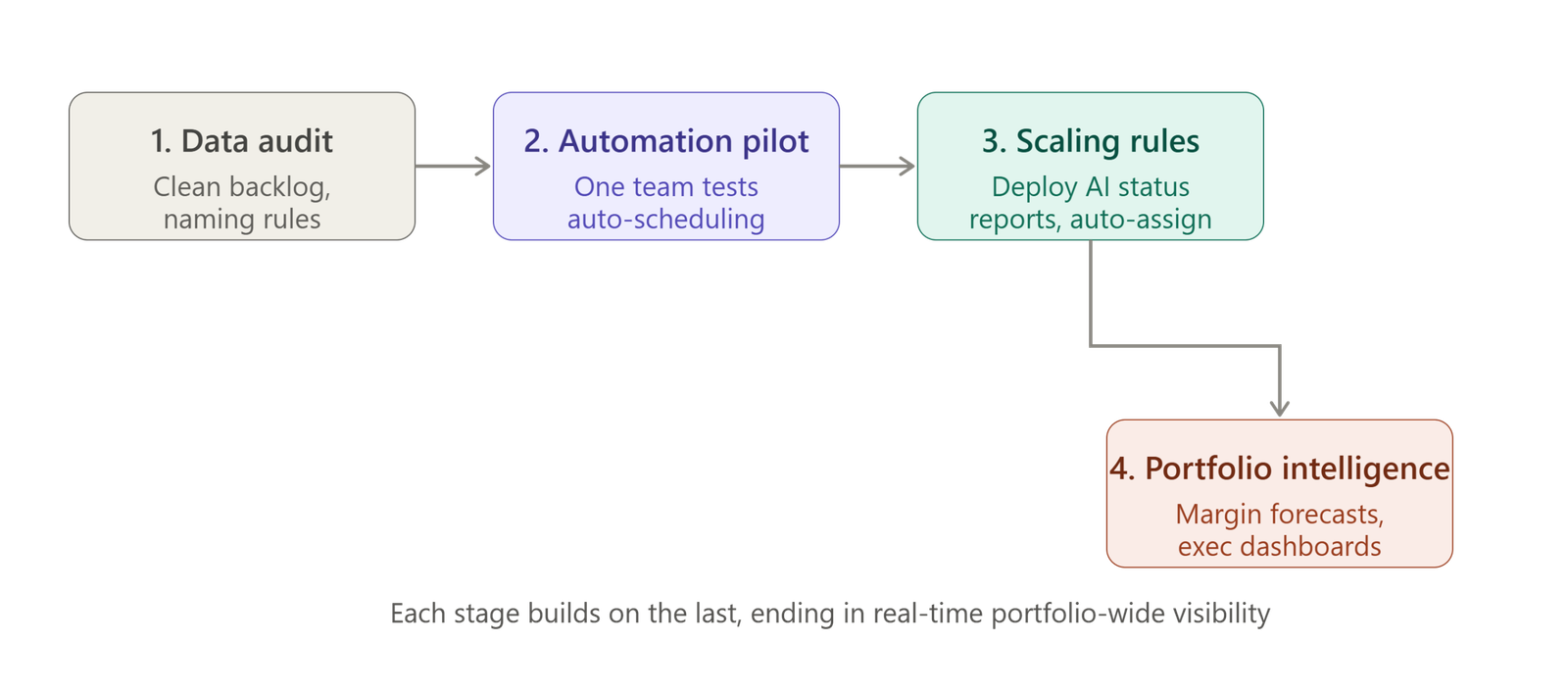
  [STAGE 1: Data Audit]        ---->   [STAGE 2: Automation Pilot]
  - Clean backlog & tasks              - Select one project team
  - Standardize naming rules           - Test auto-scheduling

                                                |
                                                v

  [STAGE 4: Portfolio Intelligence] <---   [STAGE 3: Scaling Rules]
  - Real-time margin predictions       - Deploy AI status reports
  - Executive dashboards               - Automate task assignments
-
Stage 1: Workspace & Data Cleansing
Before enabling AI features, archive outdated projects, standardize task naming conventions, and clean your team’s resource capacity data.
-
Stage 2: Pilot Deployment
Select a single project team to test AI features (such as automated time blocking in Motion or ClickUp Brain Q&A) for 30 days.
-
Stage 3: Establish Automation Guardrails
Configure clear automation rules for low-risk tasks (like updating status tags or drafting meeting notes) while keeping human approval required for budget or timeline changes.
-
Stage 4: Portfolio-Wide Scale & Reporting
Roll out automated AI status summaries and risk forecasting across all active client projects to maintain executive visibility.
4. Selection Matrix: Choosing the Right AI Tool
Use this operational decision guide to identify which platform fits your team’s current structure:
-
Choose Motion if: You are struggling with daily schedule chaos, constant meeting shifts, and manual calendar blocking.
-
Choose ClickUp if: You want to consolidate scattered tools (docs, chat, task boards) into a single workspace backed by AI search.
-
Choose monday.com if: Your non-technical team needs approachable, visual board layouts with no-code automation rules.
-
Choose Asana or Wrike if: You operate inside an enterprise PMO that requires advanced governance, risk prediction, and complex dependency structures.
-
Choose Teamwork.com if: You manage client services, billable hours, and project margin tracking.
Conclusion
Adopting specialized ai tools for project managers is no longer optional for teams aiming to maintain high efficiency in 2026. From Motion‘s autonomous dynamic scheduling to ClickUp‘s unified workspace intelligence and Wrike‘s predictive risk analysis, AI software removes administrative bottlenecks while elevating project execution.
By combining these AI platforms with strong human leadership, clear communication, and strategic oversight, project managers can save hours of weekly administrative overhead while delivering projects on schedule and within budget.
For more software reviews, AI productivity guides, and enterprise automation frameworks, visit OpenAIHit.
FAQs
Will AI tools replace human project managers?
No. AI automates repetitive administrative tasks such as status reporting, schedule updates, and resource tracking. However, strategic decision making, negotiation, stakeholder management, leadership, and conflict resolution require human expertise.
How do AI tools improve project planning accuracy?
AI engines analyze historical project performance data, task completion speeds, and resource availability to generate realistic timeline estimates, identify dependency risks, and recommend optimal workload allocations.
Can AI project management software integrate with existing tools?
Yes, modern platforms integrate seamlessly with communication tools (Slack, Microsoft Teams), cloud storage (Google Drive, Dropbox), code repositories (GitHub, GitLab), and enterprise CRMs via native connectors and webhooks.
Are free AI project management tools sufficient for small teams?
Yes, platforms like ClickUp, monday.com, Notion, and Taskade offer functional free tiers that include basic AI features, task boards, and collaborative workspaces suitable for small projects.