The search landscape has officially reached its “tipping point.” In 2026, the majority of informational queries have migrated away from the traditional list of blue links and toward conversational AI. For business owners and digital publishers, this has created a new, urgent question: How do I get mentioned in ChatGPT answers?
Securing a brand visibility ChatGPT slot isn’t about “gaming” an algorithm like the old days of keyword stuffing. It is about becoming a “trusted node” in a neural network. When ChatGPT (or its SearchGPT interface) provides an answer, it looks for sources that offer unique data, high authority, and a structure that is easy for an LLM (Large Language Model) to digest.
At openaihit.com, we have analyzed thousands of AI-generated responses to decode the patterns. Here are the five proven tactics for a successful ChatGPT brand mention strategy in 2026.
1. Adopt the “Source-First” Content Architecture
In 2026, ChatGPT doesn’t just want to tell you the answer; it wants to prove why it knows the answer. This is why AI answer engine optimization starts with how you structure your data.
The Power of Structured Data Tables
AI models love organized data. If you want to be the cited source for a comparison or a technical specification, stop burying that information in long paragraphs. Use H3 tags for specific sub-topics and present the “meat” of the information in clean, Markdown-ready tables. When ChatGPT scans a page and finds a perfectly formatted table, it is far more likely to “scrape” that specific data point and provide a citation link back to your site.
The “Direct Answer” Lead
Every blog post should begin with a 50–70 word summary that directly answers the primary question of the article. This “TL;DR” (Too Long; Didn’t Read) section acts as a “hook” for the AI. By providing a concise, fact-heavy summary at the top, you are essentially hand-feeding the AI the exact sentence it needs to answer a user’s prompt.
2. Generate “Unique Proprietary Data” (The AI Bait)
One of the biggest mistakes brands make in 2026 is publishing “echo chamber” content—articles that just repeat what everyone else is saying. ChatGPT is programmed to prioritize “novelty” and “authority.”
To get cited by AI, you must provide something the models can’t find elsewhere. This includes:
-
Original Surveys: Conduct a poll of 500 people in your niche and publish the results.
-
Case Studies: Detailed breakdowns of real-world results with specific numbers.
-
First-Hand Experiments: “We tested [Product X] for 30 days, and here is exactly what happened.”
When an AI engine sees a specific statistic (e.g., “According to a 2026 study by updatednetworth.com, 40% of celebrities now invest in agave fields”), it is almost forced to cite the source because that data point is unique. You aren’t just writing an article; you are creating a “fact” that the AI wants to use.
3. Optimize for “Agentic Crawlers”
In 2026, it isn’t just “Googlebot” visiting your site. You are being visited by “GPT-Bot,” “Claude-Bot,” and various other agentic crawlers. If your site is bloated with heavy JavaScript or complex pop-ups, these bots might fail to index your most important brand mentions.
Simplify the Path to Information
Check your robots.txt file to ensure you aren’t accidentally blocking the bots that feed ChatGPT’s search capabilities. Furthermore, ensure your site uses “Semantic HTML.” Using tags like <article>, <section>, and <aside> helps the AI understand the hierarchy of your information.
Implement “LLM-Ready” Schema
Beyond traditional Schema.org markups, 2026 has seen the rise of “AI-specific” metadata. This includes clearly defining your brand’s “Knowledge Graph” entities. By explicitly telling the internet who you are, what you do, and what you are an expert in, you reduce the chance of the AI “hallucinating” or confusing your brand with a competitor.
4. The “Authority Gap” Strategy: Earn Citations on Third-Party Sites
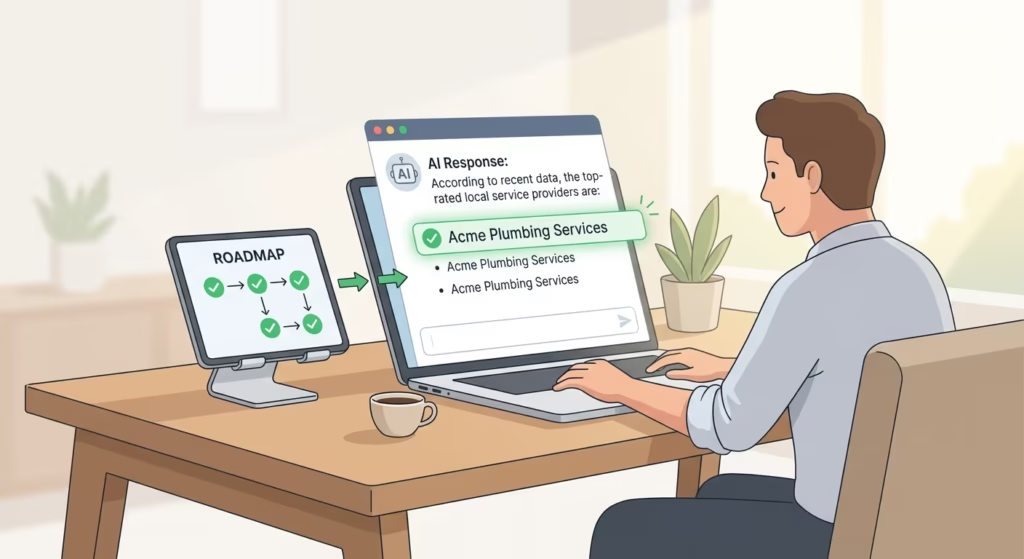
Your ChatGPT brand mention strategy shouldn’t just happen on your own website. ChatGPT often looks at “consensus” across the web. If five different reputable sites mention your brand as an expert in “sustainable luxury,” ChatGPT will take that as a fact.
Digital PR in the Age of AI
In 2026, guest posting isn’t for “backlinks” in the traditional sense; it is for “Entity Association.” You want your brand name to appear in the same sentence as high-authority keywords on sites like Forbes, TechCrunch, or specialized industry journals.
When an AI model is trained or updated, it looks at the “co-occurrence” of words. If “openaihit.com” frequently appears near the term “best GEO tools,” the AI builds a neurological connection between those two entities. This is the secret sauce to brand visibility ChatGPT results.
5. Master the “Conversational Keyword” (Long-Tail 2.0)
In 2026, people don’t type “best car 2026” into an AI. They type: “I have a family of four, I live in a cold climate, and I want an electric SUV with at least 400 miles of range. What are my best options?”
To get mentioned in that specific answer, your content needs to be optimized for these complex, multi-intent prompts.
The FAQ Revolution
Every page on your site should have a “People Also Ask” style FAQ section. But instead of short, one-word answers, write these answers in a “natural language” format. Use full sentences and provide context.
-
Bad: “Range: 400 miles.”
-
Good: “The [Brand Name] SUV offers a 400-mile range, which is specifically designed to handle cold-weather battery drain better than its competitors.”
The more your content sounds like a helpful human giving advice, the more likely the AI is to “adopt” your tone and cite your brand as the expert source.
Comparison: Traditional SEO vs. AI Answer Engine Optimization (2026)
| Metric | Traditional SEO (Google) | GEO (ChatGPT/AI) |
| Primary Goal | Ranking in the Top 10 | Being the “Cited Answer” |
| Key Factor | Backlinks & Keywords | Authority & Unique Data |
| User Intent | Browsing / Searching | Problem Solving / Inquiry |
| Content Style | Search-Engine First | Natural Language / Direct |
| Success Metric | Click-Through Rate (CTR) | Brand Mention Frequency |
Why “Trust” is the Ultimate Currency in 2026
The reason most brands fail to get mentioned in ChatGPT answers is a lack of trust. AI models are being tuned to avoid “misinformation.” If your site looks like a generic AI-generated content farm, the real AI (ChatGPT) will sniff it out and exclude you.
This is why your “About Us” page, your author bios, and your “Expertise” signals are more important than ever. You need to prove that there is a human expert behind the content. At openaihit.com, we recommend linking your authors to their LinkedIn profiles and including “Verified Expert” badges where applicable. Trust is the filter that determines who gets the citation and who gets left in the “blue link” graveyard.
Conclusion: The Future of Brand Visibility
The journey to get mentioned in ChatGPT answers is not a one-time task; it is a fundamental shift in how you produce digital content. In 2026, the brands that win are those that stop “writing for robots” and start “providing for agents.”
By focusing on unique data, structured architecture, and high-authority digital PR, you can ensure that when a user asks an AI for a recommendation, your brand is the one it suggests. The “Liquid Gold” of 2026 isn’t just traffic—it’s being the most trusted name in the AI’s “brain.”
For more strategies on staying ahead of the 2026 SEO curve, keep following our updates at openaihit.com.
Frequently Asked Questions (FAQs)
How long does it take to see brand mentions in ChatGPT?
Because ChatGPT now has “real-time” search capabilities (SearchGPT), you can see mentions within days of publishing high-quality, unique data. However, for “base model” training, it can take months for a brand to become a permanent part of the AI’s internal knowledge.
Does paying for ChatGPT Plus help my brand get mentioned?
No. Your personal subscription level has no impact on how the AI cites sources. The AI’s selection process is based purely on the relevance and authority of the content it finds on the open web.
Can I “pay” to be a cited source in AI?
As of 2026, there is no direct “Pay-to-Play” model for AI citations in the way there is for Google Ads. However, sponsored content on high-authority sites can indirectly help by increasing your brand’s “Entity Strength” across the web.
Why is ChatGPT citing my competitor instead of me?
Usually, it’s because the competitor provides a more “direct” answer or has a unique data point (like a proprietary study) that the AI finds more useful for the user’s specific prompt.