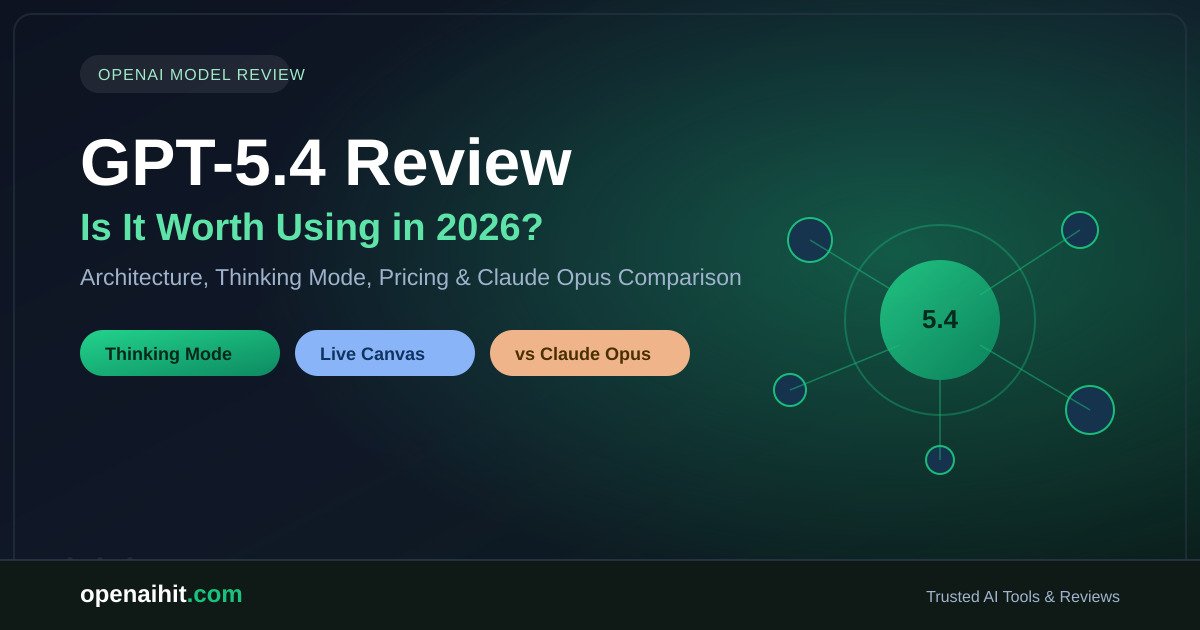
The artificial intelligence landscape in 2026 is no longer about the sheer novelty of large language models (LLMs). Instead, it has transitioned into an era of raw operational efficiency, agentic workflows, and high-fidelity multi-step reasoning. At the center of this paradigm shift stands OpenAI’s latest mid-cycle iteration. If you are managing complex digital ecosystems, auditing massive content architectures, or optimizing enterprise technical stacks, determining whether to allocate your budget to this platform is a critical business decision.
This comprehensive, data-backed gpt-5.4 review deconstructs the architecture, evaluates its real-world performance metrics, dissects the financial investment tiers, and compares it directly against its fiercest competitors to see if it genuinely earns its keep in your daily professional workflow.
What is GPT-5.4? An Architectural Overview
Unlike major integer leaps that focus purely on scaling parameter counts, GPT-5.4 represents OpenAI’s strategic pivot toward computational optimization and inference-time compute scaling. Launched as a mid-generation refinement, this model addresses the core systemic flaws of earlier architectures: high latency, token optimization inefficiencies, and the persistent challenge of hallucination during deep analytical synthesis. If you’re still exploring beyond OpenAI’s ecosystem, we’ve also rounded up other AI assistants like ChatGPT worth testing for comparison.
Core Breakthroughs in the 2026 AI Framework
The fundamental shift in this model lies in how it processes information. It no longer relies solely on a flat, linear next-token prediction pathway. Instead, it utilizes an advanced mixture-of-experts (MoE) topology paired with a dynamic routing layer that optimizes system resource allocation based on the complexity of the inbound prompt.
Key GPT-5.4 Features Shaping Modern Workflows
To understand why this model is distinct from its predecessors, we must examine the specific, actionable gpt-5.4 features that directly impact professional output quality and asset creation.
1. Advanced Compute-Over-Inference Routing
The model introduces a multi-tier processing system. When a user inputs a routine task (such as basic copy editing or formatting syntax), the system triggers a lightweight, low-compute route to save bandwidth and deliver near-instantaneous responses. However, when faced with abstract debugging or high-level strategic data cross-referencing, it automatically routes the query to an intensive, deep-thinking pipeline.
2. Live Interface Synergy via ChatGPT Canvas
Building upon early foundational interface experiments, the native integration of the Live Canvas environment allows users to co-edit code, structural layouts, and long-form documents side-by-side with the model. The interface tracks real-time edits, isolates specific code blocks for execution, and allows for precise inline modifications without rewriting whole paragraphs or files.
3. Native Multimodal Asset Generation Engine
GPT-5.4 incorporates direct, localized pipelines to media sub-systems like the Sora video architecture and advanced vector rendering tools. Instead of acting as a simple text bridge to external plugins, the model natively understands spatial orientation, programmatic visual elements, and temporal video timeline data directly inside the primary prompt window.
GPT-5.4 vs GPT-5: A Critical Technical Upgrade Analysis
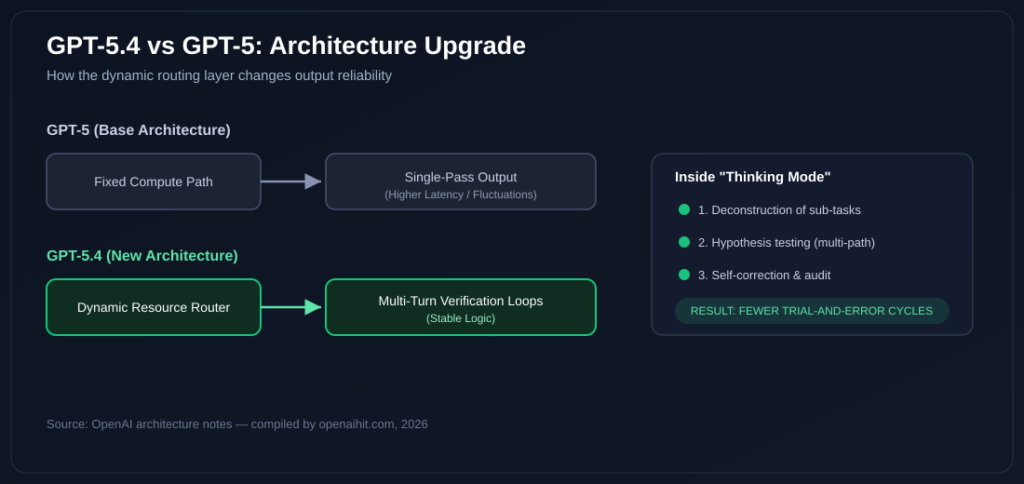
For professionals considering an upgrade or evaluating corporate subscription renewals, comparing gpt-5.4 vs gpt-5 highlights substantial operational changes rather than minor incremental patches.
GPT-5 Base Architecture ➔ Fixed Compute Path ➔ Single-Pass Output (Higher Latency/Fluctuations)
GPT-5.4 Architecture ➔ Dynamic Resource Router ➔ Multi-Turn Verification Loops (Stable Logic)
Context Window Reliability and Memory Retention
While the base version boasted an impressive raw context token count, it frequently suffered from “loss in the middle”, a well-documented phenomenon where long context inputs caused the model to miss data points buried in the middle of extensive documentation. GPT-5.4 utilizes a refined attention mechanism that ensures uniform retrieval accuracy across its entire context window, making large-scale data ingestion and technical content audits significantly more reliable.
Fact-Checking and Decreased Hallucination Rates
The original baseline version often prioritized linguistic eloquence over historical or mathematical accuracy when handling edge cases. The 5.4 update introduces an internal verification layer. It benchmarks its own logical claims against internal weights and verifiable real-time data tables before presenting the final output to the user interface, dropping factual errors to a historical low for the platform.
Deep Dive: The ChatGPT GPT-5.4 Thinking Mode
The most discussed element of the 2026 upgrade is the prominent implementation of the dedicated chatgpt gpt-5.4 thinking mode. Understanding how this subsystem operates is essential for maximizing output accuracy for advanced technical tasks.
The Mechanics of Inference-Time Reflection
When you engage the thinking mode, the model does not instantly generate a visible stream of text. Instead, it creates an invisible, structured internal scratchpad where it performs multiple operations before output execution:
- Deconstruction: Breaking complex prompts down into independent, logical sub-tasks.
- Hypothesis Testing: Simulating different execution paths (e.g., trying two distinct coding loops or content layout frameworks).
- Self-Correction: Auditing the code or data stream for internal contradictions, syntax violations, or broken links.
Operational Impact: For tasks requiring high-level technical accuracy, such as optimizing complex XML schemas, mapping programmatic internal link flows, or calculating multi-variable financial projections, the thinking mode eliminates the frustrating “trial and error” cycles that developers and marketers previously accepted as a standard part of AI interactions.
The Ultimate Showdown: GPT-5.4 vs Claude Opus
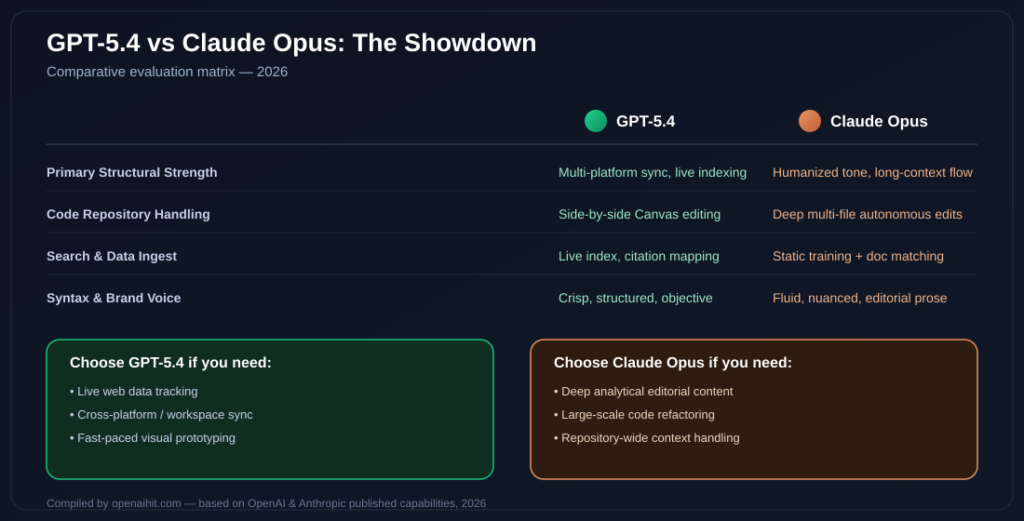
For enterprise users and specialized digital agencies, selecting a primary AI model usually comes down to a direct comparison: gpt-5.4 vs claude opus. Both tools occupy the top tier of performance in 2026, yet their design philosophies and practical strengths diverge sharply. This mirrors a pattern we’ve seen across the broader market too our GPT-5 vs Claude vs Gemini breakdown found the same split between versatility and enterprise-grade reasoning.
GPT-5.4 vs Claude Opus: Comparative Evaluation Matrix
| Performance Category | GPT-5.4 Ecosystem | Claude Opus (Latest Iteration) |
| Primary Structural Strength | Multi-platform tool sync, real-time live indexing, and agentic media execution. | Highly humanized editorial tone, flawless long-context logical flow, and clean code block isolation. |
| Code Repository Handling | Excellent for interactive side-by-side editing and localized runtime scripting via Canvas. | Superb at scanning entire multi-layered codebases and performing deep, autonomous file edits. |
| Search Engine & Data Ingest | Native access to live data indexes with high accuracy and citation mapping. | Static training superiority matched with deep document-pair matching layers. |
| Syntax and Brand Voice | Crisp, data-backed, objective, and highly structured format output. | Fluid, highly nuanced, authoritative editorial prose that easily passes complex brand filters. |
Strategic Implementation Choices for Enterprise
If your workflows are deeply integrated with live web data tracking, cross-platform application extensions (such as direct cloud storage or workspace syncs), and fast-paced visual prototyping, GPT-5.4 remains the undisputed market leader. Conversely, if your core priority is producing deeply analytical, human-like editorial content or running extensive code refactoring projects over deep internal archives, Claude Opus continues to hold a distinct edge in stylistic prose and repository-wide context handling.
Commercial Accessibility: Is GPT-5.4 Free?
With the increasing cost of processing power and enterprise-grade servers worldwide, OpenAI has shifted its commercial strategy regarding access tiers.
Dissecting the Free Tier Limitations
If you are asking, is gpt-5.4 free?, the answer requires an understanding of tiered access models. OpenAI does provide a restricted, heavily throttled version of the 5.4 mini framework within the standard free user interface. However, this free tier lacks the advanced reasoning modules, limits the use of the deep thinking mode, restricts real-time multimodal canvas access, and reverts to older, slower processing tracks during high-traffic global windows.
Evaluating the Cost: GPT-5.4 Pro Price and Subscription Tiers
For professionals who cannot afford throttling or restricted feature access, the platform is structured across distinct subscription levels:
- The Plus Tier ($20/Month USD): Tailored for standard power users. It offers expanded access to the main model, but carries dynamic message limits that fluctuate based on real-time server strain.
- The Pro / Advanced Developer Tier ($200/Month USD): Designed for businesses requiring uninterrupted access. This tier provides unlimited use of the high-compute chatgpt gpt-5.4 thinking mode, top-tier priority processing over global networks, and advanced configuration toggles for custom agent integration.
To see how these tiers stack up against the rest of the market, check our roundup of best AI programs and their pricing across every major provider.
Final Verdict: Is GPT-5.4 Worth Using in 2026?
Determining whether GPT-5.4 is worth your investment depends heavily on how you value your operational speed and data precision.
If your daily routine consists of simple text generation, basic email drafting, or low-level summaries, the free tier or standard legacy models are more than sufficient. Paying for the premium tiers would result in underutilized computational power.
However, if your business goals demand technical accuracy, advanced automation setups, multi-layered data synthesis, and frictionless workspace collaboration, the mid-cycle improvements found in GPT-5.4 make it an essential asset for 2026. The platform has effectively shifted from a simple conversational novelty into a highly predictable, reliable, and deeply integrated digital workhorse that significantly reduces manual editing hours and operational friction across the board. For more information of tools visit Openaihit.
FAQs
What is the main difference between GPT-5.4 and GPT-5?
GPT-5.4 introduces dynamic compute routing and fixed Mixture-of-Experts architecture. It resolves the “loss in the middle” memory issue, ensuring uniform context retrieval and a 33% reduction in factual errors compared to base GPT-5.
What makes the GPT-5.4 Thinking Mode unique?
Instead of instant text generation, the Thinking Mode uses an internal scratchpad to deconstruct prompts, test execution paths, and self-correct logic before displaying the output, ensuring near-perfect structural precision.
Is GPT-5.4 free to use?
No, the full flagship version is not free. Free users only get access to a highly throttled, resource-capped GPT-5.4 mini model that excludes advanced reasoning modules and real-time Canvas tools.
What is the price of the premium GPT-5.4 tiers?
The Plus Tier costs $20/month with dynamic usage caps based on server traffic. The Pro/Developer Tier costs $200/month, unlocking unthrottled access to the deep Thinking Mode and priority network bandwidth.
GPT-5.4 vs Claude Opus: Which is better?
GPT-5.4 is superior for live web search syncs, multi-platform tool extensions, and fast asset prototyping. Claude Opus remains better for long-form humanized editorial prose and deep, multi-file code refactoring.