Modern ai tools for transcription automatically convert spoken audio, video files, and live meeting conversations into precise text transcripts, complete with speaker labels, automated summaries, timestamp tracking, and actionable meeting notes within minutes.
-
Advanced ai audio to text generators achieve accuracy rates above 95% across multi-speaker environments and varied accents.
-
Specialized ai meeting transcription bots join video conferencing platforms like Zoom, Google Meet, and Microsoft Teams to record, transcribe, and extract action items in real time.
-
Dedicated ai video transcription engines export closed-caption and subtitle files (SRT, VTT) directly to media editors and video publishing platforms.
-
Custom vocabulary features allow users to upload technical jargon, industry terms, and brand names to eliminate spelling mistakes in transcripts.
-
Generous free ai transcription tool options allow students, journalists, and small teams to process hours of audio without paying upfront software fees.
-
Comprehensive export capabilities support versatile document outputs, including TXT, DOCX, interactive links, PDF, and automated summary emails.
Introduction
Transcribing audio or video files manually is one of the most tedious, time-consuming tasks in modern content workflows. On average, transcribing a single hour of clear spoken audio manually takes between four to six hours of intense typing, constant rewinding, and careful double-checking. For journalists conducting interviews, research teams organizing focus groups, or corporate teams running multiple meetings daily, manual transcription quickly becomes a massive operational bottleneck.
Fortunately, generative speech-to-text artificial intelligence has fundamentally transformed this landscape. Modern ai tools for transcription process multi-hour audio files in just minutes with remarkable precision. Instead of manually typing every spoken word, creators and professionals can now convert lectures, podcasts, customer calls, and interviews into formatted text instantly.
Whether you need automated captions for video production, instant notes for team meetings, or a reliable free ai transcription tool for personal research, this comprehensive 2026 guide evaluates the top 10 tools designed to convert audio and video into actionable text effortlessly.
Why Use AI Tools for Transcription?
The transition from manual typing to AI-driven speech processing offers massive structural and operational benefits across diverse industries.
Unprecedented Time Savings
By leveraging high-speed neural networks, AI engines transcribe long-form recordings in a fraction of the actual audio runtime. A 60-minute interview that previously required five hours of manual labor is now fully transcribed and summarized in less than three minutes.
Rapid Accuracy & Dialect Handling Improvements
In recent years, deep learning speech recognition models have vastly improved at processing complex accents, overlapping speech, background noise, and specialized technical vocabulary. Today’s tools maintain high transcript fidelity across complex environments.
Versatile Across Multiple Industries
-
Businesses & Executives: Utilize ai meeting transcription to log strategy sessions, record client agreements, and automatically distribute task summaries to team members.
-
Content Creators & Podcasters: Rely on ai video transcription to generate readable YouTube subtitles, create blog posts from video topics, and improve search visibility.
-
Students & Researchers: Convert long academic lectures and qualitative interview recordings into searchable digital notes instantly. If summarizing those notes afterward is also on your list, our guide to best AI tools for summarizing documents covers the next step in that workflow.
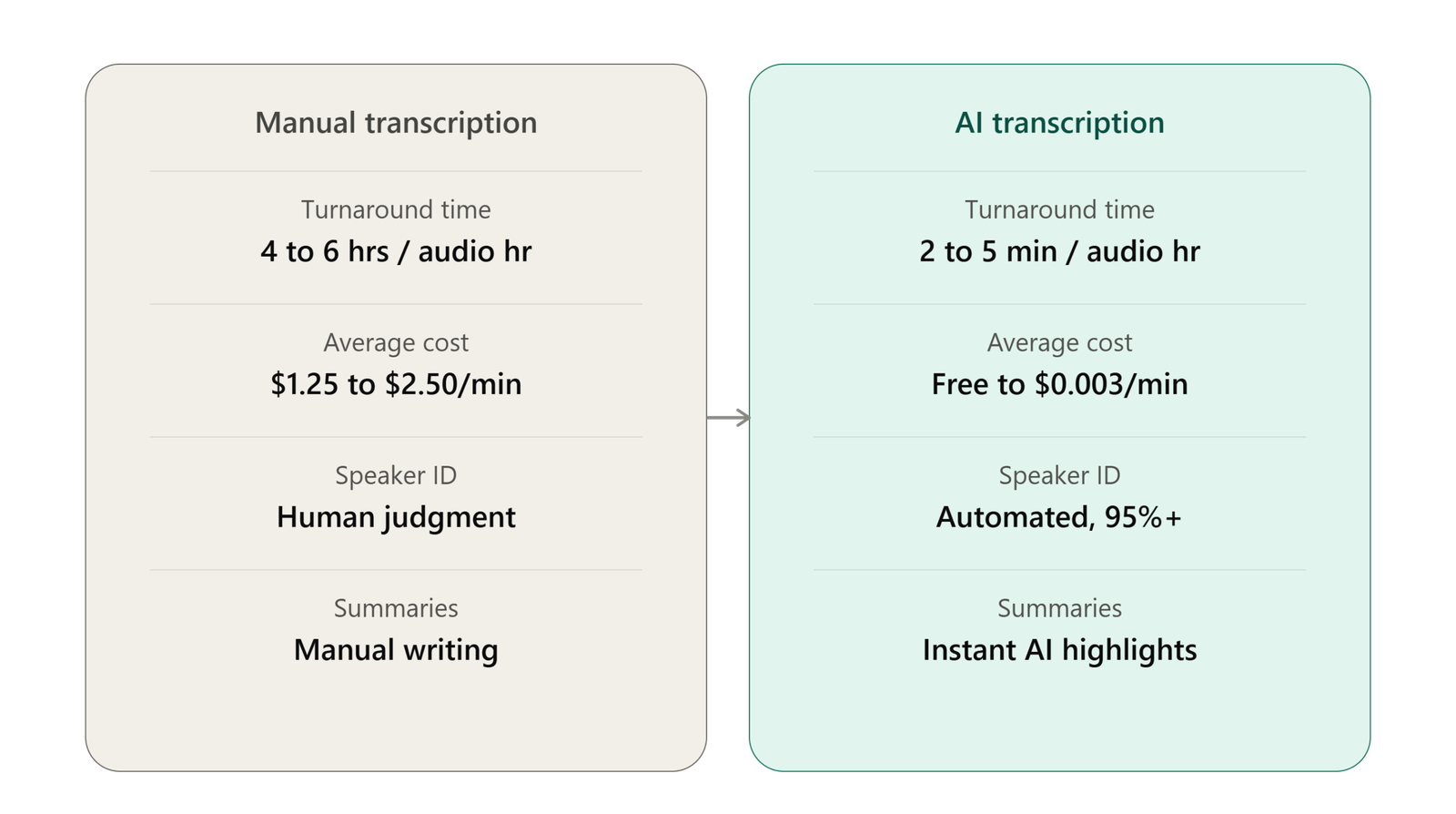
Manual vs. AI Transcription Speed & Cost Comparison
| Metric / Dimension | Manual Human Transcription | AI Speech-to-Text Transcription |
| Turnaround Time | 4 to 6 hours per audio hour | 2 to 5 minutes per audio hour |
| Average Cost | $1.25 – $2.50 per audio minute | Free to $0.003/min (or monthly sub) |
| Speaker Identification | Highly accurate (human judgment) | Automated diarization (up to 95%+ accuracy) |
| Actionable Summaries | Requires manual writing | Instant AI-generated highlights & notes |
How to Choose the Right AI Transcription Tool
Selecting the right transcription tool depends on your primary input formats, output needs, and team size.
Consider these key decision criteria before picking a tool:
-
Accuracy Percentage & Language Support: Evaluate whether the platform natively handles global accents and supports multi-language or translation capabilities if working with international audio.
-
Speaker Diarization (Identification): Ensure the tool automatically separates and tags different speakers (e.g., Speaker 1, Speaker 2) throughout the transcript.
-
Audio vs. Video Compatibility: Verify if the tool accepts both pure audio formats (MP3, WAV, M4A) and video containers (MP4, MOV) or connects live to video call software.
-
Export Formats & Subtitle Support: Look for platforms exporting to SRT/VTT for video captions, or DOCX/TXT for written articles and documentation.
-
Free Tier Limitations vs. Paid Features: Determine whether a free ai transcription tool tier offers enough monthly minutes or if your workload requires a paid subscription.
Best AI Tools for Transcribing Audio and Video
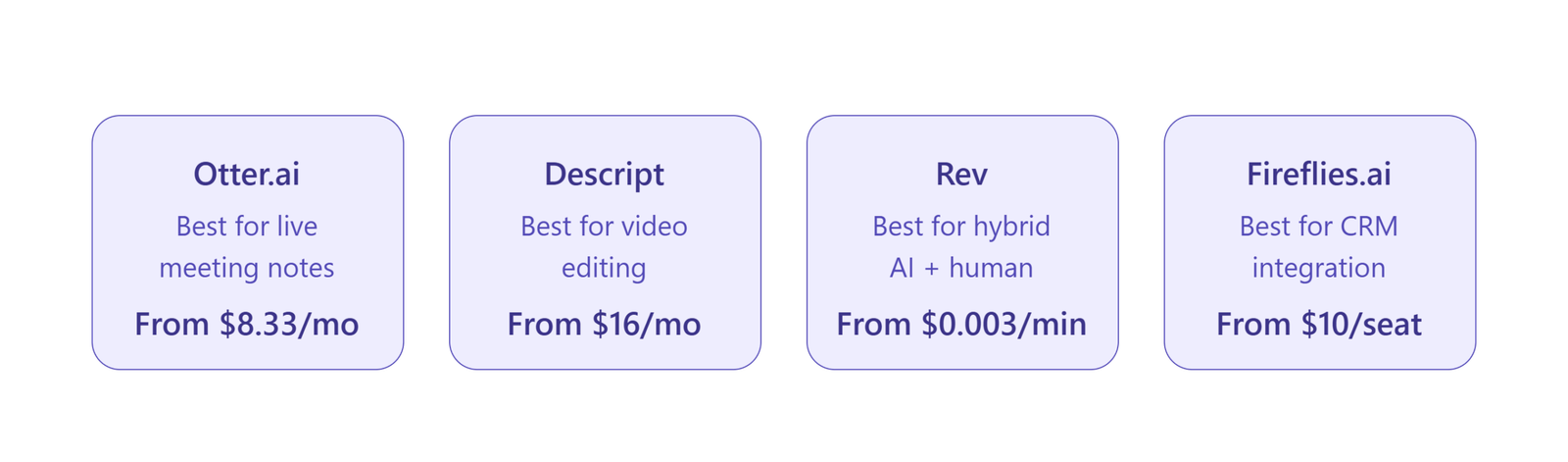
Otter.ai: Best for Real-Time Meeting Transcription & Team Notes
Otter.ai is widely recognized as an industry standard for ai meeting transcription. Its automated bot joins live web conferences on Zoom, Google Meet, and Microsoft Teams to record conversations, transcribe dialogue in real time, capture shared slides, and generate structured meeting summaries.
It excels at collaborative workflows, allowing team members to highlight key transcript sections, insert comments, and assign action items directly during or after the call.
-
Key Features: Live meeting assistant, automated slide capture, real-time speaker identification, custom vocabulary lists, and executive summary generation.
-
Pros: Excellent live transcription speed; smooth calendar integration; strong collaborative annotation features.
-
Cons: Free plan has strict per-meeting duration limits (30 mins) and file upload caps.
-
Best For: Corporate teams, managers, consultants, and students attending live web meetings.
-
Pricing: Free Basic plan (300 monthly minutes); Pro starts at $8.33/month billed annually.
Rev: Best for High-Accuracy Hybrid AI & Human Workflows
Rev offers a powerful dual-engine approach combining rapid automated speech recognition with an option to order professional human transcriptions when absolute precision is required. Its AI engine delivers impressive speed for ai audio to text conversion across complex audio files.
Rev also provides comprehensive API developer tools, interactive editing tools, and custom enterprise security standard compliance.
-
Key Features: High-accuracy AI transcription, seamless option for 99% accurate human editing, automatic global subtitle creation, and developer APIs.
-
Pros: Highly accurate AI model; smooth web transcript editor; flexible pay-as-you-go pricing models.
-
Cons: Human transcription add-ons increase costs significantly for large media volumes.
-
Best For: Media production studios, legal professionals, journalists, and enterprises needing flexible accuracy options.
-
Pricing: AI automated transcription at $0.003/minute (Reverb); Human transcription at $1.99/minute.
Descript: Best AI Video Transcription & Text-Based Media Editor
Descript approaches speech processing differently by linking transcription directly to media editing. When you upload an audio or video file, Descript transcribes it and allows you to edit the actual media file simply by editing the generated text document.
If you delete a word or sentence from the text transcript, Descript automatically trims that exact segment from the underlying video or audio timeline, making it a favorite for ai video transcription. For creators editing video beyond just transcripts, our roundup of best AI voice generators for content creators pairs well with tools like this.
-
Key Features: Text-based video/audio editing, filler word removal (“um”, “uh”), voice cloning (Overdub), Studio Sound audio restoration, and automated subtitles.
-
Pros: Revolutionizes video editing speed; easy transcript-based cuts; excellent studio noise cleanup.
-
Cons: Steeper learning curve for users who only want simple text export.
-
Best For: Podcasters, YouTubers, video editors, and course creators.
-
Pricing: Free tier (60 media minutes/month); Hobbyist starts at $16/month billed annually.
Sonix: Best for Multi-Language Transcription & Global Media
Sonix is an advanced automated platform specializing in fast, multi-language speech-to-text processing. Supporting over 40 languages and dialects, Sonix allows creators to transcribe, translate, and edit audio and video files in a single browser-based workspace.
Its interactive web transcript editor offers word-by-word timestamp alignment, custom dictionaries, and flexible export tools suited for global organizations.
-
Key Features: Multilingual transcription (40+ languages), automated translation, word-level confidence scores, and multi-folder user permissions.
-
Pros: Exceptional multi-language accuracy; clean interactive editor; fast file processing speeds.
-
Cons: Pay-as-you-go model can get expensive for heavy daily transcription.
-
Best For: Global research teams, documentary filmmakers, and international businesses.
-
Pricing: Standard Pay-as-you-go ($10/hour); Premium tier ($5/hour + $22/user/month subscription).
Fireflies.ai: Best for AI Meeting Transcription & CRM Integration
Fireflies.ai is an intelligent meeting assistant built specifically to record, transcribe, and analyze voice conversations across business organizations. It connects automatically with calendar tools to join sales, recruitment, and internal team meetings.
Beyond standard transcripts, Fireflies uses conversational intelligence to search calls for key topics, track sentiment, measure talk-time ratios, and push call summaries straight to CRMs like Salesforce and HubSpot.
-
Key Features: Automated meeting bot, topic tracking, conversation intelligence analytics, CRM integrations, and custom AI search filters.
-
Pros: Deep CRM and workflow automation integration; powerful call analytics.
-
Cons: Free plan has limited meeting storage and restricted AI credits.
-
Best For: B2B sales teams, recruiters, customer support managers, and agency leaders.
-
Pricing: Free plan available; Pro starts at $10/seat/month billed annually.
Google Docs Voice Typing & Google Recorder: Best Free AI Transcription Tool Option
For students, journalists, and creators operating on a tight budget, Google provides two accessible native options: Google Recorder (for Pixel devices) and Google Docs Voice Typing (browser-based).
Google Recorder transcribes spoken audio locally on-device in real time without needing an internet connection, offering instant speaker tagging and search capabilities. Google Docs Voice Typing allows users to dictate spoken thoughts directly into a text document for free.
-
Key Features: Live real-time dictation, on-device offline processing (Google Recorder), automatic punctuation, and zero cost.
-
Pros: 100% free with no monthly minute limits; excellent dictation speed; no account setup required beyond Google.
-
Cons: Lacks advanced video file imports, custom brand dictionaries, and bulk file upload features.
-
Best For: Students, solo writers, field journalists, and casual users seeking a free ai transcription tool.
-
Pricing: 100% Free.
OpenAI Whisper: Best Open-Source High-Precision Engine
OpenAI’s Whisper model represents a massive leap forward in open-source automatic speech recognition (ASR). Trained on hundreds of thousands of hours of diverse multilingual audio data, Whisper delivers exceptional robustness against background noise, accents, and technical terminology. Developers can review the full technical documentation directly on OpenAI’s Whisper GitHub repository for setup instructions and model specifications.
While developers can run Whisper locally for free via Python or command-line interfaces, non-technical users can access Whisper-powered web interfaces across various third-party apps.
-
Key Features: Open-source ASR, multi-accent recognition, automatic language translation to English, and robust noise handling.
-
Pros: Industry-leading accuracy; completely free to run locally; handles harsh background audio effortlessly.
-
Cons: Requires technical knowledge to install and run locally unless accessed through third-party graphical apps. Developers comparing broader AI coding and automation options may also want to check our best AI agents 2026 guide.
-
Best For: Developers, tech-savvy researchers, and privacy-conscious organizations needing offline processing.
-
Pricing: Free and open-source (Pay-per-use via OpenAI API at $0.006/minute).
Trint: Best for Journalists, Newsrooms, and Media Outlets
Trint was founded by a veteran broadcast journalist specifically to streamline editorial production workflows. It converts audio and video files into editable text while linking every word directly to the underlying media playback.
Journalists can highlight text quotes, generate verified story snippets, collaborate in real time with newsroom editors, and export formatted captions straight to broadcast editing suites.
-
Key Features: Real-time editorial workspace, media-to-text sync, verified quote builder, enterprise security, and live mobile recording app.
-
Pros: Built for newsroom workflows; strong mobile application; multi-language editing capabilities.
-
Cons: Higher baseline subscription price compared to general-purpose meeting tools.
-
Best For: Newsrooms, investigative journalists, documentary producers, and media agencies.
-
Pricing: Starter plan starts at $52/user/month; enterprise custom plans available.
Notta: Best Multilingual Audio & Video Notetaker
Notta is an efficient cross-platform speech recognition tool designed to turn live meetings, podcasts, and recorded files into structured text. Operating smoothly across web, desktop, and mobile devices, Notta supports over 100 transcription languages.
It features an online screen recorder that generates simultaneous transcriptions, making it ideal for creating software tutorials, webinars, and online class notes.
-
Key Features: 104 transcription languages, screen and audio recording, automatic AI summaries, and multi-device cloud sync.
-
Pros: High multilingual translation and transcription performance; versatile mobile apps.
-
Cons: Free tier restricts transcript duration per recording.
-
Best For: International students, educators, cross-border business teams, and remote workers.
-
Pricing: Free plan available; Pro plan starts at $9/month billed annually.
Happy Scribe: Best Subtitle & Transcription Combo Workspace
Happy Scribe is a popular European platform that blends AI automated transcription with human translation and subtitling services. It offers an easy-to-use subtitling workspace that allows creators to adjust subtitle timing, burn captions onto video files, and export standard SRT/VTT caption files.
Happy Scribe supports over 120 languages and dialects, making it a go-to solution for European and global media creators.
-
Key Features: Dual AI + Human subtitling, interactive caption editor, video hardcoding, and interactive public transcript sharing.
-
Pros: Excellent captioning interface; supports vast array of global languages and accents; clean UI.
-
Cons: AI free plan exports are restricted to preview modes.
-
Best For: Video creators, online course instructors, and agencies needing polished subtitles.
-
Pricing: Free plan with basic features; Basic paid tier starts at $10/month billed annually.
Free vs. Paid AI Transcription Tools: Quick Comparison
Deciding between a free ai transcription tool and a paid enterprise platform depends heavily on your monthly audio volume, required accuracy level, and export format needs.
| Feature / Capability | Free AI Transcription Tools | Paid / Enterprise AI Platforms |
| Monthly Minute Allowance | 60 – 300 minutes per month | Unlimited or 1,000+ minutes per month |
| File Imports & File Formats | Limited file uploads; basic live dictation | Unlimited MP3, MP4, WAV, MOV bulk uploads |
| Speaker Diarization | Basic or absent | Precise automated multi-speaker labeling |
| Export Formats | Plain Text (.TXT) only | DOCX, PDF, SRT, VTT, JSON, direct CRM sync |
| Custom Vocabulary | Unavailable | Custom brand terms, jargon, and name dictionaries |
| Best Suited For | Personal dictation, short lectures, light calls | Sales teams, video editors, newsrooms, enterprises |
Tips to Get Accurate AI Transcriptions
While modern ai tools for transcription are highly sophisticated, the quality of your output depends heavily on the quality of your input recording. Follow these best practices to ensure maximum transcript accuracy:
-
Ensure High Audio Quality: Use a dedicated USB or XLR microphone rather than built-in laptop microphones whenever recording interviews or podcasts.
-
Minimize Background Noise: Record in quiet, carpeted, or sound-treated rooms to reduce ambient noise, echo, and HVAC hums that confuse speech recognition models.
-
Prevent Speaker Overlap: Encourage speakers during meetings or interviews to speak one at a time. Overlapping voices disrupt automated speaker identification algorithms.
-
Utilize Custom Dictionaries: Add unique technical terms, product names, industry acronyms, and participant names into your tool’s custom vocabulary settings prior to transcribing.
-
Quickly Proofread Key Names and Numbers: Spend two minutes skimming the generated transcript to verify proper nouns, phone numbers, and financial statistics before publishing or sharing.
The Future of AI in Transcription
Speech recognition technology is rapidly evolving beyond basic word-for-word typing toward context-aware intelligence:
-
Real-Time Zero-Latency Captioning: Future AI engines will display fully context-corrected live subtitles instantly during live broadcasts without conversational lag.
-
Contextual Accent & Dialect Adaptation: Advanced neural models will dynamically adjust to regional accents and mixed-language conversations (such as Hinglish or Spanglish) seamlessly.
-
Simultaneous Multilingual Translation & Speech Synthesis: Transcripts will automatically translate into multiple global languages in real time, accompanied by natural-sounding AI voice dubbing.
Conclusion
Adopting modern ai tools for transcription eliminates hundreds of manual typing hours, allowing creators, businesses, and researchers in 2026 to convert audio and video into structured knowledge instantly. Whether you require live meeting notes with Otter.ai, video editing integration with Descript, CRM sync with Fireflies.ai, or free open-source transcription via OpenAI Whisper, there is a tailored solution available for every workflow. for more updates of AI tools visit Openaihit.
Frequently Asked Questions
Q1: What is the best free AI transcription tool available in 2026?
For completely free dictation and live audio transcription, Google Recorder (on Pixel devices) and Google Docs Voice Typing offer unlimited usage without monthly caps. For technical users, OpenAI Whisper provides free, open-source high-precision transcription when run locally.
Q2: How accurate are modern AI transcription tools?
Under clear audio conditions with minimal background noise, top ai tools for transcription achieve accuracy rates between 90% to 98%. However, heavy background noise, strong audio distortion, or heavy speaker overlap can reduce automated accuracy.
Q3: Can AI meeting transcription tools distinguish between multiple speakers?
Yes, modern ai meeting transcription tools utilize speaker diarization technology to identify, separate, and label different voices (e.g., Speaker 1, Speaker 2) throughout the transcript automatically.
Q4: Do AI transcription tools support video files?
Yes, most leading tools—including Descript, Rev, Happy Scribe, and Sonix, support direct video file uploads (such as MP4, MOV, and AVI) and allow users to export closed captions in SRT and VTT subtitle formats.