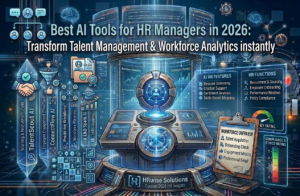
AI tools for HR managers have evolved from basic applicant tracking add-ons into fully autonomous workforce engines. Today’s ai hr software streamlines the entire employee lifecycle, from skills-based sourcing and unbiased screening (ai for recruitment) to sentiment analysis, real-time feedback, and attrition forecasting (ai for employee engagement). By deploying specialized hr automation tools, human resources teams eliminate up to 60% of repetitive administrative tasks, allowing leaders to focus on strategic talent strategy and organizational culture.
Eightfold AI: Best for skills-based candidate matching, talent intelligence, and internal mobility.
Rippling: Best all-in-one unified ai hr software combining global payroll, IT provisioning, and core HR.
Lattice: Best for AI-driven performance reviews, real-time goal tracking, and continuous engagement.
Paradox (Olivia): Best conversational ai for recruitment screening and high-volume interview scheduling via chat.
Culture Amp: Best enterprise-grade sentiment analysis tool for predicting burnout and attrition risk.
Introduction
Human Resources has undergone a massive transformation over the last few years. Research indicates that HR teams historically spend over 50% of their working hours on administrative friction, manually sorting through hundreds of resumes, answering repetitive policy queries, chasing onboarding paperwork, and compiling annual feedback forms.
In 2026, relying on spreadsheets and static legacy software is no longer sustainable.
Modern ai tools for hr managers act as digital co-pilots across every stage of the employee journey. By leveraging modern ai hr software, People Ops leaders can instantly identify top talent, deliver personalized onboarding experiences, measure employee sentiment in real time, and build high-retention workplace cultures.
Whether you manage a fast-growing startup or an enterprise workforce, this guide evaluates the top 10 AI-powered HR platforms transforming human capital management today. Research indicates that HR teams historically spend over 50% of their working hours on administrative friction, according to Gartner’s HR technology research.
How AI is Transforming Modern HR Operations
Integrating artificial intelligence into human resources goes far beyond automating basic data entry. It creates proactive, predictive organizational systems.
Core Functions Empowered by AI
-
AI for Recruitment & Talent Acquisition: AI algorithms analyze candidate skills rather than just keyword-heavy resumes, auto-schedule multi-stage interviews, and eliminate unconscious hiring bias.
-
AI for Employee Engagement & Retention: Natural language processing (NLP) audits employee feedback surveys in real time to detect early warning signs of burnout, disengagement, or attrition risk.
-
HR Automation Tools & Lifecycle Orchestration: Cross-department workflows—such as background verifications, IT device shipping, and benefits enrollment, execute automatically without manual email back-and-forth.
-
AI-Driven Performance Reviews: AI writing assistants help managers craft objective, bias-free performance feedback and align team OKRs effortlessly.
These same orchestration principles power broader workplace automation — see our full breakdown of the best AI automation tools for cross-department workflows.”
Key Criteria for Choosing the Right AI HR Software
Before selecting an AI tool for your People Ops stack, evaluate these four critical pillars:
-
Ecosystem & HRIS Integration: The tool must sync natively with your core systems (e.g., Workday, BambooHR, ADP, Greenhouse, Lever, Slack, Microsoft Teams).
-
Algorithmic Fairness & DEI Compliance: Ensure the platform provides transparent, auditable AI models that prevent demographic or gender bias during screening and evaluation.
-
Data Security & Privacy: HR software handles sensitive personal data (PII), bank details, and performance records. Look for enterprise SOC 2 Type II, GDPR, and HIPAA compliance.
-
Scalability & User Experience: The software must be intuitive for both HR administrators and non-technical employees accessing self-service portals.
Quick Comparison: Top AI Tools for HR Managers
| Tool | Core HR Focus | Standout AI Feature | Free Trial / Tier? | Best For |
| Eightfold AI | Talent Acquisition | Skills-graph predictive candidate matching | Demo-based | High-volume & enterprise hiring |
| Rippling | Unified HRIS & Payroll | Cross-app workflow automation bots | Demo-based | Scaling mid-market & global remote teams |
| Lattice | Performance & Engagement | AI feedback co-pilot & OKR alignment | Demo-based | Mid-market growth companies |
| Paradox (Olivia) | Conversational Recruiting | AI chatbot for screening & auto-scheduling | Demo-based | Retail, hospitality & volume recruiting |
| Culture Amp | Engagement & Analytics | Sentiment analysis & attrition forecasting | Demo-based | Enterprise people intelligence & DEI |
| Leena AI | HR Service Desk | Autonomous 24/7 AI employee assistant | Demo-based | Distributed workforces needing instant support |
| Moxo | Workflow Orchestration | AI agents for cross-department onboarding | Free trial | Teams where handoffs between HR & IT stall |
| HireVue | Video Interviewing | Validated AI skill & video assessments | Demo-based | Early talent, campus & technical hiring |
| BambooHR | Core HR & Onboarding | Automated approval workflows & turnover risk | Free trial | Growing SMBs seeking simple core HR |
| Textio | DEI & Job Posting | Inclusive language audit & bias detection | Demo-based | Recruiting teams focused on diverse sourcing |
In-Depth Reviews: Top 10 AI Tools for HR Managers in 2026
Eightfold AI: Best AI for Recruitment & Talent Intelligence
Eightfold AI is an enterprise-grade talent intelligence platform that shifts hiring from static resume keywords to dynamic skills-based matching. Built on a deep global skills graph, Eightfold analyzes a candidate’s potential and adjacent skill sets rather than relying solely on past job titles.
It enables recruiters to instantly surface top-tier candidates from internal talent pools, past applicant databases, and external channels while reducing hiring cycles by up to 60%.
-
Key Features: Deep skills-graph matching, internal talent mobility, succession planning, diversity and inclusion tracking, predictive career pathing.
-
Pros: Drastically reduces time-to-hire; excels at discovering passive internal candidates; built with strong anti-bias safeguards.
-
Cons: Enterprise pricing and implementation complexity mean it is less suited for small startups.
-
Best For: Enterprise organizations and fast-growing tech companies prioritizing skills-based hiring.
-
Pricing: Custom enterprise pricing (quote-based).
Rippling: Best Unified AI HR Software for Payroll, IT, and HRIS
Rippling stands out as a powerful all-in-one workforce management system. Instead of siloing HR data, Rippling connects payroll, benefits, computer provisioning, and app permissions onto a single employee database.
Its AI engine allows HR managers to build custom “Recipe” automations—such as automatically ordering a laptop, setting up Google Workspace/Slack accounts, and triggering welcome sequences the second an offer letter is signed.
-
Key Features: Automated global payroll, IT device management, custom workflow builder, smart compliance tracking, dynamic org charts.
-
Pros: Eliminates departmental handoffs between HR, Finance, and IT; supports global contractor and employee management seamlessly.
-
Cons: Advanced automation capabilities require subscribing to multiple Rippling modules.
-
Best For: Growing mid-market businesses and global remote companies wanting a single source of truth.
-
Pricing: Core platform starts at $8/user/month (modular pricing based on features).
Lattice: Best AI for Employee Engagement, OKRs, and Performance
Lattice integrates performance management, 360-degree reviews, goal tracking (OKRs), and employee engagement surveys into a single intuitive platform. Its built-in AI writing assistant helps managers write constructive, clear, and bias-free performance reviews in half the time.
Furthermore, Lattice’s AI engine analyzes employee survey responses to highlight sentiment trends, manager effectiveness, and team burnout risks before they impact retention.
-
Key Features: AI-assisted performance feedback, real-time engagement pulse surveys, OKR alignment nudges, 1-on-1 meeting agendas, career growth tracks.
-
Pros: Highly engaging user interface; connects day-to-day goals with annual performance reviews; excellent sentiment reporting.
-
Cons: Requires consistent manager participation to unlock maximum value.
-
Best For: HR leaders aiming to build a continuous feedback culture in remote or hybrid teams.
-
Pricing: Plans start at $11/user/month.
Paradox (Olivia): Best Conversational AI for Automated Recruitment
Paradox (featuring its conversational assistant, Olivia) revolutionizes high-volume hiring by automating candidate interaction via web chat, SMS, and WhatsApp. Candidates can apply, complete basic screening questions, and schedule their own interviews directly through a natural chat interface in under 3 minutes.
By handling repetitive top-of-funnel screening, Paradox allows talent acquisition teams to focus on candidate relationships rather than calendar management.
-
Key Features: Conversational AI screening, multi-channel candidate engagement (SMS/WhatsApp/Web), automated calendar scheduling, offer letter delivery.
-
Pros: Reduces candidate drop-off rates dramatically; operates 24/7 in multiple languages; ideal for high-volume hourly hiring.
-
Cons: Specialized primarily for talent acquisition rather than full employee lifecycle management.
-
Best For: Retail chains, hospitality groups, healthcare organizations, and high-volume recruiters.
-
Pricing: Custom enterprise pricing (quote-based).
Culture Amp: Best AI for Employee Retention & Attrition Analytics
Culture Amp is a leading employee experience platform backed by deep organizational psychology data. Its AI analytics engine processes thousands of qualitative feedback comments from pulse surveys, onboarding reviews, and exit interviews to extract actionable key drivers of morale. For teams wanting to dig deeper into the underlying data science, our roundup of the best AI tools for data analysis explains how these insights get uncovered.
It automatically benchmarks your company’s engagement against global industry standards and alerts HR managers to specific departments at risk of turnover.
-
Key Features: AI-powered qualitative sentiment analysis, turnover risk forecasting, DEI benchmarking, manager coaching nudges, turnover cost calculators.
-
Pros: Deep psychological insights backed by benchmark data; clear actionable recommendations for executive teams.
-
Cons: Custom setup required to align surveys with unique company structures.
-
Best For: HR Directors and People Analytics leaders focused on culture development and reducing attrition.
-
Pricing: Custom quote-based pricing.
Leena AI: Best Autonomous HR Service Desk & Employee Self-Service
Leena AI serves as a 24/7 autonomous digital assistant for current employees. Grounded in your company’s internal documentation, employee handbooks, and HRIS systems, Leena AI instantly answers employee questions regarding leave balances, health insurance policies, expense reimbursement, and company benefits.
It resolves up to 80% of routine HR service desk tickets automatically, dramatically reducing internal support queues.
-
Key Features: Conversational HR knowledge base bot, automated leave request processing, policy document lookup, ticketing system integration.
-
Pros: Resolves employee queries instantly via Slack, Teams, or Web; drastically reduces repetitive email inquiries for HR ops.
-
Cons: Requires a well-structured internal policy document base during initial setup.
-
Best For: Mid-to-large enterprises with complex policies and high internal HR ticket volume.
-
Pricing: Custom enterprise pricing (quote-based).
Moxo: Best HR Automation Tools for Lifecycle Workflow Orchestration
Moxo is a specialized human-AI process orchestration platform designed to streamline complex employee lifecycle transitions—such as pre-boarding, cross-departmental onboarding, role changes, and offboarding.
Instead of lifecycle steps getting lost in scattered emails between HR, IT, and hiring managers, Moxo’s AI agents automatically coordinate document collection, digital signatures, background checks, and hardware delivery with full progress visibility.
-
Key Features: AI workflow builder, magic-link document collection, automated reminder agents, compliance-grade audit trails, cross-department tracking.
-
Pros: Prevents onboarding bottlenecks across departments; provides real-time progress dashboards for People Ops.
-
Cons: Not a standalone HRIS (coordinates existing tools rather than storing master employee data).
-
Best For: Companies where employee onboarding stalls due to multi-department approval delays.
-
Pricing: Free plan to start; paid plans start from $80/month.
Hire Vue: Best AI for Video Interviewing & Skill Assessments
HireVue combines structured video interviewing with validated pre-employment AI assessments. Candidates record responses to structured interview questions at their convenience, and HireVue’s AI assists recruiters by evaluating technical skills, problem-solving abilities, and situational judgment.
It ensures every candidate receives a consistent, structured interview process while drastically reducing time-to-hire for large campus drives and technical roles.
-
Key Features: On-demand video interviews, validated coding and skill assessments, automated interview scheduling, structured scoring rubrics.
-
Pros: Highly scalable for volume screening; eliminates early-round interview scheduling bottlenecks; ensures standardized evaluation.
-
Cons: Requires clear candidate communication to ensure comfort with video recording workflows.
-
Best For: Enterprise talent acquisition teams, campus hiring, and technical recruitment.
-
Pricing: Custom enterprise contracts.
BambooHR: Best Core AI HR Software for Growing Mid-Market Companies
BambooHR is a fan-favorite HRIS designed specifically for small-to-medium businesses. Its platform incorporates smart automation to handle employee databases, electronic signatures, PTO tracking, performance reviews, and applicant tracking in one place.
BambooHR uses predictive analytics to track employee retention trends and automate approval workflows, freeing HR managers from manual paperwork.
-
Key Features: Core employee database, automated PTO & approval workflows, applicant tracking system (ATS), e-signatures, turnover health analytics.
-
Pros: Exceptionally user-friendly interface; rapid implementation; affordable for growing businesses.
-
Cons: Lacks the ultra-deep customization required by massive multinational conglomerates.
-
Best For: Small-to-medium businesses (SMBs) seeking a clean, reliable, and automated core HR hub.
-
Pricing: Starts at approx. $10/user/month (quote-based tiers available).
Textio: Best AI Tool for Inclusive Job Descriptions & DEI Writing
Textio is an AI-powered writing tool explicitly engineered to eliminate gender, racial, and age bias from job postings and performance evaluations. As you draft job descriptions, Textio analyzes your wording in real time and provides an “Inclusivity Score” along with specific vocabulary suggestions that attract a broader, more diverse candidate pool.
-
Key Features: Real-time inclusivity scoring, gender/bias language detection, employer brand alignment, performance review feedback auditing.
-
Pros: Proven to increase qualified female and minority applicant response rates by up to 30%; easy browser extension integration.
-
Cons: Highly focused niche utility (writing optimization) that requires pairing with a broader ATS.
-
Best For: Recruitment teams and DEI officers committed to building fair, inclusive workplace cultures.
-
Pricing: Custom enterprise subscriptions.
Strategic Best Practices for Implementing AI in HR
To ensure a smooth transition when deploying ai hr software, follow these strategic implementation guidelines:
1. Maintain the “Human-in-the-Loop” Principle
AI should empower HR decision-making, not replace human judgment entirely. Final decisions regarding hiring, promotions, terminations, and disciplinary actions must always involve human oversight to preserve empathy, context, and legal compliance.
2. Audit for Algorithmic Bias Regularly
Periodically audit your recruitment and performance AI tools to ensure they do not accidentally favor specific demographics over others. Choose vendors that publish transparent AI audit reports and comply with regional AI governance laws.
3. Communicate Openly with Employees
When implementing tools like AI sentiment monitoring or automated service desks, communicate transparently with your workforce. Explain how employee data is secured, how privacy is protected, and how AI improves their daily work experience.
4. Start with High-Friction Operational Pain Points
Avoid trying to automate your entire HR department overnight. Begin by deploying AI in areas with the highest friction, such as candidate interview scheduling (ai for recruitment) or answering routine leave policy queries (hr automation tools), before scaling to complex performance systems. If scheduling is your biggest bottleneck, our guide to the best AI tools for scheduling and calendar management covers dedicated solutions beyond HR-specific platforms.
The Future of AI in Human Resources
The role of AI in HR is expanding into autonomous organizational design:
-
Agentic HR Workflows: AI agents will autonomously handle complex cross-departmental operations (e.g., managing global mobility, tax residency updates, and multi-country benefits adjustments) without manual intervention.
-
Predictive Skill Gap Mapping: AI platforms will continuously compare company growth goals against current employee skill graphs, automatically recommending personalized upskilling courses before skill shortages occur.
-
Biometric Burnout Prevention: Integration with wellness software will allow HR teams to proactively manage work capacity, preventing employee turnover through data-driven workload adjustments.
Conclusion
Adopting modern ai tools for hr managers is no longer just a competitive advantage—it is essential for building agile, human-centric organizations in 2026.
-
Choose Rippling or BambooHR if you want an automated, unified core HRIS platform for core operations and payroll.
-
Choose Eightfold AI or Paradox if your priority is transforming talent acquisition through intelligent ai for recruitment.
-
Choose Lattice or Culture Amp if you want to elevate retention and employee satisfaction through data-backed ai for employee engagement.
-
Choose Leena AI or Moxo if you need robust hr automation tools to eliminate repetitive support tickets and workflow handoffs.
To explore more HR tech evaluations, workforce automation strategies, and digital transformation guides, visit the latest resources on openaihit.
Frequently Asked Questions
Q1: What is the primary benefit of using ai tools for hr managers?
The primary benefit is eliminating administrative overhead. By automating manual resume screening, interview scheduling, employee query resolution, and onboarding paperwork, HR managers can shift up to 60% of their time toward strategic talent development, leadership coaching, and workplace culture.
Q2: How does ai for recruitment prevent hiring bias?
Modern ai for recruitment tools (like Eightfold AI and Textio) evaluate candidates based on validated skill graphs, potential, and performance metrics rather than demographic markers, prestige institution names, or gendered language. However, algorithms must be audited regularly to ensure fairness.
Q3: Is ai hr software suitable for small-to-medium businesses (SMBs)?
Yes, Platforms like BambooHR, Rippling, and Lattice offer scalable pricing and user-friendly features designed specifically for growing mid-market companies without requiring massive IT support teams.
Q4: How does ai for employee engagement protect worker privacy?
Reputable ai for employee engagement software (like Culture Amp and Lattice) aggregates and anonymizes survey responses before running NLP sentiment analysis. Individual responses remain confidential, giving leadership high-level team insights without compromising personal trust.