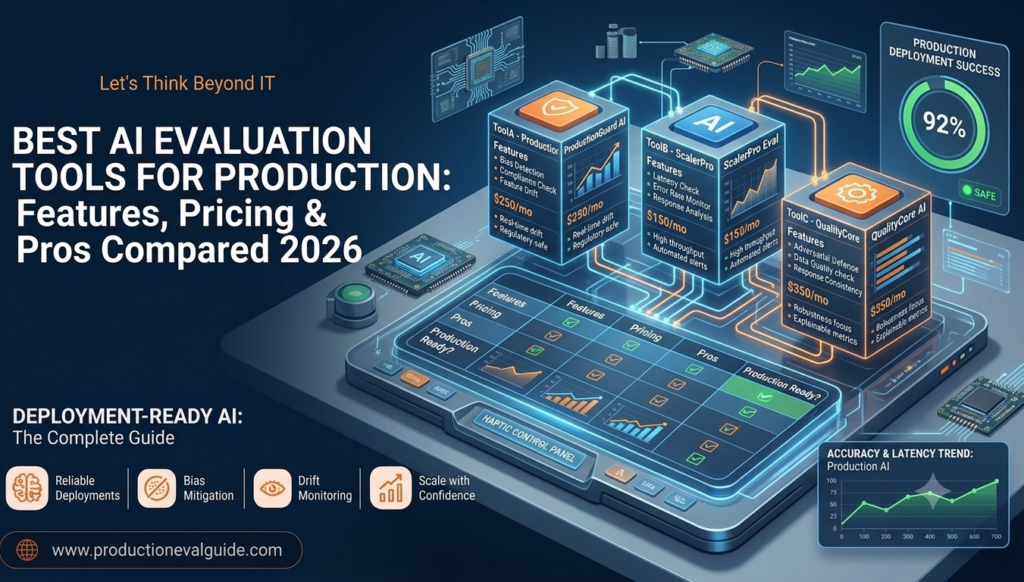
The best AI evaluation tools for production in 2026 include LangSmith, Arize Phoenix, DeepEval, Ragas, Braintrust, and Weights & Biases (Weave). LangSmith excels at end-to-end tracing within LangChain ecosystems; DeepEval and Ragas dominate open-source unit testing and RAG metric evaluations; while Arize Phoenix and Braintrust lead in enterprise-grade observability, real-time hallucination tracking, and high-throughput CI/CD evaluation pipelines.
Key Takeaways
-
Shift from Static to Continuous Evals: Evaluating AI in 2026 requires both offline pre-deployment unit tests (CI/CD) and online real-time production monitoring.
-
The RAG Triad Standard: Top frameworks evaluate Retrieval-Augmented Generation using Context Relevance, Groundedness (Faithfulness), and Answer Relevance.
-
LLM-as-a-Judge Dominance: Automated scoring using stronger models (e.g., GPT-4o, Claude 3.5 Sonnet) combined with deterministic heuristic checks is the industry standard for evaluation.
-
Trace-Driven Debugging: Production platforms must capture full execution graphs—including agentic tool calls, intermediate embeddings, and prompt variables—to diagnose failure modes rapidly.
-
Cost & Privacy Trade-offs: Open-source, self-hosted evaluation libraries (DeepEval, Ragas) offer maximum data privacy, while managed SaaS tools (Braintrust, LangSmith) accelerate team collaboration.
Introduction
Deploying Large Language Models (LLMs) to production is relatively easy; ensuring they consistently deliver accurate, safe, and low-latency responses at scale is notoriously difficult. Unlike traditional software where outputs are deterministic, generative AI applications are probabilistic. A prompt template that works flawlessly during local testing can hallucinate, suffer from context drift, or leak sensitive system prompts when exposed to real-world edge cases.
To bridge this reliability gap, engineering teams are adopting dedicated best ai evaluation tools for production pipelines. These platforms provide pre-deployment unit testing, automated LLM-as-a-Judge frameworks, real-time observability, and latency-cost tracking. They help developers catch regressions before users do, optimize retrieval-augmented generation (RAG) pipelines, and enforce strict safety guardrails.
In this comprehensive guide, we analyze the top LLM evaluation tools and AI testing platforms dominating the industry in 2026. You will learn how these platforms handle real-time tracing, offline CI/CD benchmarking, and continuous AI performance evaluation across diverse enterprise architecture requirements.
What Are Production AI Evaluation Tools?
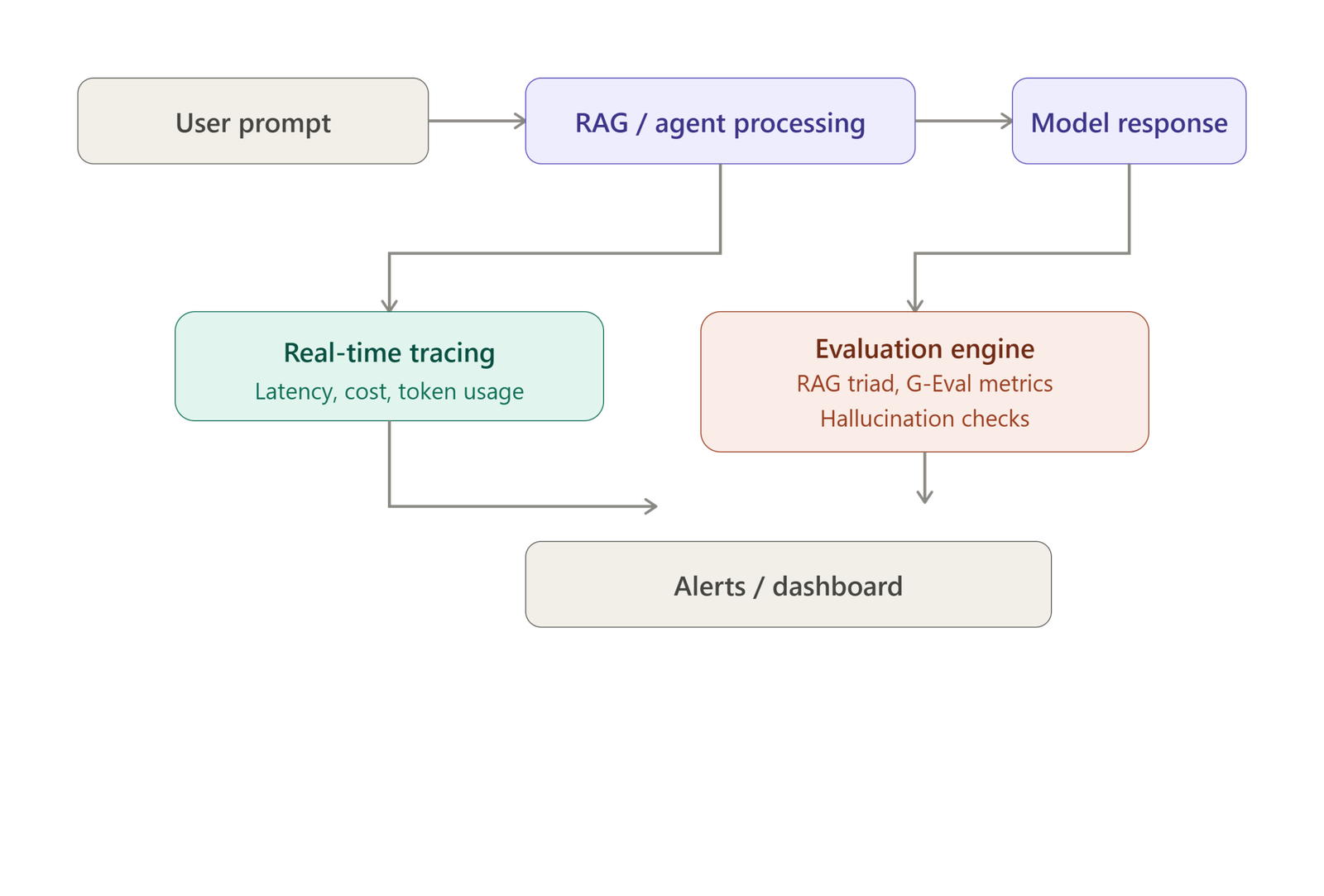
Production AI Evaluation Tools Definition: Software systems that automatically quantify, benchmark, and monitor the performance, accuracy, safety, and operational costs of generative AI applications (such as LLMs, AI agents, and RAG architectures) across both development testing suites and live production environments.
In traditional software development, unit testing checks whether input $A$ produces expected output $B$. In generative AI, the same user prompt can return structurally variable responses. Production evaluation tools replace manual spot-checking with systematic evaluation methodologies.
+-------------------------------------------------------------------------+
|                  AI EVALUATION LIFECYCLE ARCHITECTURE                   |
|                                                                         |
|  [User Prompt] ---> [RAG / Agent Processing] ---> [Model Response]     |
|                             |                             |             |
|                             v                             v             |
|                  +---------------------+       +-------------------+    |
|                  | Real-Time Tracing   |       | Evaluation Engine |    |
|                  | (Latency, Cost,     | ----> | - RAG Triad       |    |
|                  |  Token Usage)       |       | - G-Eval Metrics  |    |
|                  +---------------------+       | - Hallucinations  |    |
|                                                +-------------------+    |
|                                                           |             |
|                                                           v             |
|                                                [Alerts / Dashboard]     |
+-------------------------------------------------------------------------+
Key Pillars of Modern LLM Evaluation
-
Pre-Deployment Benchmarking (Offline Evals): Running standardized test datasets against prompt iterations, system instructions, or fine-tuned model versions before pushing changes to live users.
-
Real-Time Observability (Online Evals): Sampling live user interactions in production to calculate satisfaction scores, detect toxicity, measure hallucination drift, and trigger immediate alerts.
-
Execution Tracing: Recording the complete multi-step execution tree of compound AI systems, including vector database retriever queries, tool calls, and agentic loops.
Why Evaluating Production AI Is Critical in 2026
Building generative AI applications without specialized AI performance evaluation tools leads to silent failures. Models do not throw traditional code exceptions when they hallucinate inaccurate facts or give off-topic advice; they respond with high confidence, leaving users with poor experiences.
Key Operational Challenges Solved by AI Evaluation Tools
-
Prompt Regression Risk: Changing a single sentence in a system prompt can fix one edge case while breaking ten previously working user scenarios.
-
RAG Pipeline Inefficiencies: Poor chunking strategies or sub-optimal vector retrieval can insert irrelevant documents into context windows, inflating token costs while degrading answer quality.
-
Agentic Loop Instability: Autonomous AI agents utilizing function calling can enter infinite execution loops or fail silently during tool selection without granular tracing.
-
Compliance & Safety Standards: Organizations face regulatory pressure to ensure AI outputs do not leak personally identifiable information (PII), exhibit bias, or generate toxic material.
Top AI Evaluation Tools for Production Compared
Selecting the best ai evaluation tools for production depends heavily on your existing tech stack, privacy constraints, and whether you prioritize open-source flexibility or managed enterprise features.
                  EVALUATION TOOL LANDSCAPE MATRIX

  +----------------------+      +----------------------+
  | Managed Platforms    |      | Open-Source Engine   |
  | - LangSmith          |      | - DeepEval           |
  | - Braintrust         |      | - Ragas              |
  | - Arize Phoenix      |      | - TruLens            |
  +----------------------+      +----------------------+
            |                              |
            +--------------> <-------------+
                           |
                           v
            +------------------------------+
            | Production AI Stack (2026)   |
            +------------------------------+
1. LangSmith (by LangChain)
LangSmith is an enterprise platform designed for building, testing, debugging, and monitoring LLM applications. While engineered natively for the LangChain and LangGraph ecosystems, it integrates seamlessly with any custom Python or TypeScript AI framework. If you’re just getting oriented in this space, our broader roundup of best AI tools for developers covers where evaluation platforms fit alongside coding assistants and IDEs.
-
Core Strengths: Deep visualization of multi-step agent execution trees, easy human-in-the-loop annotation queues, and automated dataset generation from real production traces.
-
Evaluation Capabilities: Features custom evaluators, G-Eval support, pairwise model comparisons, and automated regression testing integrated into CI/CD pipelines.
-
Best For: Teams using LangChain or building complex multi-agent applications requiring visual step-by-step tracing.
2. Arize Phoenix & Arize AI
Arize Phoenix is a leading open-source observability and evaluation library that scales into Arize’s enterprise cloud platform. It offers vendor-agnostic tracing based on OpenTelemetry standards.
-
Core Strengths: Best-in-class hallucination detection algorithms, automated vector embeddings visualization, and native OpenTelemetry integration.
-
Evaluation Capabilities: Provides specialized evaluation modules for RAG pipelines (context relevance, groundedness, answer correctness), toxicity, and PII detection.
-
Best For: Enterprise ML and MLOps teams looking for standardized telemetry across both traditional ML models and generative LLMs.
3. DeepEval (by Confident AI)
DeepEval is an open-source, developer-centric LLM evaluation framework built to feel like PyTest for AI applications. It enables developers to write unit tests for prompts, RAG architectures, and agentic workflows. For teams comparing coding-focused AI tools that pair well with a CI/CD testing setup, our head-to-head on Claude Code vs Cursor is a useful companion read.
-
Core Strengths: Seamless developer experience, native CI/CD workflow integration (GitHub Actions), and support for over 14+ standardized evaluation metrics out of the box.
-
Evaluation Capabilities: Includes metrics for G-Eval, Faithfulness, Summarization, Answer Relevancy, Hallucination, Bias, and Toxicity.
-
Best For: Engineering teams looking to implement shift-left testing and automated LLM unit tests within their existing codebase.
4. Ragas (Retrieval Augmented Generation Assessment)
Ragas is a specialized framework designed specifically to evaluate Retrieval-Augmented Generation pipelines without requiring human-annotated ground truth datasets.
-
Core Strengths: Industry-standard benchmark metrics for evaluating document retriever performance and generator fidelity.
-
Evaluation Capabilities: Evaluates Context Precision, Context Recall, Context Entities, Noise Sensitivity, Faithfulness, and Answer Relevance.
-
Best For: Teams building document-heavy search systems, enterprise knowledge bases, and RAG-driven AI assistants.
5. Braintrust
Braintrust is an enterprise-grade AI evaluation platform focused on speed, security, and developer productivity. It combines prompt playgrounds, dataset management, and automated evaluation logging into a unified web interface.
-
Core Strengths: Extremely fast evaluation execution speeds, local-first privacy architecture, and intuitive prompt iteration interfaces for non-technical domain experts.
-
Evaluation Capabilities: Supports custom code-based evaluators, LLM-as-a-Judge grading, and automated side-by-side model benchmarking.
-
Best For: Mid-market to enterprise companies looking for a collaborative platform where developers and product managers iterate on prompts together.
Detailed Comparison Table: Features, Pricing & Capabilities
| Tool Name | Type / License | Primary Focus | Native RAG Metrics? | CI/CD Integration | Starting Price |
| LangSmith | Managed SaaS / Enterprise | Tracing, Debugging, Evals | Yes | Excellent | Free tier; $39/user/mo |
| Arize Phoenix | Open Source / Managed | Observability & Tracing | Yes | Good | Free open-source; Enterprise quote |
| DeepEval | Open Source / Cloud Platform | LLM Unit Testing | Yes | Native (PyTest) | Free open-source; $19/mo Cloud |
| Ragas | Open Source Framework | RAG Pipeline Evaluation | Specialized | Moderate | Free open-source |
| Braintrust | Enterprise SaaS / Hybrid | Evals & Prompt Iteration | Yes | Excellent | Free trial; Usage-based plans |
| Weights & Biases (Weave) | Managed SaaS | MLOps & Prompt Tracking | Yes | Good | Free tier; $50/user/mo |
Evaluation Methodologies: How AI Performance Is Measured
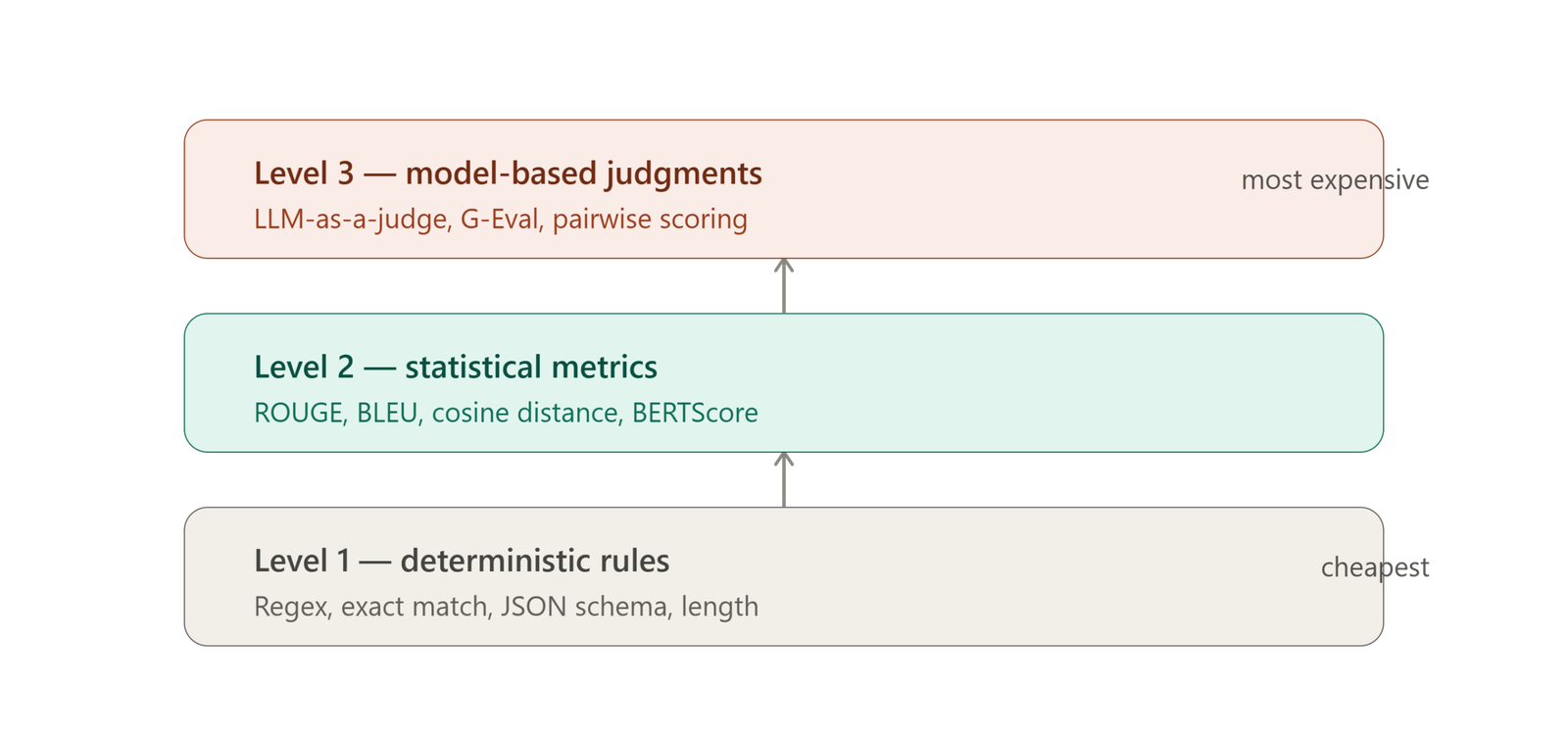
Modern LLM evaluation tools employ three complementary measurement methodologies to assess model performance accurately.
                      TRIPLE-LAYER EVALUATION METHODOLOGY

    [LEVEL 1: Deterministic Rules]  ---> Regex, Exact Match, JSON Schema, Length
                 |
    [LEVEL 2: Statistical Metrics]  ---> ROUGE, BLEU, Cosine Distance, BERTScore
                 |
    [LEVEL 3: Model-Based Judgments]---> LLM-as-a-Judge (G-Eval, Pairwise)
1. Deterministic & Heuristic Checks
Fast, inexpensive checks executed via traditional code:
-
JSON Schema Validation: Ensures structured outputs match required API payload formats.
-
Regex & Keyword Matching: Verifies that forbidden terms, profane language, or specific brand names are excluded or included.
-
Latency & Token Counters: Tracks response generation time (TTFT – Time to First Token) and total input/output token counts.
2. Statistical & Semantic Similarity
Compares model responses against reference texts using vector math:
-
Embedding Distance: Calculates cosine similarity between vector representations of the generated answer and ground truth.
-
Semantic Bleed Analysis: Measures whether generated content strays outside the source context provided in the retrieval window.
3. LLM-as-a-Judge (G-Eval Framework)
Utilizes powerful state-of-the-art models (such as GPT-4o, Claude 3.5 Sonnet, or fine-tuned Llama models) with explicit scoring criteria to grade complex qualities:
-
Faithfulness / Groundedness: Measures whether every claim in the generated output is directly supported by the retrieved context.
-
Answer Relevancy: Assesses whether the generated response directly answers the user’s prompt without introducing off-topic information.
This approach builds on the original G-Eval research paper from Microsoft and Tsinghua University, which first proposed using LLMs with chain-of-thought reasoning to grade generated text.
Step-by-Step: Setting Up a Production Evaluation Pipeline
To build a reliable evaluation pipeline using AI testing tools, follow this four-phase operational deployment strategy.
                      PRODUCTION EVALUATION PIPELINE

  [Phase 1] Define Metrics & Gold Standard Benchmark Dataset
     |
  [Phase 2] Embed Tracing SDKs into Application Code
     |
  [Phase 3] Configure Automated CI/CD Regression Tests (DeepEval/PyTest)
     |
  [Phase 4] Deploy Production Sampling & Real-Time Hallucination Alerts
4-Phase Deployment Strategy
-
Curate a Golden Dataset: Assemble 100 to 500 representative user queries, complete with realistic edge cases, complex questions, and verified ground-truth reference answers.
-
Integrate Open-Telemetry Tracing: Instrument your application code using standard SDKs (e.g., OpenInference, LangSmith SDK) to automatically log prompts, completion tokens, latency, and intermediate RAG document retrieves.
-
Automate Pre-Merge Unit Tests: Configure your GitHub Actions or GitLab CI/CD pipelines to run automated evaluations (e.g., via
deepeval run test_evals.py) on every pull request. Prevent merging if faithfulness or accuracy scores drop below set thresholds (e.g., < 0.85). -
Implement Production Sampling & Monitoring: Sample 5% to 10% of live user interactions in production for real-time scoring. Set up automated Slack or PagerDuty alerts when real-time hallucination rates spike.
Pricing Models & Cost Optimization Strategies
Running automated evaluations—especially those using LLM-as-a-Judge techniques—incurs financial costs. Choosing the right pricing structure prevents unexpected budget overruns.
Common Pricing Models in 2026
-
Per-User / Seat Subscription: Fixed monthly fee per developer account (common in managed SaaS like LangSmith and Weights & Biases).
-
Hosted Evaluation Usage (Per-Token / Per-Trace): Pay-as-you-go pricing based on the total volume of evaluation traces ingested by the platform cloud.
-
Self-Hosted Open Source: Free software license fees, but you pay infrastructure costs for hosting databases (ClickHouse, PostgreSQL) and LLM judge API tokens.
How to Reduce AI Evaluation Costs
-
Use Tiered Evaluation Sampling: Run full LLM-as-a-Judge evaluations on 100% of pre-deployment test cases, but sample only 2% to 5% of live production traffic.
-
Deploy Smaller Judge Models: Use smaller, faster models (e.g., GPT-4o-mini, Claude 3 Haiku, or fine-tuned Llama-3-8B models) for routine evaluations, reserving top-tier models for complex multi-step reasoning validation.
-
Combine Heuristics with LLMs: Run cheap deterministic regex and length checks first; trigger expensive LLM judge evaluations only if deterministic checks pass.
Common Pitfalls in AI Evaluation & How to Avoid Them
-
Over-Relying on Single-Metric Scores: Relying solely on an overall “accuracy” score masks critical issues. Break evaluations down into granular sub-metrics (Faithfulness, Context Precision, Toxicity).
-
Testing Only Happy-Path Prompts: Benchmarking using only clean, well-formatted inputs leads to false confidence. Always test against noisy inputs, spelling errors, prompt injection attempts, and ambiguous queries.
-
Ignoring Data Leakage in Ground Truths: Ensure test datasets do not contaminate fine-tuning training datasets, which can inflate evaluation scores artificially.
-
Failing to Human-Audit the LLM Judge: Periodically evaluate your LLM judge by comparing its automated scores against human expert ratings to ensure scoring alignment.
Future Trends in AI Evaluation Beyond 2026
-
Agentic Multi-Turn Evaluations: Evaluation engines will shift from single-turn prompt-response grading to multi-turn conversation simulation using autonomous user agents.
-
Real-Time Self-Correction: When an online evaluation engine detects a hallucination during response generation, it will automatically instruct the LLM to re-generate the answer before presenting it to the user.
-
Standardized AI Safety Regulations: Global regulatory standards will require certified evaluation trail audits before enterprise AI agents can interact with public financial or medical data.
Conclusion
Selecting the best ai evaluation tools for production is an essential step in transitioning generative AI from experimental prototypes into reliable, enterprise-grade software products. Implementing continuous testing, execution tracing, and automated scoring safeguards your applications against prompt regressions, unexpected hallucinations, and spiraling token costs.
If you are looking for developer-friendly unit testing and CI/CD integration, open-source libraries like DeepEval and Ragas offer unparalleled flexibility and privacy. For organizations requiring full visual multi-agent tracing and enterprise team collaboration, managed platforms like LangSmith, Braintrust, and Arize Phoenix provide comprehensive solutions.
Stay ahead of the rapidly evolving AI infrastructure ecosystem by exploring more hands-on tool reviews, developer guides, and MLOps strategies at openaihit.com.
FAQs
What is the difference between AI observability and AI evaluation?
AI observability focuses on tracking real-time operational health, telemetry, latency, token consumption, system logs, and error traces in production. AI evaluation focuses on measuring the actual quality, accuracy, correctness, hallucination rate, and safety of the generated outputs against predefined standards or metrics.
How do LLM-as-a-Judge frameworks work?
LLM-as-a-Judge frameworks use a high-capability language model (such as GPT-4o or Claude 3.5 Sonnet) supplied with a strict prompt template, evaluation criteria, scoring rubrics, and contextual input data to grade and score the response of another model automatically.
Which evaluation tool is best for RAG applications?
Ragas and DeepEval are widely considered the best specialized tools for RAG evaluation because they offer native metrics specifically built for retrieval-augmented architectures, such as Context Precision, Context Recall, Noise Sensitivity, and Groundedness.
Are open-source AI evaluation tools secure for confidential enterprise data?
Yes, open-source evaluation tools like DeepEval, Ragas, and Arize Phoenix can be self-hosted entirely within your private cloud infrastructure (AWS VPC, GCP, or Azure), ensuring that sensitive user data and proprietary prompts never leave your secure network.
How many test cases should a benchmark dataset contain?
For pre-deployment CI/CD evaluation, a golden dataset of 100 to 300 well-curated, diverse test cases covering both core user journeys and edge cases is typically sufficient to catch prompt regressions and quality degradation.
Can I evaluate AI applications without ground truth answers?
Yes. Metrics like Faithfulness (checking if the response matches the retrieved context), Toxicity, Prompt Injection detection, and JSON schema validation do not require human-annotated ground-truth answers.
What is the RAG Triad?
The RAG Triad is an evaluation framework that measures three critical points of a RAG pipeline: Context Relevance (is the retrieved context relevant to the query?), Faithfulness (is the answer grounded strictly in the retrieved context?), and Answer Relevance (does the answer directly address the user query?).
How do AI evaluation tools integrate into CI/CD pipelines?
Tools like DeepEval provide command-line interfaces (CLIs) and integrations with testing frameworks like PyTest. You can configure your CI/CD workflow (e.g., GitHub Actions) to run evaluation scripts on every pull request, blocking code merges if evaluation scores fall below required thresholds.