
AI tools for business are transforming the way companies operate worldwide. From automating routine tasks to analyzing massive datasets, these tools have become indispensable for businesses seeking efficiency, innovation, and competitive advantage. Consequently, companies of all sizes, from startups to multinational corporations, leverage AI solutions to streamline operations, optimize decision-making, and enhance customer experiences.
Moreover, integrating AI tools goes beyond mere automation. They enable data-driven strategies, predictive analytics, and personalized customer interactions, therefore improving revenue and growth, while helping businesses adapt quickly to changing market demands.
Interestingly, just like exploring Hamburg places to visit requires planning and understanding of the environment, choosing the right AI tools demands careful consideration of business goals, resources, and data infrastructure, ensuring long-term success and efficiency.
Key Advantages of AI Tools for Business

Businesses that implement AI tools effectively gain multiple benefits, including reduced manual workload, improved accuracy, and faster decision-making, as machine learning algorithms uncover patterns humans might overlook, ultimately helping businesses stay competitive and efficient.
AI-driven customer service chatbots offer round-the-clock support, improving customer satisfaction and loyalty. For businesses seeking scalability, AI tools provide a cost-effective solution by automating repetitive processes such as data entry and invoice processing, allowing staff to focus on higher-value tasks.
Similarly, AI-powered analytics tools assist businesses in forecasting trends, optimizing supply chains, and improving marketing campaigns.Ultimately, integrating AI tools is no longer optional it is a strategic necessity for businesses aiming to thrive in the digital era.
Types of AI Tools for Business
Businesses can leverage a wide range of AI tools to address specific operational needs. For example, AI helps in customer service, marketing, analytics, and operations.
Popular AI tools include:
-
Chatbots and Virtual Assistants: Enhance customer service and lead generation.
-
Predictive Analytics Software: Forecast trends, sales, and customer behavior.
-
Natural Language Processing (NLP) Tools: Analyze customer reviews, emails, and social media sentiment.
-
Automated Marketing Tools: Personalize email campaigns, ads, and content recommendations.
-
Robotic Process Automation (RPA): Streamline repetitive tasks in finance, HR, and operations.
Therefore, selecting the right AI tools depends on business size, budget, and strategic objectives. Small businesses might prioritize cost-effective chatbots, whereas large enterprises can benefit from predictive analytics combined with RPA.
Implementing AI in Business Operations
Successfully implementing AI requires planning, infrastructure, and employee engagement. First, businesses should identify key areas where AI can add value.
Steps to implement AI tools effectively:
-
Assess Business Needs: Identify areas where AI can add value.
-
Choose the Right Tools: Evaluate features, integration capabilities, and costs.
-
Data Preparation: Ensure clean, organized, and relevant datasets.
-
Employee Training: Equip staff to use AI tools effectively.
-
Monitor and Improve: Continuously assess performance and optimize tools.
In addition, businesses should remember that AI adoption is a journey, not a one-time project. Consequently, continuous learning and adaptation are key to maximizing ROI.
Enhancing Customer Experience with AI

AI tools play a pivotal role in delivering personalized and efficient customer experiences. By analyzing data from multiple touchpoints, businesses can understand customer preferences and behaviors more accurately than ever before.
From chatbots that provide instant answers to AI-driven recommendation engines, customers enjoy faster responses, relevant suggestions, and smoother transactions. For example, e-commerce businesses use AI to suggest products based on browsing history, while banks employ AI to detect fraudulent transactions in real-time.
Moreover, when AI is used ethically and transparently, it not only improves customer satisfaction but also builds trust and brand loyalty. As a result, companies that focus on human-centered AI solutions are more likely to retain and engage their clients long-term.
AI-Powered Analytics and Decision-Making
In today’s data-driven business environment, decision-making must be informed and precise. For instance, AI-powered analytics tools allow businesses to process large datasets, identify trends, and generate actionable insights.
Unlike traditional analytics, AI can uncover patterns that may be invisible to human analysts. Machine learning algorithms continuously learn from data, improving predictions and recommendations. Consequently, companies can optimize pricing, inventory, and marketing strategies.
Furthermore, AI tools help businesses mitigate risks by detecting anomalies, predicting potential issues, and suggesting corrective actions. Ultimately, AI transforms raw data into a strategic asset that drives growth and innovation.
Popular AI Tools for Marketing and Sales
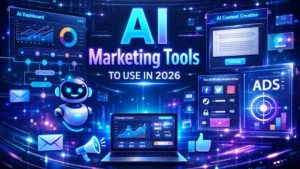
AI is reshaping marketing and sales by enabling automation, personalization, and better customer targeting. In particular, AI tools help marketers and sales teams deliver measurable results efficiently.
Key AI tools for marketing and sales include:
-
Email Marketing Automation: Personalized campaigns based on behaviour and preferences.
-
Social Media Analytics: Measure engagement, sentiment, and trending topics.
-
Lead Scoring Tools: Identify high-potential leads and prioritize follow-ups.
-
Sales Forecasting Software: Predict future revenue and demand accurately.
-
Content Generation Tools: Create blog posts, social media content, and product descriptions.
Consequently, these tools empower marketing and sales teams to operate more efficiently, deliver relevant messaging, and achieve business objectives.
AI in Operations and Supply Chain

AI is increasingly used to optimize operations, inventory management, and supply chain processes. By predicting demand, identifying inefficiencies, and automating routine tasks, businesses can reduce costs and enhance productivity.
AI-powered systems can forecast stock levels, detect bottlenecks, and recommend corrective measures. For example, predictive maintenance ensures equipment reliability and reduces downtime. Meanwhile, logistics companies leverage AI for route optimization, reducing fuel consumption and delivery times.
Therefore, AI adoption in operations allows businesses to achieve operational excellence while staying agile in a competitive market. Additionally, it enables real-time decision-making, helping companies respond faster to changing customer demands and market trends.
Key Challenges and Considerations
While AI tools offer immense potential, businesses must navigate challenges related to implementation, data privacy, and cost.
Common challenges include:
-
High Initial Investment: Some AI tools require significant upfront costs.
-
Data Quality Issues: Poor data can lead to inaccurate insights.
-
Integration Complexity: AI must work seamlessly with existing systems.
-
Ethical Concerns: Companies need transparent and responsible AI usage.
-
Skill Gaps: Employees must be trained to leverage AI effectively.
However, awareness of these challenges helps businesses plan strategically, ensuring AI adoption is smooth, ethical, and sustainable.
Future of AI Tools for Business
The future of AI in business is promising, with continuous innovations shaping operations, customer engagement, and decision-making. For example, emerging technologies like generative AI, advanced NLP, and autonomous systems will further revolutionize the business landscape.
Businesses that stay ahead of AI trends will gain a competitive edge, improve efficiency, and deliver superior customer experiences. In a way, planning AI adoption is similar to exploring Hamburg places to visit—it requires knowledge, strategy, and a vision for the future.
Future trends to watch:
-
Generative AI for content creation and design.
-
AI-driven personalization in marketing and sales.
-
Autonomous operations in manufacturing and logistics.
-
Ethical AI frameworks ensuring transparency and trust.
Consequently, businesses embracing these trends will thrive in a digital-first, data-driven world.
FAQs
Q1: What types of businesses can benefit from AI tools?
A: Businesses of all sizes from startups to large corporations can leverage AI for marketing, operations, analytics, and customer service.
Q2: How much does it cost to implement AI tools?
A: Costs vary depending on tool complexity, customization, and scale. However, some tools offer subscription models suitable for small businesses.
Q3: Can AI replace human employees?
A: AI complements human work by automating repetitive tasks but does not replace critical thinking, creativity, and strategic decision-making.
Q4: Is AI adoption safe for customer data?
A: Yes, as long as businesses follow best practices in data privacy, encryption, and ethical AI use.
Conclusion
AI tools for business are no longer optional; they are essential for growth, efficiency, and competitiveness. From marketing and sales to operations and analytics, AI empowers businesses to make data-driven decisions, enhance customer experiences, and optimize resources.
For a comprehensive list of AI solutions beyond ChatGPT that can transform your business, check out AI tools besides ChatGPT.Much like exploring Hamburg, places to visit require preparation and planning, and successful AI adoption depends on strategy, knowledge, and adaptability.
By embracing AI responsibly and strategically, businesses can unlock unprecedented opportunities for growth, innovation, and long-term success. To learn more about the best solutions for your business, explore our AI Tools Bazaar for a complete guide to top AI tools.