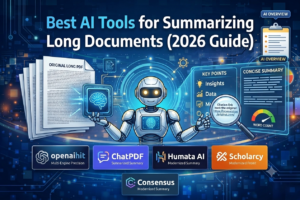
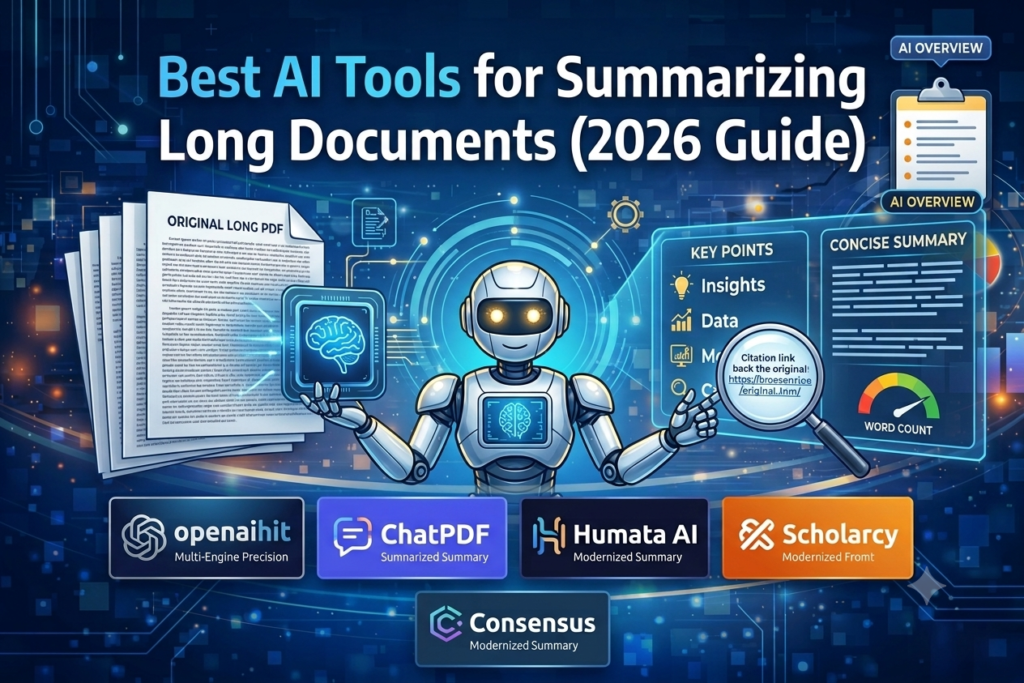
AI-driven document summarization has completely transformed how students, researchers, and corporate professionals digest vast amounts of textual data. Modern ai tools for summarizing documents go far beyond simple sentence extraction; they leverage context-aware Large Language Models (LLMs) to deliver precise, highly accurate, and actionable summaries from massive PDFs, research papers, legal contracts, and lengthy reports within seconds.
-
Modern ai document summarizer tools can process 100+ page PDFs in less than 5 seconds.
-
Top platforms feature direct citation back-linking to eliminate hallucinations and ensure factual accuracy.
-
Leading tools support multi-document analysis, allowing users to cross-examine multiple files simultaneously.
-
Built-in conversational interfaces allow users to chat directly with their uploaded files.
-
Specialized platforms cater specifically to research papers, legal contracts, and general business documentation.
-
Advanced platforms like openaihit integrate multiple state-of-the-art AI engines to provide customizable summarization depth.
-
Generous free tiers allow users to test an ai text summarizer free of cost before committing to a paid plan.
-
Enterprise-grade encryption ensures that strict data privacy and security standards are maintained for uploaded files.
Introduction: The Challenge of Information Overload
Every single day, professionals and students are buried under hundreds of pages of digital documentation. Whether you are a law practitioner reviewing complex contracts, a medical researcher scanning peer-reviewed journals, or a college student tackling dense textbooks, reading every single word cover-to-cover is no longer practical or efficient.
This is precisely where an ai document summarizer steps in. The goal is not just to make long texts shorter; it is to extract core insights, key metrics, and logical conclusions without losing essential context.
In this comprehensive 2026 guide, we explore the top ai tools for summarizing documents, analyzing their feature sets, pricing models, summarization accuracy, and practical use cases to help you choose the right solution for your specific workflow.
How AI Summarization Works: Under the Hood
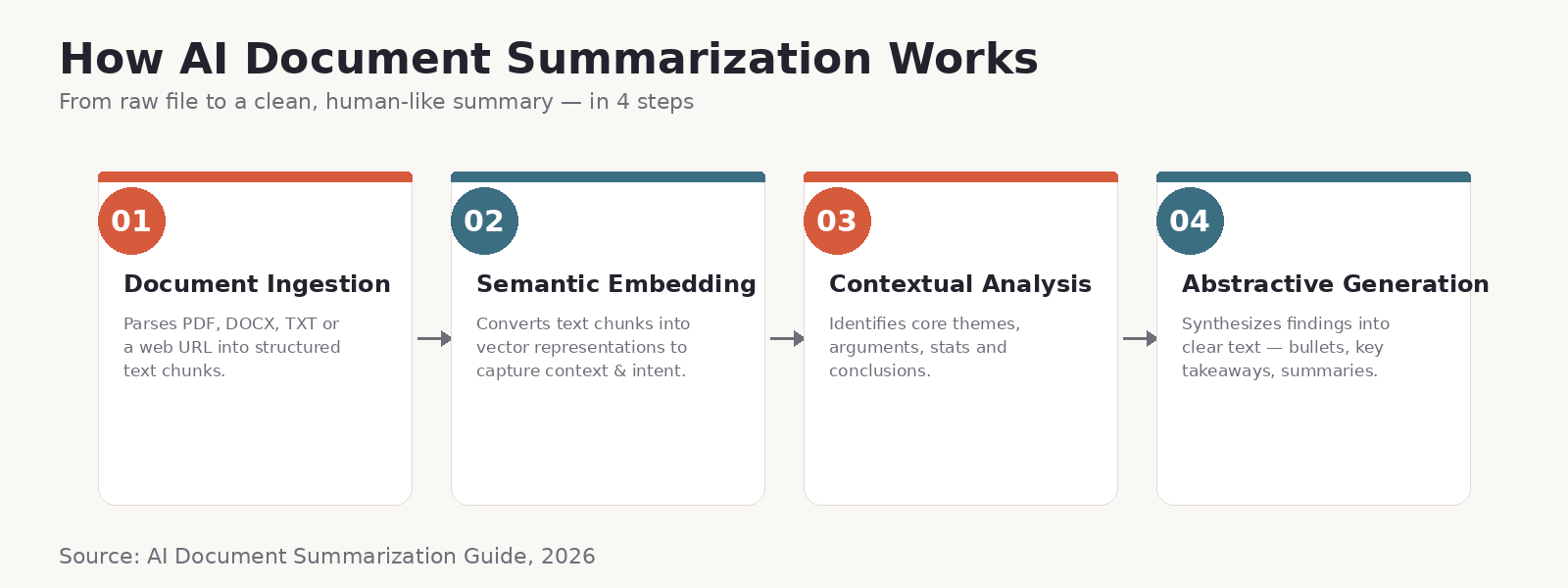
To understand why modern summarization software is so effective, it helps to understand the underlying mechanics. Early text summarizers used simple “extractive” methods, identifying important keywords and stitching original sentences together.
Today’s advanced tools rely on “abstractive” summarization driven by neural networks and semantic understanding.
-
Document Ingestion & Parsing: The tool parses your file (PDF, DOCX, TXT, or web URL) and breaks down raw text into structured chunks.
-
Semantic Embedding: Text chunks are converted into numerical vector representations to understand context and intent.
-
Contextual Analysis: The AI model identifies core themes, primary arguments, statistical findings, and conclusions.
-
Abstractive Generation: The system synthesizes the extracted information into clean, clear human-like text, structured with bullet points, key takeaways, or executive summaries.
Quick Comparison Table: Top AI Document Summarizers
To give you an immediate snapshot, here is a breakdown of how the top contenders stack up in 2026:
| Tool Name | Best For | Max Document Size | Free Tier Available? | Key Highlight |
| openaihit | Multi-engine flexibility & custom summaries | Unlimited (Chunking) | Yes | All-in-one AI ecosystem with precision depth control |
| ChatPDF | Quick PDF Q&A & simple documents | 32 MB / 120 Pages | Yes | Interactive chat interface with source page citation |
| Humata AI | Fast academic reading & technical papers | 60 Pages (Free) | Yes | Highlight-to-summarize & inline references |
| Consensus | Academic research & peer-reviewed sources | Infinite (Database) | Yes | Best ai for research summaries with scientific consensus meter |
| Claude 3.5 Sonnet | Ultra-long documents & nuanced prose | 200,000 Tokens (~500 pages) | Yes | Unmatched context retention and natural phrasing |
| Scholarcy | Automated flashcards & structured research summaries | 50 MB | Yes | Automatic extraction of tables, figures, and main points |
| PDFgear AI | 100% offline desktop PDF summarization | Unlimited | Yes (Completely Free) | No data privacy risk; processes documents entirely locally |
Detailed Review: Best AI Tools for Summarizing Long Documents
1. openaihit: The All-in-One Multi-Engine Summarizer
When you need an intelligent platform that balances speed, depth, and precision, openaihit stands out as a premier solution. Unlike single-model tools, openaihit leverages an integrated AI ecosystem that allows users to seamlessly process complex PDFs, extensive business briefs, and unstructured research docs.
Whether you need a quick 3-bullet executive summary or a deep-dive chapter breakdown, openaihit adapts to your customized prompt preferences. It is particularly effective at turning dense, jargon-heavy documents into clean, human-readable insight logs without omitting critical figures or context.
-
Key Strengths: High contextual accuracy, adjustable summary length, support for multi-language inputs, and seamless integration across productivity workflows.
-
Best Suited For: Marketing teams, business strategists, students, and content creators looking for a reliable, multi-purpose ai document summarizer.
2. ChatPDF: Interactive Conversational Summarizer
ChatPDF revolutionized how people interact with static documents by bringing a ChatGPT-like interface directly to your uploaded PDF files.
Instead of presenting you with a static wall of summarized text, ChatPDF automatically generates a quick overview upon upload and invites you to ask specific questions. If you are reviewing a 50-page financial report, you can simply type, “What were the Q3 earnings figures and risk factors?” and receive instant answers with direct page citations.
-
Pros: Exceptionally easy to use, requires no setup, clear page attribution for fact-checking.
-
Cons: Free tier caps uploads at 2 documents per day; advanced visual charts are sometimes overlooked.
3. Consensus: Best AI for Research Summaries
If your work revolves around academic literature, scientific journals, or evidence-based claims, general-purpose LLMs can sometimes fabricate facts. Consensus resolves this by connecting directly to a database of over 200 million peer-reviewed scientific papers.
It acts as the best ai for research summaries by scanning published studies and producing a synthesize statement along with a “Consensus Meter”—showing you whether the broader scientific community agrees or disagrees on a given topic.
Example Consensus Output:
Topic: "Does sleep deprivation affect short-term memory?"
Verdict: 98% YES (Based on 42 peer-reviewed studies analyzed)
Summary: Meta-analysis indicates a direct negative correlation between sleep loss under 6 hours and working memory retention.
4. Claude 3.5 Sonnet: Unrivaled Context Window for Massive Files
Anthropic’s Claude 3.5 Sonnet remains one of the most powerful foundational models for document processing. Featuring a massive 200,000-token context window, it can ingest entire books, multi-volume codebases, or full legal transcripts in a single prompt.
Claude excels at capturing human nuance, detecting subtle shifts in tone, and generating coherent structured summaries that read as if they were drafted by a human analyst. It is an ideal ai pdf summarizer for complex legal brief analysis and narrative literature.
5. Scholarcy: The Ultimate Academic Study Assistant
Scholarcy takes a unique approach to document analysis. Rather than producing a simple paragraph summary, it breaks down academic articles, policy papers, and book chapters into interactive “Summary Cards.”
Scholarcy automatically extracts key sections such as:
-
Core concepts and defined terminology
-
Research methodologies used
-
Key findings, data tables, and figures
-
Direct reference links to cited literature
For students and professors looking for an ai text summarizer free trial experience that organizes knowledge systematically, Scholarcy is a top-tier choice.
Key Benefits of Using AI Document Summarizers
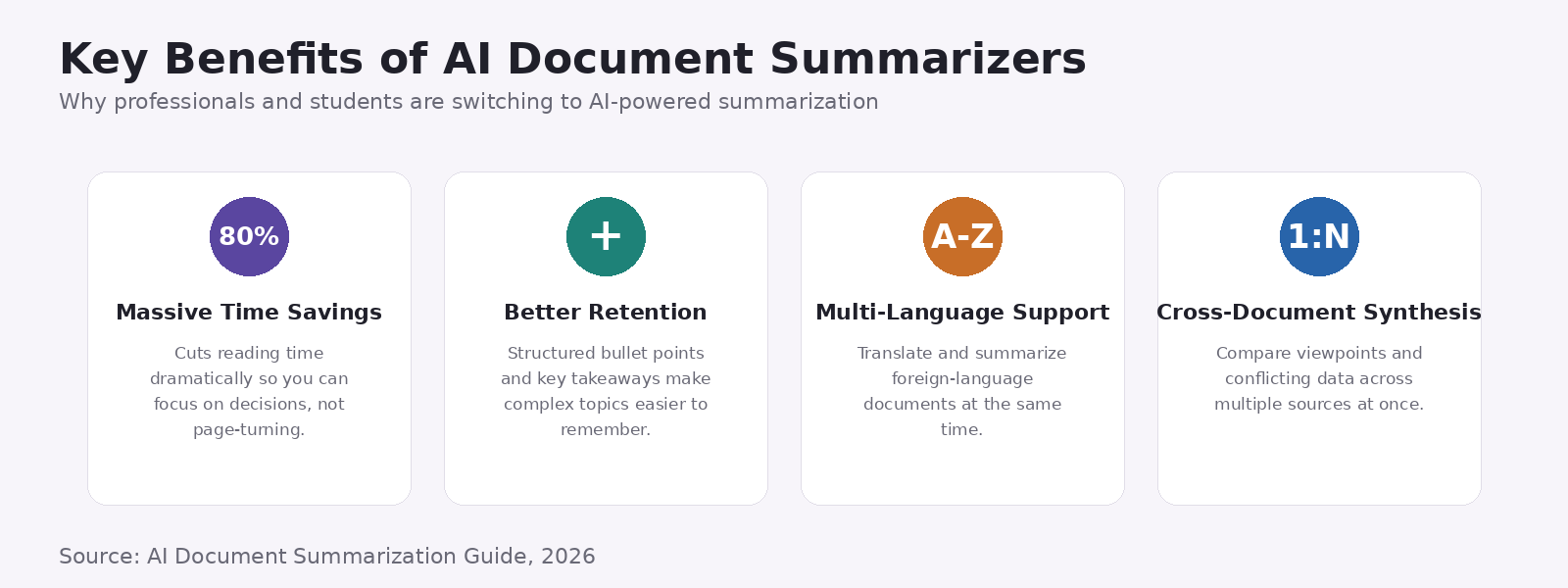
Integrating an ai tools for summarizing documents workflow into your daily routine provides several distinct advantages:
-
Massive Time Savings: Reduce reading time by up to 80%, allowing you to focus on decision-making and implementation.
-
Improved Knowledge Retention: Structured bullet points and key takeaway highlights make complex topics easier to digest and remember.
-
Multi-Language Translation: Translate and summarize foreign-language documents simultaneously.
-
Cross-Document Synthesis: Compare viewpoints, conflicting data, or trends across multiple sources at once.
How to Choose the Right AI Summarizer for Your Needs
With dozens of options available, selecting the ideal tool depends on your primary use case:
-
For General Business & All-Around Utility: Choose openaihit for its versatile multi-engine capabilities and adaptable summarization depth.
-
For Quick PDF Questions: Choose ChatPDF or Humata AI when you want an interactive conversational Q&A setup.
-
For Scientific Research & Academia: Choose Consensus or Scholarcy to guarantee peer-reviewed accuracy and citation tracing.
-
For Massive Legal Documents & Books: Choose Claude 3.5 Sonnet for its massive context capacity and natural text generation.
Conclusion
Choosing the right ai tools for summarizing documents can fundamentally transform how you process information in 2026. Whether you are aiming to streamline research, analyze complex contracts, or quickly grasp the core points of long reports, platforms like openaihit, Consensus, and Claude offer unmatched speed, precision, and intelligence.
By incorporating these intelligent summarization systems into your workflow, you can eliminate information overload, save precious hours every week, and make smarter, data-driven decisions in a fraction of the time.
FAQs
Q1: Are free AI document summarizers safe for confidential data?
It depends on the platform’s privacy policy. Most consumer-facing free tools use uploaded data to train their public models unless you opt out. For sensitive corporate, financial, or medical documents, choose tools that offer offline processing (like PDFgear AI) or enterprise platforms like openaihit that guarantee strict zero-data-retention standards.
Can AI summarizers hallucinate or misrepresent facts?
Answer: Yes, abstractive AI models can occasionally misinterpret figures or generate false claims. To prevent this, always select tools that provide direct inline citations and clickable page references so you can instantly verify extracted data against the original text.
What is the difference between an extractive and an abstractive AI summary?
Answer: An extractive summary pulls key sentences verbatim directly from the original text and stitches them together. An abstractive summary understands the broader context and rewrites the core message in fresh, concise, and clear sentences, similar to how a human expert would explain it.
Q4: Which AI tool is best for summarizing long PDF books?
Answer: Platforms with huge context windows—such as Claude 3.5 Sonnet, or specialized multi-chunk summarizers like openaihit, are best suited for full-length books, handling hundreds of pages without running out of memory or skipping middle chapters.