The digital marketing landscape has fractured. If you are still running your digital content strategy using the exact same playbook from a few years ago, you are likely watching your organic referral traffic slip away. The reason is not that people stopped asking questions online, but rather that the way they receive answers has fundamentally changed.
The primary battleground for visibility is no longer just the traditional Search Engine Results Page (SERP). Instead, we are living in the era of generative engine optimization vs seo, where brands must learn to optimize for conversational AI models alongside standard search algorithms.
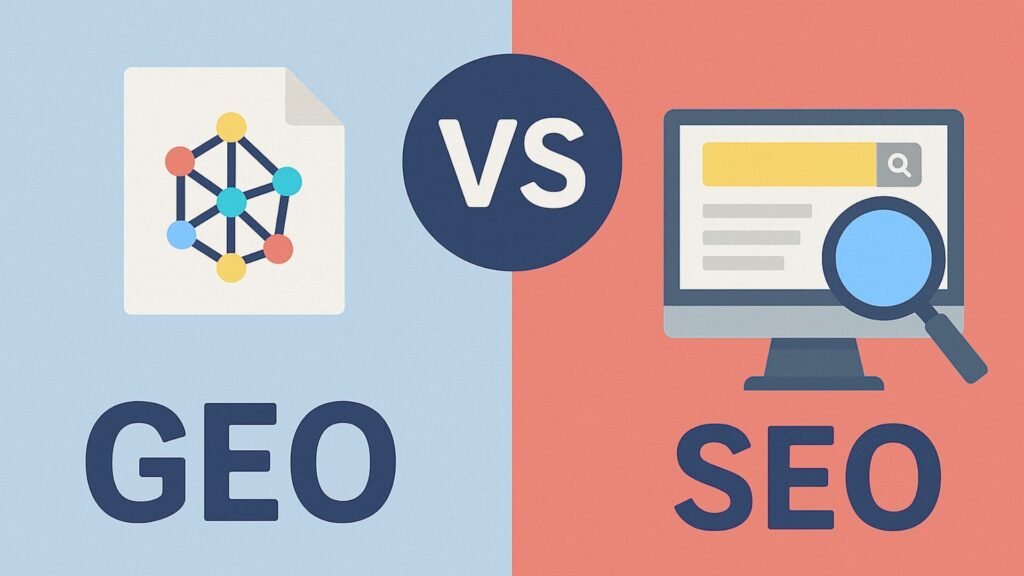
To survive this shift, you need a clear grasp of geo vs traditional seo. Traditional search engine optimization focuses on ranking a specific URL in a numbered list of blue links to win a user’s click. On the flip side, generative engine optimization is the practice of structuring your brand data and content so that conversational AI platforms find it, trust it, and actively pull it into their generated summaries.
GEO Explained: The New Mechanics of Discovery
To understand why this shift is so disruptive, we have to look closely at how modern AI search engines work. When geo explained simply, it comes down to a change in user behavior and data extraction.
In a traditional search setup, a user types a fragmented keyword phrase like “best project management software small team.” Google processes that keyword, evaluates link graphs, and displays a list of pages that match the phrase. The user must click a link, read the article, and piece together their own answer.
Generative engines completely eliminate that manual research phase. A user can type a complex, multi-layered prompt:
“I run a 10-person remote marketing agency with a $300 monthly budget. We struggle with tracking video asset approval timelines. Which software should we use, and what are the specific pros and cons for our size?”
An AI search engine does not just look for that exact string of words. It runs a process called a fan-out query, breaking that massive prompt into dozens of micro-searches simultaneously. It scans the web, extracts relevant data blocks, synthesizes a custom response, and applies citations to the sources it used. If your website is not designed for this type of automated ingestion and extraction, you completely vanish from the conversation.
The Structural Breakdown: SEO vs GEO
When you compare seo vs geo, you are looking at two entirely different goals for content delivery. The optimization levers you pull to satisfy a traditional search crawler do not always align with what an AI model looks for when compiling a response.
The following table breaks down the core operational differences between traditional search methods and generative engine optimization based on current 2026 performance data.
| Optimization Vector | Traditional SEO Framework | Generative Engine Optimization (GEO) |
| Primary Metric | Keyword Rankings, Organic CTR, Impressions | Citation Share of Voice, Brand Mention Frequency |
| Discovery Unit | Individual Web Page URLs (Links) | Entities, Brand Names, Structured Facts |
| User Query Style | Short, Fragmented Keyword Strings | Long, Conversational, Multi-Intent Prompts |
| Content Priority | Content Length, Strategic Keyword Placement | Fact Density, Direct Answers, Extractable Lists |
| Authority Signals | Backlink Profiles, Domain Age, Anchor Text | Cross-Platform Consensus, Third-Party Mentions |
What Stays the Same: The Shared Foundation
Despite the clear structural differences in geo vs traditional seo, it is a mistake to think traditional methods are completely obsolete. Generative engines are not magical entities that create information out of thin air. They rely on live web crawlers to gather information. Because of this, a massive portion of your traditional search foundation directly fuels your AI visibility.
Technical Health and Crawlability
If an AI bot cannot access your server, it cannot cite you. Basic technical optimization remains critical. You must ensure your robots.txt file explicitly allows access to user agents like ChatGPT-User or PerplexityBot. Furthermore, relying heavily on client-side JavaScript rendering can ruin your visibility. AI crawlers favor raw HTML that they can process immediately without waiting for complex scripts to load.
Google’s E-E-A-T Framework
xperience, Expertise, Authoritativeness, and Trustworthiness are just as important to an AI model as they are to Google’s core algorithm. Conversational engines are designed to avoid hallucinations and false claims, meaning they cross-reference information across multiple sites.
If your content features real-world case studies, clear author credentials, and verified data, it signals safety to both traditional search systems and generative models.
What Actually Changes: The New Rules of Engagement
When analyzing generative engine optimization vs seo, the true divergence appears in how content must be written and distributed. To win citations in AI summaries, you have to abandon several old content-writing habits.
1. From Keyword Density to Fact Density
Traditional content writing often involved repeating a primary keyword a specific number of times to prove relevance. In 2026, generative engines completely ignore keyword stuffing. They scan for data density.
Instead of writing vague sentences like “Our software provides significant time savings for busy teams,” you must write with hard statistics: “Our platform automates report generation, reducing manual administrative tasks from 4 hours to 12 minutes based on user testing data.”
2. The Rise of Entity Authority Over Link Building
In traditional search, getting a backlink with exact-match anchor text from an authoritative domain was the gold standard. In the realm of seo vs geo, AI models care far more about entity authority. An AI looks for web-wide consensus. If your brand name is mentioned consistently across Reddit threads, industry forums, YouTube descriptions, and news articles, the AI recognizes your company as a verified entity in your market, even if those mentions do not include a hyperlink.
3. Structuring for Automated Extraction
AI models favor highly organized data formats because they are easy to chop up and paste into a summary. Content that relies on long, winding paragraphs gets bypassed.
To maximize your GEO potential, you must lean heavily on scannable elements: bulleted lists for product features, short definition blocks at the start of sections, and comprehensive Markdown tables for product comparisons.
Actionable Strategy: Optimizing for the AI Era
If you want to transition your website from a standard search asset to an AI-ready powerhouse, you need to implement specific, modern discovery protocols.
Implement Comprehensive Schema Markup
Schema org structured data is the native language of AI search. By adding detailed JSON-LD code to your web pages, you give AI engines a direct map of your content. Ensure your technical team deploys Organization, Product, Software Application, and FAQ schemas across your entire domain. This removes all ambiguity about what your business offers.
Deploy an llms.txt File
Just as traditional webmasters use a robots.txt file to guide search bots, modern sites in 2026 use an llms.txt file. This is a clean, markdown-based text file placed in your root directory that serves as a specific directory map for large language models. It highlights your most critical documentation, core product summaries, and authoritative resources, giving AI crawlers a clean stream of information to read without wading through irrelevant site files.
Expand Your Footprint Beyond Your Own Domain
Because AI models crawl external platforms to verify your credibility, your digital PR strategy must change. Focus on getting featured in industry roundups, participating genuinely in community discussions on platforms like Reddit, and securing accurate citations on open data platforms. The broader your footprint across the web, the more likely an AI is to pull your entity into its answers.
Conclusion
The shift from traditional SEO to GEO is not a minor algorithmic adjustment; it is a fundamental evolution of how the world accesses information. When evaluating geo explained protocols across modern brand assets, winning the digital marketing game in 2026 requires balancing both sides of the coin. You must maintain the technical standards and structural integrity of traditional search while adapting your writing style and digital footprint to satisfy the data-extraction needs of conversational AI engines.
By building your authority as an entity rather than just a collection of links, you ensure your brand stays visible no matter how your audience chooses to search. If you want to dive deeper into automated search audits, modern data schemas, and cutting-edge digital growth tactics for this new era, explore the interactive marketing guides over at Openaihit. Start auditing your content for AI crawlers today to protect your brand’s future traffic.
Frequently Asked Questions
Is traditional SEO completely dead because of GEO?
No, traditional search methods are not dead. Generative search engines use live web indexing to find current information, meaning strong traditional search performance directly powers your AI visibility. They are complementary strategies, not mutually exclusive ones.
How do I track my website’s GEO performance?
Traditional rank tracking tools cannot accurately measure conversational search. To track your GEO performance, you must measure your citation frequency across different platforms, monitor referral traffic coming from AI domains, and track your brand’s share of voice inside specific user prompts.
Will optimized content look different for human readers?
Content optimized for GEO is actually easier for humans to read. Because AI models prefer clear headings, direct answers, short paragraphs, and structured tables, your pages naturally become more scannable and user-friendly for human visitors.
How often should I update content for AI search engines?
AI models have a strong preference for recency and freshness when answering current questions. Based on available data from digital tracking agencies, updating your primary informational pages at least once every three months helps maintain your citation momentum.