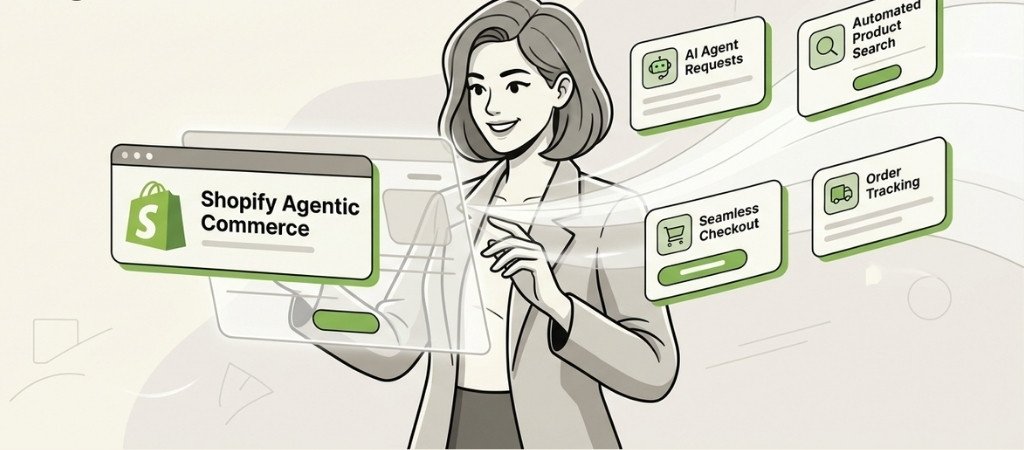
The e-commerce landscape of 2026 has officially shifted from a “search and click” model to an “ask and buy” ecosystem. If you are a merchant today, the most frequent visitor to your store might not be a human, but an AI shopping agent.
The launch of Shopify Agentic Storefronts in March 2026 marked the “RenAIssance Edition” of Shopify’s platform, fundamentally changing how products are discovered. No longer do customers need to navigate through menus and filters; instead, they tell their AI assistant to “find the best leather wallet under $80,” and the transaction happens right then and there.
At openaihit.com, we are breaking down everything you need to know about agentic commerce shopify and how to ensure your brand thrives in the age of ChatGPT, Gemini, and Copilot.
1. What are Shopify Agentic Storefronts?
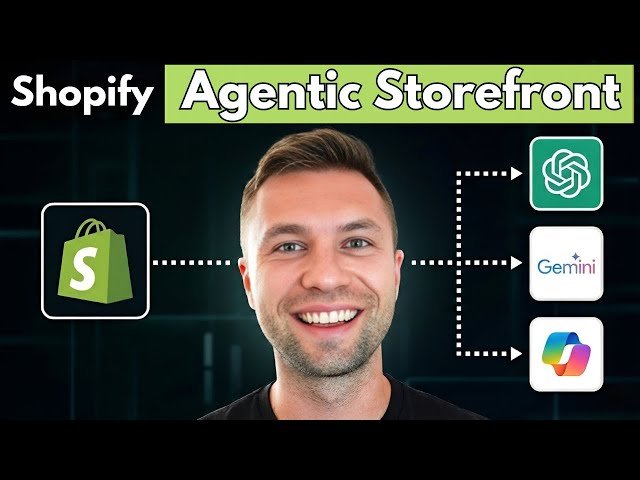
Shopify Agentic Storefronts are a new type of native sales channel that allows AI platforms (like ChatGPT, Google Gemini, and Microsoft Copilot) to browse, evaluate, and sell your products directly within their chat interfaces.
Unlike a traditional website where a human interacts with a UI, an agentic storefront is designed for machine-to-machine interaction. Through the Shopify Catalog AI 2026 engine, your product data is structured and served via API so that AI agents can “understand” your inventory, pricing, and shipping policies in real-time.
The Key Shift in 2026
In 2024 and 2025, AI could talk about your products by scraping your site. In 2026, Shopify’s Universal Commerce Protocol (UCP) allows AI to act. This means an AI agent can:
-
Check real-time inventory levels.
-
Apply valid discount codes.
-
Calculate shipping to a specific zip code.
-
Complete the checkout without the customer ever visiting your
.myshopify.comURL.
2. How to Sell on ChatGPT, Gemini & Copilot via Shopify
As of late March 2026, Shopify enabled agentic storefronts by default for eligible merchants (starting with US-based stores). Here is how you manage and optimize this new sales frontier.
Setting Up the Channel
-
Shopify Admin: Navigate to Settings > Sales Channels.
-
Verify Activation: Look for “Agentic Storefronts” or specific AI platform icons (ChatGPT, Google AI, Copilot).
-
Universal Commerce Protocol (UCP): Ensure your store is UCP-enabled. This is the “shared language” that lets your Shopify store talk to any AI platform without custom coding.
How to Sell on ChatGPT Shopify
To specifically target the millions of users on ChatGPT, your Shopify Catalog AI 2026 needs to be pristine. ChatGPT uses the Storefront Catalog MCP (Model Context Protocol) to pull your data.
-
Discovery: When a user asks for a recommendation, ChatGPT queries the Shopify Catalog.
-
Conversion: If “Direct Checkout” is enabled, the user can click “Buy Now” inside the ChatGPT interface.
-
Attribution: These orders appear in your Shopify analytics as ai-attributed orders shopify, allowing you to see exactly which platform generated the sale.
3. The Power of Agentic Commerce: Why it Matters
The rise of agentic commerce shopify solves a major problem: Decision Fatigue. Customers are tired of scrolling through 50 versions of the same product. They want the “best” one chosen for them by an assistant they trust.
Benefits for Merchants:
-
Higher Conversion Rates: Recent data from early 2026 shows that AI-referred shoppers convert 31% higher than traditional organic search traffic.
-
Lower Customer Acquisition Cost (CAC): Instead of fighting for expensive PPC keywords, you win through Generative Engine Optimization (GEO).
-
Ready-to-Buy Moments: AI agents only surface your products when they perfectly match a user’s intent, meaning the lead is “hot” the moment they see your brand.
4. Understanding AI-Attributed Orders and Analytics
One of the biggest concerns for merchants is: “How do I know if my AI strategy is working?” Shopify has solved this with a dedicated dashboard for ai-attributed orders shopify.
| Metric | Definition | Importance |
| AI Referral Source | Which LLM (ChatGPT, Gemini, etc.) sent the user. | Helps you decide where to focus your “Brand Context” efforts. |
| Agent Path | Whether the agent bought directly or redirected to your site. | Determines if you should optimize your on-site “Headless” checkout. |
| Semantic Rank | How often you appear as the #1 AI recommendation. | The 2026 version of “Google Page 1.” |
| Assisted AOV | The average order value for AI-driven sales. | AI often suggests “bundles,” frequently leading to higher AOVs. |
5. Optimizing Your Shopify Catalog for AI (2026 Best Practices)
If your product data is messy, you are invisible to AI. Agentic storefronts rely on “legibility.” Here is how to optimize your Shopify catalog ai 2026 for maximum visibility.
1. Semantic Product Descriptions
Stop writing for humans; start writing for LLMs. Use Shopify Magic to generate descriptions that highlight technical specs, materials, and “use cases.” AI agents look for intent matches. Instead of “Blue Shirt,” use “Breathable moisture-wicking organic cotton t-shirt for hot climates.”
2. High-Fidelity Schema (JSON-LD)
Your JSON-LD markup must be flawless. Ensure your @type: Product schema includes:
-
GTIN/SKU: Essential for price comparisons.
-
AggregateRating: AI agents prioritize products with high social proof.
-
Availability: Real-time stock status prevents AI “hallucinations” about your inventory.
3. The Knowledge Base App
Shopify’s new Knowledge Base App allows you to feed your brand’s “brain” directly to AI. You can upload your return policy, brand story, and FAQ. When a customer asks Gemini, “Does this brand use sustainable packaging?”, the AI pulls the answer directly from your Knowledge Base rather than guessing.
6. Challenges and Risks: Should You Opt Out?
Despite the growth, some merchants are hesitant. On March 24, 2026, when Shopify enabled these storefronts by default, a wave of “Opt-Out” discussions began.
Why Merchants Opt Out:
-
Loss of Brand Control: Inside ChatGPT, your beautiful theme and “Upsell” pop-ups are gone. It’s a text-based transaction.
-
Attribution Gaps: Standard tracking tools like GA4 struggle with “in-chat” checkouts, though Shopify’s native AI-attributed orders tool is filling that gap.
-
Policy Complexity: Some vendor contracts forbid selling through third-party “marketplaces” like an AI chat interface.
The Turboocruiser Recommendation:
Don’t opt out—opt-in for discovery. You can choose to allow AI to recommend your products but force the final checkout to happen on your site. This gives you the traffic of the “RenAIssance” while maintaining the brand experience of your own storefront.
7. The Future: Multi-Step Agentic Workflows
By the end of 2026, we expect to see autonomous shopping agents. Imagine a user saying: “My sister’s birthday is in two weeks. She likes hiking and sustainable fashion. Find a gift under $100, buy it, and have it gift-wrapped and delivered by next Friday.”
For a Shopify merchant to win that sale:
-
Your agentic storefront must be active.
-
Your shipping logic must be clear to the AI.
-
Your gift-wrap service must be a selectable “attribute” in your API feed.
Conclusion: The Era of AI-First Commerce
Shopify Agentic Storefronts represent the biggest shift in retail since the invention of the mobile shopping cart. In 2026, “being found” is no longer about keywords; it’s about being the most trusted and legible answer to an AI’s query.
By optimizing your Shopify catalog ai 2026, monitoring your ai-attributed orders, and embracing agentic commerce shopify, you position your brand at the very start of the customer’s journey—inside their favorite AI assistant.
For more updates on how AI is hitting the e-commerce world, keep following openaihit.com.
FAQs
Q1: Is there an extra fee for Agentic Storefronts?
Currently, Shopify includes the basic agentic infrastructure in most plans, though some “Premium AI Connectors” for enterprise-level platforms may require a Shopify Plus subscription.
Q2: How do I see my AI sales?
Go to your Shopify Analytics tab and filter by “Sales Source.” You will see a breakdown of orders attributed to ChatGPT, Gemini, and other LLMs.
Q3: Can I block certain AI agents?
Yes. Through your robots.txt or Shopify’s “Agentic Settings,” you can choose to allow Google Gemini but block smaller, less-reputable AI scrapers.
Q4: Does this work for B2B?
Absolutely. In fact, agentic commerce is thriving in B2B, where AI “procurement agents” use Shopify’s API to reorder supplies automatically based on inventory levels.
Q5: Will my SEO rankings drop?
No. In fact, good SEO feeds into good GEO (Generative Engine Optimization). AI agents still use high-authority backlinks and site health to determine which brands to “trust” and recommend.