
Artificial intelligence is reshaping industries, businesses, and everyday life. It helps companies make decisions faster, assists in healthcare diagnostics, powers financial analytics, and even guides people in planning trips or choosing Hamburg places to visit. However, despite these benefits, there is one recurring question: What’s the biggest problem with AI? The answer isn’t simple, as AI’s risks stem from multiple interconnected issues: bias, lack of transparency, ethical challenges, overreliance, and insufficient regulation.
AI systems are designed to learn patterns from data. When the data contains errors, gaps, or human bias, the AI adopts these flaws, sometimes amplifying them unintentionally. This makes AI decisions unreliable or unfair in certain contexts. Understanding what’s the biggest problem with AI? is crucial for developers, policymakers, and everyday users, especially as AI becomes embedded into personal decisions like selecting Hamburg places to visit.
What’s the Biggest Problem With AI? Core Challenges

One of the main answers to what’s the biggest problem with AI? is data quality. Indeed, AI works only as well as the data it learns from. Consequently, incomplete or biased datasets lead to flawed outputs. For example, travel recommendations may be inaccurate when users search for Hamburg places to visit.
Therefore, improving data quality is essential. In addition, organizations must continuously validate and update their datasets. Moreover, high-quality data helps reduce bias and improves user trust. Ultimately, reliable data ensures trustworthy AI results.
Poor data quality can result in predictions that are inaccurate, unethical, or misleading. In healthcare, biased datasets can misdiagnose patients. In finance, they can deny fair access to credit. Addressing these challenges requires rigorous data collection, continuous validation, and more inclusive datasets.
Ethical Challenges: A Complex Part of the AI Problem
Ethics is central to the question: what’s the biggest problem with AI? AI influences decision-making in highly sensitive areas such as hiring, law enforcement, and healthcare. When AI makes biased or unfair decisions, the consequences are real and impactful.
Ethical challenges include:
- Bias and discrimination that replicate societal inequalities
- Misuse of personal data without consent
- Generation of misleading or harmful content
Even seemingly simple tasks, like recommending Hamburg places to visit, can unintentionally reflect biased preferences if AI models rely on unrepresentative historical data. Solving these ethical challenges requires transparent AI design, continuous oversight, and accountability mechanisms.
Transparency: Why AI Decisions Often Remain a Mystery
Another critical aspect of what’s the biggest problem with AI? is transparency. Many AI models, especially deep neural networks, operate as “black boxes.” Users and even developers often cannot explain why the AI made a specific decision. This lack of clarity reduces trust, accountability, and reliability.
Key transparency challenges include:
- Black-box models with complex internal logic
- Difficulty explaining AI-generated recommendations
- Limited ability to audit or verify decisions
- Users blindly trusting AI outputs without understanding them
- Inconsistent results across similar inputs
Transparency is vital for AI applied to healthcare, finance, education, and even everyday decisions like finding Hamburg places to visit. Without clear explanations, trust in AI systems diminishes and ethical concerns grow.
Workforce Impact: What’s the Biggest Problem With AI?

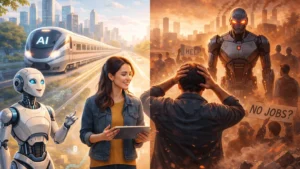
Automation is frequently cited when asking what’s the biggest problem with AI? AI replaces repetitive or routine tasks, which can displace workers across industries. This transformation is particularly visible in administrative work, manufacturing, and customer service. While AI creates new roles in system management, auditing, and data analysis, the transition may be uneven, and many workers require reskilling to remain competitive.
The workforce challenge is more than just replacement; it’s about equity. Without adequate training and educational programs, vulnerable groups may struggle to adapt. Responsible AI deployment must include strategies to balance efficiency gains with workforce stability.
Overreliance: What’s the Biggest Problem With AI?
A subtle but significant answer to what’s the biggest problem with AI? is overreliance. People increasingly depend on AI for decision-making in daily life. From writing and research to choosing destinations like Hamburg places to visit, overreliance can weaken critical thinking and independent judgment.
When humans accept AI outputs without question, they risk overlooking errors, biases, or misleading suggestions. Over time, this can reduce analytical skills and limit the ability to evaluate complex problems. AI should complement human intelligence, not replace reasoning entirely.
Security Risks: AI in the Hands of Malicious Actors
Another part of what’s the biggest problem with AI? lies in security. AI tools can be exploited for cyberattacks, identity theft, and misinformation. Deepfakes, AI-powered phishing, and automated hacking tools exemplify how malicious actors use the same technology that improves cybersecurity to cause harm.
Key AI-related security threats include:
- Deepfake impersonation and identity fraud
- AI-powered phishing attacks
- Automated hacking and vulnerability exploitation
- Data manipulation in AI training sets
- Misinformation spread through AI-generated content
The rapid evolution of AI makes it difficult for regulatory frameworks to keep up. Even routine systems, like AI assisting users in exploring Hamburg places to visit, can be vulnerable to manipulation if not properly secured.
Regulation: The Lag Between Innovation and Oversight

Regulatory gaps highlight another key issue in answering what’s the biggest problem with AI? Technology evolves faster than policies, creating areas where AI deployment outpaces legal safeguards. Without clear international guidelines, developers and companies may face ethical dilemmas, and users may be exposed to harm.
Effective regulation should address bias, transparency, ethical compliance, and security. Governments must collaborate globally to ensure AI benefits society while minimizing risks. Until regulation catches up, AI remains both promising and potentially hazardous.
FAQs
Q: What’s the biggest problem with AI?
A: The combination of bias, lack of transparency, ethical challenges, overreliance, and weak regulation.
Q: Can AI replace human jobs entirely?
A: No. While AI automates certain tasks, humans are essential for creativity, judgment, and ethical decisions.
Q: How can AI become safer?
A: Through better data quality, transparency, ethical frameworks, security measures, and stronger regulations.
Q: Does AI affect everyday decisions?
A: Yes. Even seemingly simple decisions, like finding Hamburg places to visit, can be influenced by AI recommendations.
Conclusion:What’s the Biggest Problem With AI?
So, ultimately, what’s the biggest problem with AI? It is not only a single flaw, but rather a combination of bias, opacity, ethical uncertainty, overreliance, security risks, and regulatory lag. Moreover, AI’s influence on industries, daily life, and decisions from healthcare to exploring Hamburg places to visit cannot be ignored.
Therefore, to mitigate these issues, we need better data, transparent design, ethical standards, workforce adaptation, and balanced regulation. By implementing these measures, AI can enhance human life while avoiding unintended harm as I discussed in more depth in my article on the current situation with AI.
Understanding the biggest problem with AI is the first step toward safe, fair, and effective technology. Responsible development ensures trust, and exploring how AI can write code highlights its real-world impact. Finally, collaboration across industries and governments strengthens AI benefits.