
Artificial Intelligence (AI) has rapidly transformed life in the United States. Moreover, from daily conveniences to major industries, AI now influences nearly every aspect of society. But as its presence grows, questions arise: Is AI a problem in the US? While AI brings undeniable benefits, it also introduces challenges that affect employment, privacy, and ethics. Therefore, understanding these concerns is essential for citizens, policymakers, and businesses alike.
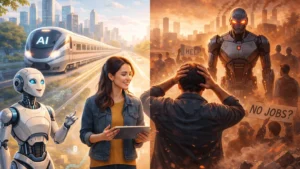
Furthermore, AI technologies can automate tasks, improve healthcare diagnostics, and streamline business operations. However, these innovations often raise concerns about job displacement, data privacy, and algorithmic bias. For instance, automated systems may replace human workers in industries such as manufacturing, logistics, and customer service. Consequently, debates continue over whether AI is a threat or an opportunity for economic growth.
Is AI a Problem in the US? Exploring Its Economic Impact

AI is reshaping the labor market in ways that are both promising and challenging. For example, while automation can boost efficiency, it can also displace workers who perform routine or repetitive tasks. Many experts argue that the pace of AI adoption could outstrip society’s ability to reskill employees, therefore raising concerns about unemployment and income inequality.
In addition, AI-driven technologies have concentrated economic power in a few large corporations, potentially limiting competition. While smaller businesses benefit from AI tools, access to advanced technologies remains uneven. As a result, the economic impact of AI in the US continues to be a topic of intense discussion.
AI Privacy Concerns: Why AI Is a Problem in the US
The rapid proliferation of AI has intensified debates about privacy and surveillance. For instance, AI systems collect vast amounts of data, often without explicit consent. From facial recognition to predictive analytics, these technologies raise concerns about how personal information is used and protected.
In the short term, AI enables targeted advertising, personalized recommendations, and efficient services. Nevertheless, long-term risks involve the erosion of privacy and potential misuse of sensitive data. Consequently, policymakers are grappling with the question: Is AI a problem in the US due to privacy issues?
Ethical Challenges in AI: Is AI a Problem in the US Workforce?
While AI improves efficiency, it also presents significant ethical dilemmas:
-
Moreover, algorithmic bias can perpetuate social inequalities
-
Additionally, lack of transparency in AI decision-making complicates accountability
-
Furthermore, holding AI responsible for errors remains challenging
-
Finally, ethical concerns arise in autonomous vehicles and AI-driven medical diagnostics
Therefore, ethical oversight must be strengthened to ensure fairness, safety, and public trust.
AI in Healthcare: Can AI Be a Problem in the US Medical System?
AI has revolutionized healthcare by improving diagnostics, predicting disease outbreaks, and optimizing patient care. However, concerns persist regarding accuracy, bias, and patient consent.
-
For example, AI diagnostics may misinterpret complex medical data
-
Consequently, reliance on AI can reduce human oversight
-
In addition, sensitive patient data may be vulnerable to breaches
Nevertheless, the potential benefits of AI in healthcare are immense, suggesting that careful regulation can mitigate harm while advancing medical innovation.
Public Perception: How Americans See AI as a Problem

Public opinion about AI varies widely. Furthermore, media coverage often emphasizes sensational risks, from job loss to dystopian scenarios. As a result, this framing strongly influences how people perceive AI’s impact on society.
Although some Americans embrace AI as a tool for convenience and efficiency, others fear its consequences. Therefore, understanding these perceptions is crucial for policymakers and technology developers aiming to foster public trust.
Government Regulations: Solving AI Problems in the US
Government regulations play a vital role in determining whether AI becomes a problem or a solution in the US. In particular, regulatory frameworks can guide ethical AI use, protect citizens’ rights, and encourage innovation.
-
For instance, setting standards for transparency and accountability
-
Additionally, enforcing data privacy protections
-
Moreover, monitoring algorithmic fairness and bias
-
Finally, encouraging research in AI ethics
Without proactive governance, AI risks exacerbating existing societal inequalities and privacy concerns.
AI and Education: Addressing AI Problems in the US Schools
Education is central to mitigating AI-related problems. Specifically, teaching AI literacy and digital skills equips students to navigate a world increasingly influenced by AI.
-
For example, integrating AI concepts into school curricula
-
In addition, providing reskilling programs for adults
-
Furthermore, encouraging critical thinking about AI ethics
-
Finally, promoting awareness of AI’s societal impact
Consequently, investing in education ensures that Americans can participate effectively in an AI-driven economy.
The Cultural Impact of AI in Daily Life

Moreover, AI influences how people interact with technology, shaping habits, preferences, and even social behaviors. For example, recommendation algorithms determine what media we consume, while AI-powered apps influence communication patterns. Consequently, our daily routines and cultural trends are increasingly guided by AI systems.
How AI Shapes Daily Culture and Habits in the US
-
Moreover, AI personalizes media consumption, showing users content they are most likely to engage with.
-
Additionally, AI-generated art, music, and entertainment is becoming more mainstream.
-
Furthermore, social media algorithms influence opinions, trends, and even purchasing decisions.
-
Finally, virtual assistants and smart devices integrate into daily routines, subtly guiding behavior.
Global Perspective: Lessons from Abroad
The US is not alone in confronting AI challenges. In fact, observing international approaches can provide insights:
-
For example, the EU emphasizes strict AI regulations and human oversight
-
Additionally, Asian countries integrate AI with smart city initiatives
-
Furthermore, collaborative research improves AI safety standards
Ultimately, learning from other nations can guide US policies and help prevent AI-related problems.
FAQs
Q: Is AI taking jobs away in the US?
A: Certain routine jobs are at risk, but AI also creates new opportunities in tech, healthcare, and research.
Q: How does AI affect privacy?
A: AI collects and analyzes personal data, raising concerns about consent and misuse.
Q: Can AI be regulated effectively?
A: Yes, with robust ethical guidelines, transparency, and government oversight.
Conclusion: Is AI a problem in the US?
Similarly, just as travelers explore Hamburg places to visit with care and curiosity, Americans must approach AI with informed caution to reap its benefits safely. For readers interested in deeper context, this article on where AI appears in biblical discussions offers an additional perspective that fits smoothly into the broader conversation around technology and society.