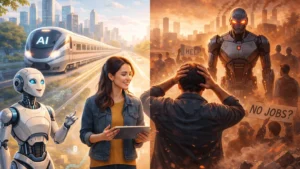

Artificial Intelligence (AI) is transforming the global workforce at an unprecedented rate. Moreover, businesses are increasingly adopting AI to improve efficiency, reduce costs, and automate repetitive tasks. Predicting how many jobs will AI replace by 2030 is crucial for policymakers, employees, and business leaders preparing for the future.
The Expanding Role of AI in Workplaces

AI technologies, such as machine learning, natural language processing, and robotics, are no longer limited to experimental labs. Indeed, their impact is actively reshaping industries worldwide. Meanwhile, manufacturing benefits from AI-driven robots that assemble products faster and more accurately than humans.
In finance, algorithms detect fraud, process data, and assist in decision-making. Additionally, knowledge-based professions are feeling the impact as AI can now generate reports, analyze complex datasets, and support medical diagnoses.Experts emphasize that estimating how many jobs will AI replace by 2030 is challenging because automation varies across industries and regions.
However, routine and repetitive roles face the highest risk, while positions requiring creativity, empathy, and complex problem-solving remain largely secure. Planning for the workforce’s future resembles planning a trip: just as travelers carefully choose Hamburg places to visit, employees must select career paths that leverage uniquely human skills.
How Many Jobs Will AI Replace by 2030?
Estimates on how many jobs will AI replace by 2030 differ widely depending on methodology and geography. According to recent studies, AI and automation could displace up to 85 million jobs worldwide while simultaneously creating 97 million new roles demanding technical expertise, creativity, and social skills.
High-risk categories include administrative roles like data entry, manufacturing line work, retail positions such as cashiers, customer service handled by chatbots, and basic transport or logistics jobs. Nevertheless, emerging roles often require human-AI collaboration, emphasizing analytical thinking, emotional intelligence, and creativity.
Therefore, although AI may replace some jobs, its overall impact is nuanced. It will eliminate certain routine roles, but simultaneously create opportunities that require human creativity, problem-solving, and collaboration. Workers who adapt and reskill can thrive in this evolving job landscape.
Industries Most Vulnerable to AI Job Displacement

Automation affects some industries more than others. Manufacturing relies increasingly on robotic systems, reducing the need for assembly line workers. Retail is seeing self-checkout and AI-driven inventory management, which decrease staffing requirements.
Customer service departments now utilize chatbots to manage inquiries efficiently, while transportation is exploring autonomous vehicles that could replace drivers and logistics planners. In finance, algorithmic trading and automated bookkeeping streamline operations.
Key Roles at Risk:How many jobs will AI replace by 2030?
-
Assembly line workers in manufacturing
-
Cashiers and retail staff
-
Customer service representatives
Furthermore, hybrid roles are emerging where humans supervise AI processes. Employees can prepare by developing transferable skills and leveraging AI as a productivity tool.
New Jobs Created by AI
While some roles may disappear, AI also generates new opportunities. For example, AI trainers guide machine learning models to function correctly, and data scientists interpret AI-generated insights. Human-AI interaction specialists focus on designing user-friendly interfaces, while ethics and compliance officers manage AI systems’ legal and moral adherence. Healthcare technology specialists integrate AI solutions into patient care.
Emerging Opportunities:How many jobs will AI replace by 2030?
-
AI trainers and supervisors
-
Data scientists and analysts
-
Human-AI interaction specialists
Consequently, these roles emphasize the importance of upskilling and career flexibility. Just as planning which Hamburg places to visit requires thought, choosing a future-proof career demands careful strategy.
Regional Differences in AI Job Replacement
AI’s effect on employment differs across regions. Advanced economies with robust technological infrastructure face higher automation risks, whereas developing nations may adopt AI more gradually. For instance, Germany leads in AI adoption, particularly in tech hubs like Hamburg, carefully balancing automation with traditional employment preservation.
Governments can reduce negative impacts by investing in workforce reskilling programs, ensuring citizens remain prepared for evolving labor demands. Estimating how many jobs will AI replace by 2030 regionally helps policymakers implement effective strategies.
Preparing the Workforce for AI
Workers can proactively adapt to AI-driven changes by upskilling in technology such as AI, coding, and data analytics. Focusing on uniquely human skills creativity, emotional intelligence, and problem-solving is also essential, while staying open to new tools and collaborative workflows with AI.
Moreover, embracing lifelong learning and actively networking within professional communities allows employees to explore hybrid roles that combine human expertise with AI assistance.Therefore, preparation ensures employees can thrive in an AI-influenced economy rather than facing displacement.
Ethical and Social Considerations

AI’s impact goes beyond economics, raising social and ethical concerns. Displacement could worsen inequality, so transparency, fairness, and privacy must guide AI adoption. Fair labor practices, bias mitigation, and inclusive policies ensure AI benefits society while minimizing harm.
Case Studies: AI in Action
Several industries illustrate AI-driven transformation. In German manufacturing, automation decreases repetitive labor but increases supervisory roles. Banking in the USA uses AI to manage transactions and fraud detection, while humans focus on client relationships. In Japan’s healthcare sector, AI supports diagnostics, but human care remains vital.
Similarly, these examples demonstrate that humans and AI often collaborate, creating new opportunities rather than total replacement. AI complements human work, roles evolve, and policymakers must balance automation benefits with workforce support.
Future Outlook:How many jobs will AI replace by 2030?
By 2030, up to 30% of jobs in developed economies could be automated. However, AI will also create new roles in management, healthcare technology, creative industries, and human-AI collaboration. Workers who reskill and stay adaptable will thrive, employers should foster AI literacy, and governments must uphold safety nets, ethics, and address bias and privacy concerns.
Key Points to Consider
-
Upskilling and adaptability are crucial for workers
-
Employers should integrate AI literacy into training programs
-
Ethical and inclusive policies are essential for AI adoption
Navigating the AI-driven job market is like planning a trip: selecting the best Hamburg places to visit requires strategy, flexibility, and informed decisions.
FAQs
Q1: Will AI replace all human jobs by 2030?
No. AI will primarily automate routine tasks, while new roles requiring creativity, empathy, and complex problem-solving will emerge.
Q2: Which industries are most at risk?
Manufacturing, retail, customer service, transportation, and finance are most vulnerable.
Q3: How can workers stay relevant?
Upskilling, focusing on human-centric skills, and embracing lifelong learning are key strategies.
Conclusion:How Many Jobs will AI Replace by 2030?
Understanding how many jobs AI may replace by 2030 is essential for preparing the modern workforce. While some roles will be automated, new opportunities will rise that demand creativity, technical skills, and emotional intelligence. To explore the deeper ethical and historical context of technology, you can also read Where Is AI in the Bible Now?
Thoughtful planning, similar to choosing Hamburg places to visit, ensures a successful journey in an AI‑driven economy. Therefore, the future of work is not about replacement but evolution: humans and AI collaborating for innovation, efficiency, and inclusivity. For more on how artificial intelligence started and evolved, see who invented AI.