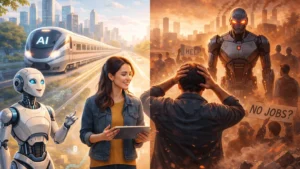
AI vs Human Creativity: can AI replace human creativity in art and writing? As generative AI tools now produce paintings, stories, and marketing content in seconds, many creators worry that machines could eventually take over creative work.
Yet the real outcome looks different. The growing generative AI impact suggests that AI is not replacing imagination but expanding it helping people generate ideas faster while humans shape meaning, emotion, and originality.
Understanding the AI vs Human Creativity
One of the most important parts of the AI creativity debate is understanding the Differences between AI creativity and human creativity.
Human Creativity
Human creativity grows from real experiences. Writers draw ideas from memories, emotions, and culture. Musicians often turn life events into melodies. Designers interpret stories, trends, and identities through visuals. Because of this, human creativity carries context and emotional depth.
Human creativity usually involves:
-
emotion and personal perspective
-
cultural understanding
-
storytelling and intention
AI creativity
AI creativity works differently. Instead of experiences, AI learns from data. AI creativity, on the other hand, relies on:
-
detect data patterns in in images, text, music, and design
-
statistical prediction based on data
-
large training datasets
Because of that process, the Differences between AI creativity and human creativity become easier to see.
Real Examples of AI Creativity vs Human Creativity
Looking at real-world projects helps explain the generative AI impact and the Differences between AI creativity and human creativity more clearly.
Several well-known experiments and creative projects show how AI can generate content while humans still guide the final vision.
| Example | Year | What Happened | Why It Matters |
|---|---|---|---|
| Edmond de Belamy AI Painting | 2018 | An AI-generated portrait created by the Paris collective Obvious sold at Christie’s for $432,500. | Showed that AI art could enter the traditional art market. |
| The Next Rembrandt Project | 2016 | Researchers analyzed Rembrandt’s paintings and used AI to generate a new painting in his style. | Demonstrated how AI can replicate artistic patterns. |
| OpenAI DALL-E Artwork | 2021–present | Artists and marketers generate images from simple text prompts. | Shows How AI enhances human creativity in content creation through faster visual ideation. |
| AI-assisted script experiments | 2023 | Writers experimented with AI to generate dialogue and concept drafts. | Highlights collaboration between human writers and AI tools. |
These examples show something important. AI can generate ideas quickly, yet humans still direct the purpose, interpretation, and creative meaning.
AI vs Human Creativity: Can AI Really Replace Humans?
Artificial intelligence has made huge progress in generating art, music, and written content. Because of this rapid progress, the question “Can AI replace human creativity in art and writing?” has become central in the ongoing AI creativity debate.
Where AI Excels in Creative Tasks
AI tools can generate poems, visual art, and articles within seconds. Research from MIT and Stanford (2023) found that generative AI increased productivity in professional writing tasks by around 37–40%.
Because of this efficiency, the generative AI impact on creative workflows continues to grow. AI can quickly produce drafts, explore visual variations, and brainstorm dozens of ideas. Yet speed alone does not define creativity.
Where Humans Still Lead in Creativity
Human creators still dominate areas that require emotional intelligence and cultural understanding. Artists like Banksy, filmmakers like Christopher Nolan, and authors such as Toni Morrison build stories influenced by personal experiences and social perspectives.
Those layers of meaning remain difficult for machines to replicate. AI can imitate styles and combine patterns, yet it does not experience inspiration.
Because of this difference, the question Can AI replace human creativity in art and writing remains complex. AI may generate ideas quickly, but meaningful storytelling still relies on human intention. That balance continues to drive the AI creativity debate.
How AI Enhances Human Creativity in Content Creation
Instead of replacing creators, a more realistic perspective focuses on How AI enhances human creativity in content creation.
Today, many creative professionals already use AI tools during early stages of ideation. Writers generate topic ideas. Designers experiment with visual concepts. Marketing teams test campaign variations.
For example:
-
marketers use AI tools to brainstorm campaign ideas quickly
-
designers generate concept sketches before refining the final design
-
writers develop outlines or headlines before crafting the full narrative
This workflow clearly shows How AI enhances human creativity in content creation.
A McKinsey Global Institute report (2023) estimates that generative AI could add $2.6 to $4.4 trillion annually to the global economy, especially in knowledge and creative industries. That enormous generative AI impact explains why AI-assisted creativity continues to expand across digital media, marketing, and entertainment.
Advantages and Disadvantages of AI in Creative Industries
Understanding the Advantages and disadvantages of AI in creative industries helps creators navigate this new technological landscape.
Advantages
The Advantages and disadvantages of AI in creative industries start with several clear benefits:
-
Faster idea generation and brainstorming
-
Lower production costs for small teams
-
Access to advanced design tools
-
Automation of repetitive tasks
These advantages are why the generative AI impact continues expanding across marketing, entertainment, and digital media.
Disadvantages
At the same time, the Advantages and disadvantages of AI in creative industries include serious challenges.
Some key concerns include:
-
copyright and intellectual property disputes
-
AI models trained on artists’ work without consent
-
repetitive or formula-based content
These concerns have become major topics in the AI future discussion about creativity and technology.
Will AI Ever Be More Creative Than Humans?
Another major question in the AI creativity debate asks: Will AI ever be more creative than humans?
AI systems can outperform humans in tasks that involve generating many ideas quickly. In creativity tests focused on idea quantity, AI models often produce more variations than a single person. Still, creativity involves more than quantity.
Psychologists often measure creativity using two key principles:
-
novelty
-
usefulness
AI can generate novelty by mixing patterns from data. Yet usefulness often depends on context, human judgment, and cultural meaning.
Because of that, many researchers believe the future will involve human-AI collaboration rather than competition. This idea is increasingly shaping the AI future discussion.
Conclusion
The AI vs Human Creativity debate shows one clear reality: AI can generate ideas quickly, yet human experience, emotion, and meaning still drive truly powerful creativity. Rather than replacement, the future points toward collaboration between human imagination and intelligent tools.
Conversations like this are part of the ongoing exploration of technology and creativity at OpenAIHit. As AI continues to evolve, the real opportunity is simple use the tools, but keep human creativity at the center.
FAQs
Is AI-generated art protected by copyright?
In the United States, copyright law generally requires human authorship, so fully AI-generated content may not qualify for copyright protection.
What industries are most affected by generative AI creativity?
Advertising, digital design, content marketing, gaming, and media production are among the industries seeing the strongest generative AI impact.
Do people prefer AI-generated art or human-made art?
Research suggests audiences still value human involvement in art because emotional authenticity plays a major role in creative appreciation.
Can AI create completely original ideas?
AI generates new combinations based on existing datasets, but it does not independently imagine ideas the way humans do.
What skills will creators need in the AI era?
Future creators will benefit from storytelling, creative direction, critical thinking, and the ability to guide AI tools effectively.
Can AI write books or novels?
Yes, AI can generate story drafts, yet human editing and narrative development are usually required to create a compelling book.
Does AI reduce human creativity?
Some studies suggest heavy reliance on AI may reduce idea diversity because many AI outputs are based on similar training patterns.
Can AI understand emotions in art or storytelling?
AI can analyze emotional language patterns, but it does not actually experience emotions or personal meaning.