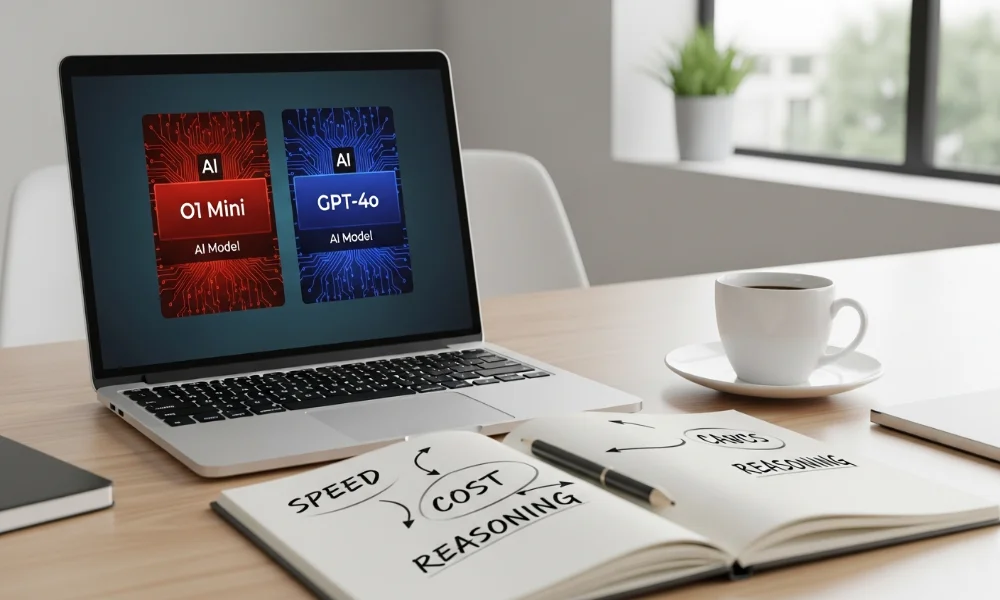
If you are curious about AI models, you might have wondered about the O1 Mini vs GPT‑4o. These two models are developed by OpenAI and are designed for advanced reasoning, content creation, and coding tasks. Choosing the right model can be confusing because both have unique strengths and features. In this article, we will break down everything to help you make the best choice.
What Are O1 Mini and GPT‑4o?
Both O1 Mini and GPT‑4o are advanced AI models from OpenAI, but they target slightly different needs. Understanding their core purpose helps users pick the right model for specific tasks. This section will explain what makes each model unique in simple terms.
O1 Mini Overview
The O1 Mini is a compact AI model designed for faster performance. It is ideal for devices with limited resources while still delivering high-quality outputs. Its smaller size allows quicker response times and lower costs. Many users find O1 Mini suitable for coding and logic-based tasks.
GPT‑4o Overview
GPT‑4o is a more robust AI model with enhanced reasoning capabilities. It can handle complex tasks like coding, writing, and advanced question answering. GPT‑4o has a larger context window, making it better for long-form content. Users who need high accuracy often prefer GPT‑4o over smaller models.
Key Differences at a Glance
Choosing between O1 Mini and GPT‑4o requires understanding their key differences. Features like token limits, latency, and cost play a crucial role in selection. A comparison table makes these differences easier to grasp at a glance.
| Feature | O1 Mini | GPT‑4o |
|---|---|---|
| Model Size | Smaller, faster | Larger, more capable |
| Context Window | Moderate (~4,000 tokens) | Large (~16,000 tokens) |
| Latency | Low, quick responses | Slightly higher, more thorough |
| Best Use Case | Coding, short tasks | Long-form content, complex tasks |
| Cost | Lower | Higher |
| Accuracy | Good for standard tasks | Excellent for reasoning tasks |
Output Tokens & Context Window
O1 Mini has a moderate token limit suitable for short interactions. GPT‑4o supports a large context, which helps maintain coherent long conversations. Users handling long documents often prefer GPT‑4o for better context retention. This makes GPT‑4o ideal for essays or code-heavy projects.
Latency and Responsiveness
O1 Mini responds faster due to its smaller model size. GPT‑4o, being larger, takes slightly longer but offers higher accuracy. Fast responses are crucial for real-time applications. Developers often weigh speed against output quality.
Cost & Efficiency
O1 Mini is more cost-efficient for small-scale tasks. GPT‑4o, while more expensive, offers superior performance for complex workflows. Budget considerations are important for ongoing usage. Many companies use O1 Mini for testing and GPT‑4o for production.
Performance & Benchmark Comparison
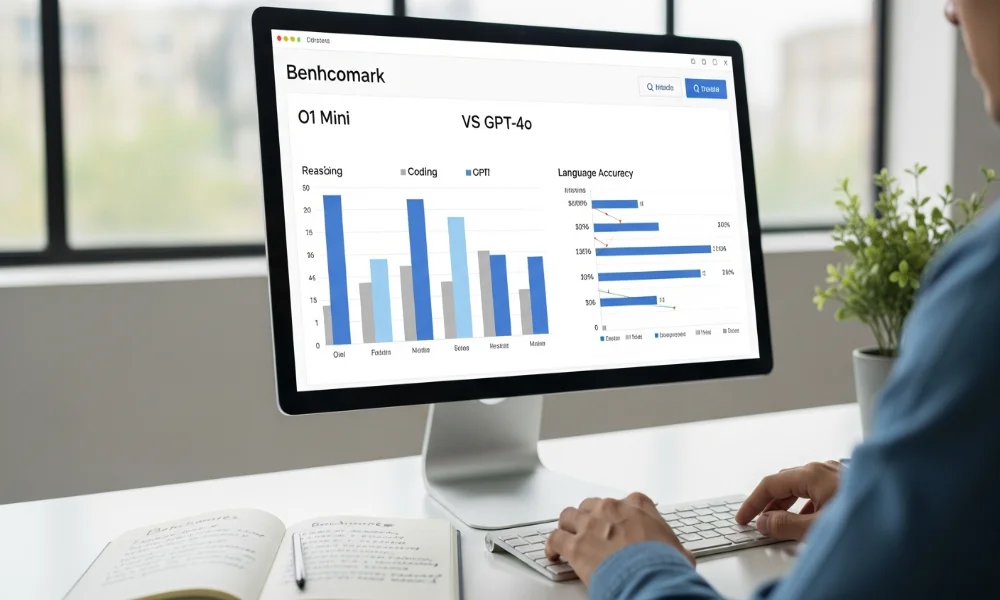
Performance evaluation is essential to understand which AI model fits your needs. Benchmarks cover reasoning, coding, and language capabilities. These metrics help users make data-driven decisions rather than relying on assumptions.
Reasoning (GPQA, Logic Tests)
GPT‑4o outperforms O1 Mini in reasoning benchmarks. Logic-based challenges show higher accuracy with GPT‑4o. Users requiring reliable logical outputs benefit from GPT‑4o consistently. O1 Mini is good for simple reasoning tasks, but struggles with complex problems.
Coding & Math Skills
O1 Mini handles standard coding tasks efficiently and quickly. GPT‑4o excels at multi-step coding and complex math problems. For developers, GPT‑4o reduces debugging time and produces cleaner code. Its advanced reasoning is helpful for algorithm-intensive tasks.
Classification & Language Skills
Both models understand natural language effectively, but GPT‑4o is better for nuanced contexts. Text classification, summarization, and translation are more accurate with GPT‑4o. O1 Mini is still useful for everyday writing and chat tasks. Its speed is a key advantage.
Use Cases: When to Choose Which
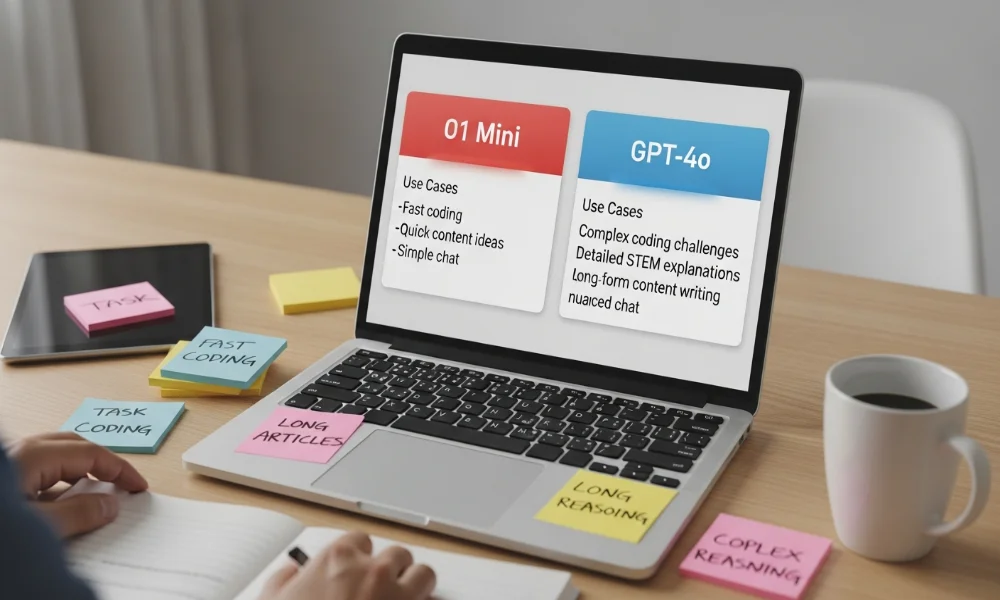
Knowing specific use cases helps in selecting the most suitable AI model. Each model shines in different scenarios depending on task complexity. Understanding this saves time, cost, and effort in AI projects.
Best for Coding and STEM
O1 Mini is great for smaller coding assignments. GPT‑4o handles complex algorithms, multi-file projects, and detailed calculations. STEM students often prefer GPT‑4o for research-heavy tasks. Both models help improve coding efficiency.
Best for Content Creation & Chat
GPT‑4o is ideal for generating long-form articles and blogs. O1 Mini works well for chatbots and concise content creation. For consistent tone and clarity, GPT‑4o is preferred. It also supports more detailed content planning.
Edge Devices vs Cloud Deployment
O1 Mini runs efficiently on edge devices with limited resources. GPT‑4o requires cloud deployment due to its larger size. Developers must choose based on device constraints and processing requirements. Latency and throughput considerations influence this choice significantly.
O1 Mini vs GPT‑4o Pros & Cons
Each model has unique advantages and limitations that influence selection. Comparing pros and cons helps users make an informed choice. Here’s a clear look at both models.
O1 Mini Pros & Cons
Pros:
-
Faster responses for real-time tasks
-
Cost-efficient for small-scale projects
-
Good for coding and simple reasoning
Cons:
-
Limited context window
-
Struggles with complex tasks
-
Less accurate for nuanced language tasks
GPT‑4o Pros & Cons
Pros:
-
Handles complex reasoning effectively
-
Large context window for long content
-
Excellent coding, math, and language skills
Cons:
-
Higher latency due to size
-
More expensive for continuous usage
-
Requires cloud deployment
Final Recommendation
Deciding between O1 Mini and GPT‑4o depends on your task requirements. If speed and cost-efficiency are priorities, O1 Mini is suitable. For complex reasoning, content creation, and coding-heavy projects, GPT‑4o is the best choice. Beginners can start with O1 Mini and scale to GPT‑4o as needs grow. Choosing the right model ensures better results and efficiency.
Conclusion
In the O1 Mini vs GPT‑4o debate, both models have their strengths and weaknesses. O1 Mini is perfect for speed, cost efficiency, and short tasks. GPT‑4o shines in complex reasoning, long-form content, and coding-heavy projects. Understanding features, benchmarks, and use cases helps you make an informed decision. By aligning the AI model with your requirements, you can maximize productivity and accuracy.