If you are looking for the best AI chatbot for your business, data analysis, or content strategy in 2026, here is the direct answer: ChatGPT remains the ultimate choice for overall flexibility, voice interactions, and creative media generation; Google Gemini completely dominates for real-time accurate web research and native Google Workspace data syncing; while Anthropic’s Claude stands fully unmatched for heavy programmatic coding, multi-file software logic, and deep analytical long-form prose. No single tool wins every category, meaning your choice must align strictly with your specific professional operational needs.
The generative AI landscape in 2026 has officially shifted away from basic text prompting. Users no longer need simple assistants that rewrite sentences; they require reliable, autonomous systems that can handle large datasets, maintain deep memory, and link directly to active web databases. Choosing a sub-optimal tool can cause massive delays in your team’s workflow and quickly exhaust your premium software budget. In this deeply detailed, data-backed chatgpt vs gemini vs claude performance review, we look past the surface marketing promises to analyze how these models handle advanced professional demands.
Why This AI Assistant Comparison 2026 Changes the Game
Evaluating modern AI chatbots simply by looking at static, academic benchmark scores is a flawed approach. Benchmarks do not capture real-world productivity or operational bottlenecks. For instance, an experienced software engineer needs an expansive, reliable context window to hold entire microservice codebases across multiple sessions. On the other hand, a digital marketer or SEO strategist prioritizes immediate search index visibility, exact content formatting, API connectors, and fast processing speeds. We’ve also broken this down model-by-model in our GPT-5 vs Claude vs Gemini deep dive, which looks purely at raw model performance rather than workflow fit.
According to enterprise workflow studies from Gartner, roughly 84% of leading digital agencies and engineering firms have actively deployed a multi-AI architecture in their everyday stacks. This shift reveals that top industry professionals are abandoning brand loyalty to a single chatbot. Instead, they treat these tools like specialized team members assigning specific tasks to whichever model possesses the absolute best processing engine for that exact requirement.
- ChatGPT (OpenAI): The Swiss Army knife of AI. It excels at fast execution, interactive workspace tools, creative copy generation, and multi-format audio-visual asset building. If ChatGPT still doesn’t check every box for your workflow, we’ve rounded up other AI assistants like ChatGPT worth testing alongside it.
- Gemini (Google): The data hub. If your business depends completely on Google Cloud, Docs, Sheets, and complex multi-tab research, Gemini’s infrastructure is built specifically for you.
- Claude (Anthropic): The academic brain. It provides deep conceptual understanding, structural data sorting, and natural human-like prose completely free of predictable robotic filler text.
Technical Features: Chatgpt vs Gemini vs Claude Head-to-Head
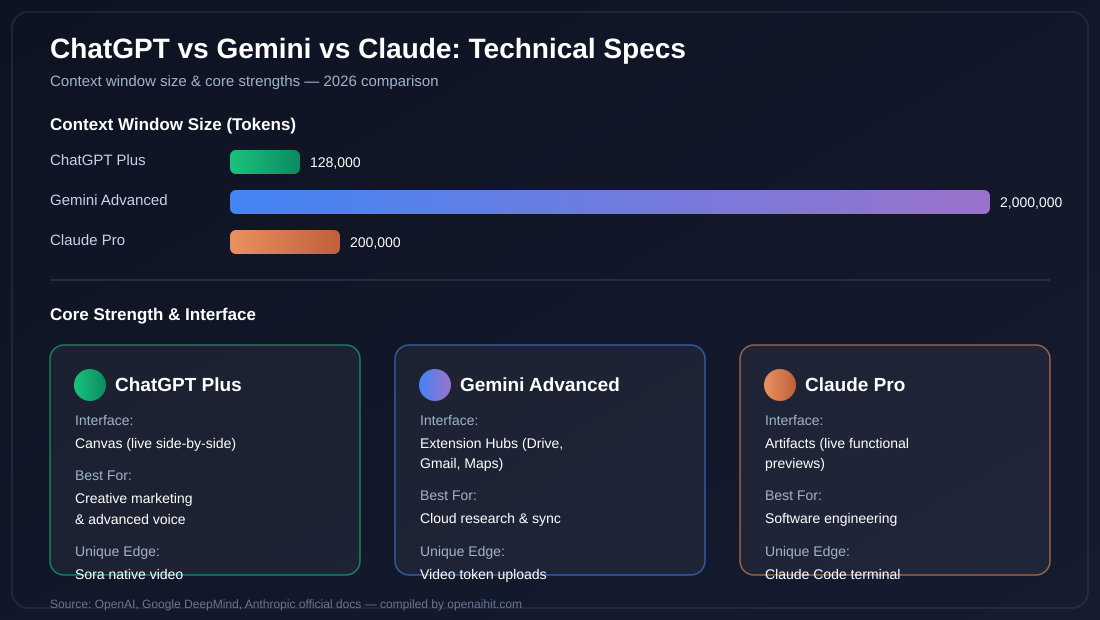
By 2026, premium tiers have fully transitioned from interactive chat spaces into agentic, task-driven terminals. Here is a granular technical breakdown to show you how these foundational ecosystems compare across crucial categories:
| Core Feature Category | ChatGPT Plus (GPT-5 series) | Gemini Advanced (3.0 Pro) | Claude Pro (Opus/Sonnet 4.6) |
| Primary Optimal Use | Creative Marketing & Advanced Voice | Cloud Research & Ecosystem Sync | Heavy Software Engineering & Logic |
| Context Window Size | 128,000 Tokens | 2,000,000 Tokens | 200,000 Tokens |
| Core Interface Asset | Canvas (Live Side-by-Side Editing) | Extension Hubs (Drive, Gmail, Maps) | Artifacts (Functional Live Previews) |
| Proprietary Strengths | Advanced Voice, Sora Native Video | Video Token Uploads, Maps Data | Claude Code Terminal Agent |
| Average Monthly Cost | ~$20 / month | ~$20 / month | ~$20 / month |
Deep Dive Performance: Which AI Wins Your Workflow?
1. Writing Quality, Editorial Tone, and Content Strategy
When building out comprehensive landing pages, technical technical documentation, or optimized search content briefs, structural diversity in text processing is essential:
- Claude Pro: Anthropic has trained its models to favor exceptional stylistic variation and factual weight. The resulting text features natural rhythm, smooth transitional phrasing, and a human-like voice that bypasses typical AI-detection metrics. It handles technical explanations beautifully.
- ChatGPT Plus: Remains the primary tool for high-velocity copy testing, social hooks, email subject variations, and rapid brainstorming. Its Canvas feature allows users to make precise edits directly to sections of a document on a split screen, preventing the need to continuously copy-paste revised text blocks.
- Gemini Advanced: Highly effective for corporate reporting, data-dense outlines, and structured summaries. However, it can occasionally feel slightly formulaic during creative long-form assignments, requiring more explicit stylistic prompting to break out of rigid patterns.
2. Live Web Research and Data Gathering Accuracy
The common industry question of gemini vs chatgpt which is better for research depends entirely on how effectively an engine extracts active information from the live web:
- Gemini Advanced: Leveraging Google’s dominant web-crawling architecture, Gemini scans live global trends, breaking technical news, and local map data with incredible speed. It handles source citation and formatting beautifully, giving it a clear advantage for real-time market analysis.
- ChatGPT Plus: Uses a combination of search crawlers (including Bing integrations) to fetch web data. While highly reliable for general topical queries, it can occasionally hit slight processing delays when trying to track down rapidly changing, real-time news breaks.
- Claude Pro: Does not place its core focus on multi-tab web search. Instead, it relies on its deep, pre-trained internal logic or processes massive files manually uploaded by the user, prioritizing deep analysis over broad web scraping.
3. Programmatic Coding and Software Architecture
For software engineers, DevOps teams, and web developers, the platform dynamics have shifted significantly toward completely autonomous code execution. If you want a deeper breakdown across use cases, check our full best AI chatbot for coding comparison for a side-by-side look at Claude, ChatGPT, and Copilot in real developer workflows.
- Claude Pro: Powered by the Sonnet and Opus engines alongside the Claude Code terminal interface, Claude owns the developer space in 2026. It effortlessly tracks edits across complex, multi-layered code repositories, spots architectural bugs with high accuracy, and uses its Artifacts panel to run live, functional web application previews right next to your chat space.
- ChatGPT Plus: A fantastic, fast alternative for quick scripting, building isolated UI components, translating scripts between different languages (e.g., Python to JavaScript), and clarifying dense API documentation step by step.
Free vs Premium: Is It Worth Upgrading?
If generative AI acts as a central engine for your business production, upgrading to a premium tier easily covers its cost by saving your team dozens of manual hours every week. However, if you are looking primarily at the chatgpt vs gemini vs claude free tiers for casual or occasional use, the free platforms still offer great value. Independent AI subscription cost breakdowns confirm that most standard tiers now converge around the same $20/month price point, making feature fit not price the real deciding factor
- ChatGPT Free Tier: Grants access to standard foundational models like GPT-4o. It includes basic web searching and limited data analysis tools, but your message limits will drop quickly during global high-traffic hours, routing you back to older legacy models.
- Gemini Free Tier: Offers a very generous free user experience. It provides clean access to real-time Google Search summaries, large document uploads, and helpful multi-media inputs with fewer strict volume cut-offs.
- Claude Free Tier: Provides a helpful introduction to Anthropic’s excellent logical reasoning and clear writing style. However, the message limits on the free tier are notoriously strict and will scale down quickly if you paste long code blocks or large documents into the chat.
For a wider view beyond just these three, our guide to the best AI programs and pricing plans compares free vs. paid tiers across the entire AI market, not just these three players.
Strategic Implementation: The Multi-AI Pipeline Setup
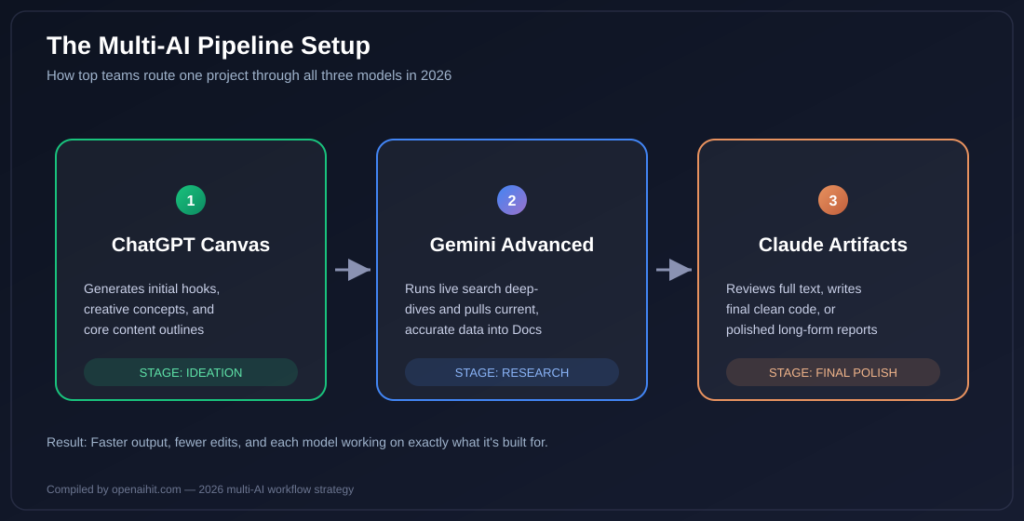
The most common operational mistake professionals make is trying to force a single model to handle every single business process. In 2026, the most productive strategy is to treat these engines as an integrated pipeline rather than standalone platforms.
ChatGPT Canvas ──► Generates initial hooks, creative concepts, and core outlines
Gemini Advanced ──► Runs live search deep-dives and pulls current data into Docs
Claude Artifacts──► Reviews full text, writes final clean code or polished reports
By passing your assets through this multi-step pipeline, you can use ChatGPT for creative ideation, Gemini for immediate live-data verification, and Claude for final structural refinement and technical assembly.
Final Verdict: Choose the Right Tool for Your Workflow
The key takeaway for 2026 is that you no longer have to limit your business to just one platform. If you want a flexible, highly interactive assistant for creative marketing, ChatGPT is your best ai for everyday use. If you need to map out data trends and sync them seamlessly across your Google ecosystem, make Gemini your core choice. For deep software engineering, complex logical tasks, and clean, natural prose, route your projects through Claude.
To keep a close eye on the latest AI core updates, model testing data, and advanced automation workflows, make sure to track the latest performance breakdowns on OpenAiHit to keep your business workflows fully optimized.
FAQs
Q1. Which AI chatbot has the best free tier features in 2026?
Ans: Google Gemini offers the best free tier, providing generous access to live web research and large file uploads. ChatGPT Free has strict caps during peak hours, and Claude’s free version has very tight message limits.
Q2. Is Claude better than ChatGPT for programming and software engineering?
Ans: Yes, Claude (with Claude Code and Artifacts) is superior for complex, multi-file software architecture. ChatGPT remains excellent for quick scripts, prototyping, and basic debugging.
Q3. Why should an SEO content writer choose Claude over other AI chatbots?
Ans: Claude produces highly polished, natural prose that mimics human rhythm. It avoids robotic filler words, meaning your long-form articles require far fewer edits before publishing.
Q4. How does Gemini’s web research capability compare to ChatGPT Plus?
Ans: Gemini wins at research because it uses Google’s native live search engine to crawl breaking news instantly. ChatGPT relies on Bing, which can occasionally face indexation delays.
Q5. What are the key limitations of relying on a single AI platform in 2026?
Ans: No single AI excels at everything. Relying on one tool causes bottlenecks; the smartest approach is a pipeline using ChatGPT for ideas, Gemini for research, and Claude for final editing.